

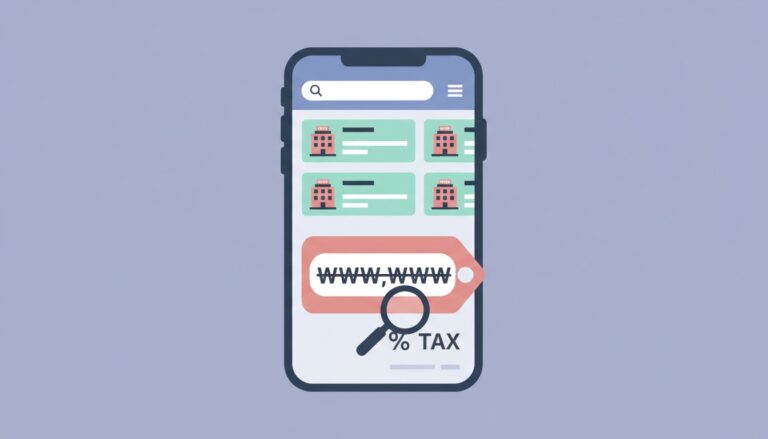
Introduction: The “Hidden Price” Trap
안녕하세요! 매일한글 에디터입니다. (Hello! This is your Daily Hangul Editor.)
You are an advanced learner (C2), which means basic survival phrases like “호텔 예약했어요” (I booked a hotel) are child’s play for you. But let’s talk about the real headache: Digital Literacy in Korean.
Have you ever browsed a Korean booking site (like Yanolja, Yeogi Eottae, or Naver Hotels), found an incredible deal, and then realized the price jumped by 20% at the final payment screen? That’s the Tax & Service Charge trap.
Today, we are going deep into the vocabulary of price comparison and hidden costs. Mastering these terms won’t just save you money; it will make you feel like a true local who knows how to navigate the system without getting ripped off.
Phase 2: Deep Dive into Critical Expressions
1. 부가세 별도 / 봉사료 포함 (VAT Excluded / Service Charge Included)
This is the fine print that makes or breaks your budget.
- Pronunciation: [Bugase Byeoldo] “Boo-ga-seh” sounds like ‘Booger’ + ‘Set’, “Byeol-do” rhymes with ‘Wall-dough’.
- Meaning:
- 부가세 (VAT): Value Added Tax (usually 10%).
- 별도 (Excluded/Separate): The opposite of 포함 (Included).
- Editor’s Insight: If you see a price that looks too good to be true, scan the page immediately for the tiny text saying ‘부가세 별도’ (VAT excluded). In spoken Korean, when confirming, we often shorten the question to: “이거 세금 포함인가요?” (Does this include tax?)
- Situation Check: Used in formal writing (websites/receipts) and business/service interactions.
2. 최저가 보장 (Lowest Price Guarantee)
- Pronunciation: [Choe-jeo-ga Bo-jang]
- Meaning:
- 최저가: The lowest price (Superlative).
- 보장: Guarantee/Warranty.
- Editor’s Insight: You will see this tag everywhere. But as a C2 learner, you should be skeptical. Use this term to challenge a price match. “타 사이트에서 더 싼 가격을 봤는데, 최저가 보장 되나요?” (I saw a cheaper price on another site; do you match the lowest price?)
3. 최종 결제 금액 (Final Payment Amount)
- Pronunciation: [Choe-jong Gyeol-je Geum-aek]
- Meaning: The actual amount that will be deducted from your card.
- Editor’s Insight: Don’t get excited until you see these three words. When asking a hotel receptionist or checking an app, focus on this. “그래서 제가 내야 할 최종 결제 금액이 얼마죠?” (So, what is the final amount I have to pay?)
Phase 3: Textbook vs. Real Life (Advanced Edition)
At the C2 level, you need to sound sharp, not just polite.
| Textbook (Standard) | Real Life (Native/Smart Consumer) |
|---|---|
| 가격이 저렴한 편이에요. (The price is on the cheap side.) |
가성비가 훌륭하네요. (The cost-performance ratio is excellent.) |
| 세금이 포함되어 있나요? (Is tax included?) |
이거 부가세 포함된 최종 가격 맞나요? (Is this the final price with VAT included?) |
| 가격이 너무 비싸요. (The price is too expensive.) |
거품이 좀 심한데요? / 바가지 요금 같아요. (There’s too much ‘bubble’ (markup)? / It feels like a rip-off.) |
Note: ‘바가지’ (Bagaji) is a classic idiom for being overcharged. As a C2 learner, using ‘거품이 있다’ (literally: it has bubbles/foam = inflated price) is a very sophisticated way to critique pricing without being aggressive.
Phase 4: Cultural Context & Manners
The “Nunchi” of Booking
In Korea, purely Korean booking apps (Yanolja, Daily Hotel) often display the “Room Only” price to rank higher on search engines like Naver. Foreign apps (Agoda, Booking.com) usually calculate taxes differently.
- Tip: When you call a hotel directly in Korea to book, asking for the “패키지 (Package)” often gets you a better deal than the room-only rate, as it might include breakfast and sauna for a fraction of the cost. Koreans love “All-in-one” efficiency.
- Manner: Even if you think the price is unfair (바가지), complaining loudly is considered rude. Instead, calmly ask for a “상세 내역서” (detailed breakdown). Logic works better than emotion in Korean service interactions.
Phase 5: Roleplay Scenario
Setting: A traveler (Tom) is at the hotel front desk, double-checking a discrepancy between the app price and the on-site price.
Tom (Student):
“죄송한데, 앱에서 봤던 금액이랑 차이가 좀 있어서요. 혹시 부가세 별도였나요?”
(Excuse me, there is a difference from the amount I saw on the app. Was VAT excluded?)
[Shows the phone screen politely]
Clerk (Korean):
“아, 네 고객님. 앱에 노출된 가격은 세금과 봉사료가 빠진 기본 운임입니다.”
(Ah, yes customer. The price shown on the app is the base fare without tax and service charge.)
Tom (Student):
“아, 그렇군요. 그럼 조식 추가했을 때 최종 결제 금액은 어떻게 되나요?”
(Ah, I see. Then what is the final payment amount if I add breakfast?)
Clerk (Korean):
“조식 포함해서 총 25만 원입니다. 현장 결제하시면 법인세 혜택은 적용 안 되세요.”
(It’s 250,000 won total including breakfast. Corporate tax benefits don’t apply for on-site payment.)
Tom (Student):
“네, 알겠습니다. 가성비 따져보니 그래도 여기가 제일 낫네요. 결제해 주세요.”
(Okay, understood. Considering the value for money, this place is still the best. Please proceed with payment.)
Phase 6: 10-Second Shadowing Drill
Read this aloud to practice the rhythm of a smart consumer. Focus on the pauses /.
“혹시 / 이 금액이 / 부가세랑 봉사료까지 / 전부 포함된 / 최종 가격인가요?”
(By any chance / is this amount / including VAT and service charge / completely / the final price?)
Phase 7: FAQ & Troubleshooting
- Q: Can I use “깎아주세요” (Please give a discount) at a hotel?
- A: At a major hotel? No. It’s awkward. However, if you are booking a “Pension” (guest house/villa) directly via phone during the off-season, you can gently ask: “현금으로 결제하면 조금 더 저렴하게 가능한가요?” (Is it possible to get it a bit cheaper if I pay in cash?). This is the C2 way to bargain.
- Q: What is ‘봉사료’ (Service Charge)?
- A: It’s usually 10% added on top of the 10% VAT. So the total markup is often 21% (compounded). If the menu says “Ten-Ten” (Ten % Tax + Ten % Service), expect to pay more.
Phase 8: Wrap-up
One-Liner Summary:
Always ask for the “최종 결제 금액” (Final Payment Amount) to avoid the “부가세 별도” (VAT Excluded) surprise.
Action Mission:
Go to a Korean hotel booking site (like Yanolja or Naver Hotel) and find the tiny text that says “세금/봉사료 포함”. If it’s not there, calculate the real price (add 10~20%) in your head!
Your Turn:
Have you ever been surprised by hidden fees in Korea? Tell me about your “sticker shock” moment in the comments!
Phase 9: Pop Quiz
1. Which term means “Value for money” or “Cost-effectiveness”?
a) 최저가 (Choe-jeo-ga)
b) 가성비 (Ga-seong-bi)
c) 봉사료 (Bong-sa-ryo)
2. If a website says “부가세 별도”, what does it mean?
a) Breakfast included
b) Tax is already included
c) Tax is excluded (you must pay extra)
3. Which phrase is the most sophisticated way to say a price is “inflated” or has a “bubble”?
a) 가격이 나빠요 (Price is bad)
b) 거품이 있다 (There is a bubble)
c) 돈이 없어요 (I have no money)
(Answers: 1-b, 2-c, 3-b)
Frequently Asked Questions (FAQ)
Q: What does "최종 결제 금액 (Final Payment Amount)" mean in Korean and how do you pronounce it?
A: In Korean, "최종 결제 금액 (Final Payment Amount)" is pronounced [Choe-jong Gyeol-je Geum-aek] and means: The actual amount that will be deducted from your card.






