

Phase 1: Introduction
Hello! This is your Senior Editor at Daily Hangul.
Picture this: You’re shopping in Myeongdong, caught up in the excitement, and you buy a gorgeous jacket. But when you get back to your Airbnb and try it on… disaster. The sleeves are too short, or maybe that “neon green” looked better under the store lights than it does in your mirror.
Your heart sinks. Not because you wasted money, but because the thought of going back to the store and navigating a conversation about exchanging the item feels terrifying.
“What if they say no?”
“How do I explain I just want a different color?”
Don’t worry. As a tutor who has helped hundreds of students navigate Korean retail therapy, I can tell you that Korean store clerks are generally very helpful—if you know how to ask politely. Today, we aren’t just learning words; we are learning how to handle a transaction with the confidence of a local Seoulite.
This guide is based on real questions from our B1-level students who wanted to move beyond simple pointing and gesturing.
Phase 2: Deep Dive into Key Expressions
Here are the three most critical phrases you need to master for a smooth exchange.
1. 이거 다른 걸로 바꿀 수 있나요?
(Can I change this for something else?)
- Pronunciation: [I-geo da-reun geol-lo ba-kkul su in-na-yo?]
- Sound Tip: ‘Geollo’ sounds a bit like ‘Girl-lo’ if you say ‘Girl’ very quickly without rolling the ‘r’.
- Meaning:
- Literal: Can I change this to a different thing?
- Real Nuance: This is the standard, polite way to ask for an exchange. It’s versatile—you can use it for size, color, or a totally different product.
- Editor’s Insight: Use the grammar pattern -(으)l 수 있나요? (Is it possible to…?). It sounds much softer and more open to discussion than “I want to change this” (이거 바꾸고 싶어요).
- Situation Check: Suitable for all retail situations (Department stores, street shops, convenience stores).
2. 혹시 사이즈/색상 교환 되나요?
(By any chance, is a size/color exchange possible?)
- Pronunciation: [Hok-si sa-i-jeu / saek-sang gyo-hwan dwe-na-yo?]
- Meaning:
- Keywords: 혹시 (Hoksi – By any chance/Perhaps), 교환 (Gyohwan – Exchange).
- Real Nuance: Adding “Hoksi” is the secret sauce. It shows you are being considerate and not demanding. It lowers the clerk’s defense immediately.
- Editor’s Insight: Use this when you like the item but just need a variation of it.
3. 차액은 어떻게 계산하나요?
(How do we handle the price difference?)
- Pronunciation: [Cha-ae-geun eo-tteo-ke gye-san-ha-na-yo?]
- Meaning:
- Literal: How do I calculate the difference amount?
- Real Nuance: If you exchange your item for something more expensive (or cheaper), use this phrase to ask about paying the extra or getting a partial refund.
- Editor’s Insight: This is a Level B1+ phrase. Using the word 차액 (Cha-aek) makes you sound very sophisticated and fluent.
Phase 3: Textbook vs. Real Life
Let’s look at how a robot speaks versus how a trendy local speaks.
| Textbook Korean (Grammatically correct, but dry) | Real Life Korean (Natural & Smart) |
|---|---|
| 이 상품을 교환하고 싶습니다. (I wish to exchange this product.) | 이거 혹시 교환 가능할까요? (Is an exchange possible for this, by any chance?) |
| 다른 색상이 있습니까? (Do you have a different color?) | 이거 다른 색깔로 바꿀 수 있어요? (Can I switch this to a different color?) |
Bottom Note: In spoken Korean, we often prefer 바꾸다 (to change/switch) over the Sino-Korean word 교환하다 (to exchange) in casual sentences, though both are perfectly fine.
Phase 4: Cultural Context & Manners
The “Receipt” Ritual
In Korea, the 영수증 (Yeong-su-jeung – Receipt) is sacred. Without it, an exchange is almost impossible. When you approach the counter, have the receipt and the card you used for payment ready in your hand. It shows you are prepared and respectful of the clerk’s time.
The “Tag” Rule
Koreans are meticulous about the condition of returned goods. If the tag (택) is removed, 99% of the time, an exchange is refused. Even if you haven’t worn it, a cut tag implies usage.
The Magic of “Joesonghande…”
Start your sentence with “죄송한데…” (I’m sorry, but…). You haven’t done anything wrong, but in Korean culture, you are acknowledging that you are creating a small hassle for the worker. This “humble approach” works wonders.
Phase 5: Real-Life Scenario (Roleplay)
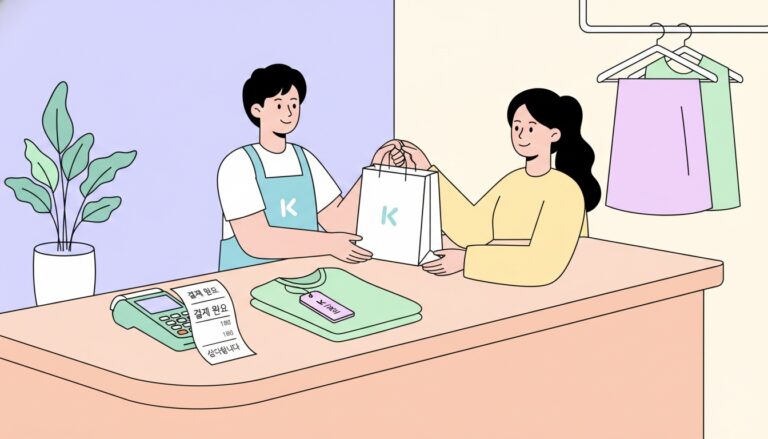
Setting: A clothing store in Hongdae. You bought a shirt yesterday, but it’s too tight.
Characters:
* Alex (Student): Holds the shirt and receipt.
* Clerk (Staff): Busy folding clothes.
(Alex approaches the counter cautiously)
Alex: 저기요, 죄송한데 어제 산 옷 교환 좀 할 수 있을까요?
(Jeogiyo, joesonghande eoje san ot gyohwan jom hal su isseulkkayo?)
Excuse me, sorry to bother you, but could I exchange these clothes I bought yesterday?
Clerk: 네, 영수증 가지고 계세요?
(Ne, yeongsujeung gajigo gyeseyo?)
Yes, do you have the receipt with you?
(Alex hands over the receipt and the shirt with tags attached)
Alex: 네, 여기요. 사이즈가 좀 작아서요. 더 큰 거 있나요?
(Ne, yeogiyo. Sa-i-jeu-ga jom jagaseoyo. Deo keun geo innayo?)
Yes, here. The size is a bit small. Do you have a bigger one?
Clerk: 잠시만요… 네, 사이즈 있어요. 그런데 이건 천 원 더 비싸요.
(Jamsimanyo… ne, sa-i-jeu isseoyo. Geureonde igeon cheon won deo bissayo.)
One moment… Yes, we have the size. But this one is 1,000 won more expensive.
Alex: 아, 괜찮아요. 차액은 카드로 결제할게요.
(Ah, gwaenchannayo. Cha-ae-geun kadeuro gyeoljehalgeyo.)
Ah, that’s fine. I’ll pay the difference with my card.
Phase 6: 10-Second Shadowing Drill
Read this aloud to practice your intonation. Pause where the slash / is.
“죄송한데 / 이거 다른 색깔로 / 교환 가능할까요?”
(Joesonghande / igeo dareun saek-kkal-lo / gyohwan ganeunghalkkayo?)
Translation: Sorry, but is it possible to exchange this for a different color?
Focus: Raise your tone slightly at the end (yo?) to sound polite and questioning, not demanding.
Phase 7: FAQ & Troubleshooting
Q: Can I get a refund (money back) instead of an exchange?
A: Yes! The word for refund is 환불 (Hwan-bul). You can ask: “환불해 주세요” (Please give me a refund). Note that small street stalls might say “No Refund,” but major stores must allow it within a certain period (usually 7 days).
Q: Can I use these phrases with an older shop owner in a traditional market?
A: Yes, absolutely. Using the polite -yo endings and “Hoksi” makes you perfectly respectful for any age group.
Phase 8: Wrap-up
One-Liner Summary:
When asking for an exchange, always start with “Hoksi” (by any chance) and check if “Gyohwan” (exchange) is possible!
Your Mission:
Check the receipt of the last thing you bought in Korea (or a Korean receipt image online). Look for the words 교환/환불 규정 (Exchange/Refund Policy) usually printed at the bottom. Can you find the number of days allowed?
Question for you:
Have you ever bought something in a foreign country and been too scared to return it? Tell us your story in the comments!
Phase 9: Pop Quiz
1. Which word means “Refund” in Korean?
A) 교환 (Gyohwan)
B) 환불 (Hwanbul)
C) 차액 (Cha-aek)
2. What is the “Magic Word” to soften your request?
A) 빨리 (Ppalli – Hurry)
B) 혹시 (Hoksi – By any chance)
C) 야 (Ya – Hey)
3. How do you say “I will pay the price difference”?
A) 차액은 낼게요 (Cha-ae-geun naelgeyo)
B) 돈 없어요 (Don eopseoyo)
C) 이거 공짜예요? (Igeo gongjjayeyo?)
Click to see answers
1. B, 2. B, 3. A
Frequently Asked Questions (FAQ)
Q: What does "차액" mean in Korean and how do you pronounce it?
A: In Korean, "차액" is pronounced [Cha-aek] and means: makes you sound very sophisticated and fluent.
Q: What does "영수증" mean in Korean and how do you pronounce it?
A: In Korean, "영수증" is pronounced [Yeong-su-jeung - Receipt] and means: is sacred. Without it, an exchange is almost impossible. When you approach the counter, have the receipt and the card you used for payment ready in your hand. It shows you are prepared and respectful of the clerk's time.
Q: What does ""죄송한데..."" mean in Korean and how do you pronounce it?
A: In Korean, ""죄송한데..."" is pronounced [I'm sorry, but...] and means: . You haven't done anything wrong, but in Korean culture, you are acknowledging that you are creating a small hassle for the worker. This "humble approach" works wonders.
Q: What does "환불" mean in Korean and how do you pronounce it?
A: In Korean, "환불" is pronounced [Hwan-bul] and means: . You can ask: "환불해 주세요" (Please give me a refund). Note that small street stalls might say "No Refund," but major stores must allow it within a certain period (usually 7 days).







