

Hello! We are Daily Hangul. 👋
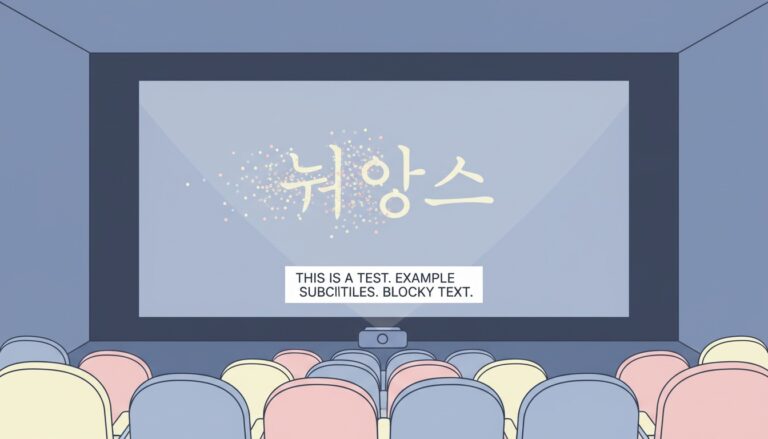
Hi there! This is your Senior Editor at Daily Hangul. Have you ever watched a masterpiece like Parasite or Decision to Leave with your non-Korean friends, and suddenly felt a weird sense of frustration? 😤
The actors are delivering lines dripping with sarcasm or deep emotional Han (한), but the English subtitles just say… “I am sad.”
As a B2 (Intermediate) learner, you are now at that sophisticated stage where you don’t just understand the words; you feel the context. Today, we are going to learn how to articulate that frustration. This isn’t just about complaining; it’s about showing off your deep understanding of the Korean language soul. Let’s dive into the art of critiquing subtitles!
Phase 1: Deep Dive into Key Expressions 🧐
Here are the three most natural ways to discuss translation quality, handpicked from real conversations among Korean cinephiles.
1. 뉘앙스가 좀 안 사는 것 같아요.
“The nuance doesn’t quite come alive.”
- Pronunciation: [Nwi-ang-seu-ga jom an sa-neun geot ga-ta-yo]
- Tip: 뉘 (Nwi) sounds like the French “Nuit” or the start of “New”. 사는 (Sa-neun) comes from ‘Salda’ (to live). Imagine a flower withering—that’s the vibe when the nuance doesn’t “live.”
- Meaning:
- Literal: The nuance seems not to live a little.
- Real Nuance: “The translation feels flat/dry compared to the original emotion.”
- Editor’s Insight: We use the verb 살다 (to live) a lot for aesthetics. If clothes look good on you, “핏이 산다” (the fit lives). If the translation is good, “느낌이 산다” (the feeling lives). Use this when the subtitle is technically correct but emotionally empty.
- Situation Check: ✅ Casual (Friend) / ✅ Formal (Polite ending)
2. 번역이 너무 직역됐어요.
“The translation is too literal.”
- Pronunciation: [Beon-yeog-i neo-mu jig-yeok-dwaet-seo-yo]
- Tip: 직역 (Jik-yeok) is the keyword here. The ‘K’ at the end of ‘Jik’ stops abruptly in your throat.
- Meaning:
- Literal: It became too much of a direct translation.
- Real Nuance: “It sounds awkward because they translated word-for-word without considering the context.”
- Editor’s Insight: This is a very intellectual critique. B2 learners should know the difference between 직역 (Literal translation) and 의역 (Liberal/Smooth translation). If you want to praise the subtitles, say: “의역이 센스 있게 잘 됐네요!” (The liberal translation was done sensibly!)
- Situation Check: ✅ Discussion / ✅ Review writing
3. 한국어 특유의 맛이 없어요.
“It lacks the unique flavor of Korean.”
- Pronunciation: [Han-gu-geo teuk-yu-ui ma-shi eop-seo-yo]
- Tip: 맛 (Mat) literally means taste. Pronounce it like ‘Mut’ in ‘Mutt’, but shorter and sharper.
- Meaning:
- Literal: It doesn’t have the unique taste of Korean.
- Real Nuance: “The sticky, chewy, cultural vibe of the original line is lost.”
- Editor’s Insight: Koreans love using 맛 (Taste) for language. We call it 말맛 (Word taste). This is the perfect phrase to use when slang, dialects (Satoori), or intricate honorifics are ignored in English.
- Situation Check: ✅ Casual / ✅ Semi-formal
Phase 2: Textbook vs. Real Life 🥊
Textbooks teach you to be correct. We teach you to be interesting.
| Textbook Korean (Standard) | Real Life Korean (Natural & Insider) |
|---|---|
| 자막이 정확하지 않습니다. (The subtitles are incorrect.) |
자막이 뭔가 좀 아쉬운데? (The subtitles are kinda lacking/regrettable, no?) |
| 번역이 이상해요. (The translation is strange.) |
번역이 원작 느낌을 다 죽였어. (The translation killed the original vibe completely.) |
| 한국말은 그렇게 안 해요. (We don’t speak like that in Korean.) |
한국 정서랑은 좀 안 맞지. (It doesn’t really fit the Korean sentiment/emotion.) |
Editor’s Note: Using “아쉽다” (regrettable/sad/lacking) is a magical B2 skill. It softens the criticism while expressing that you care about the quality. “Wrong” (틀렸다) is too strong; “Lacking” (아쉽다) is sophisticated.
Phase 3: Cultural Context 🇰🇷
The “Nunchi” of Subtitles
Why do we complain about subtitles? Usually, it’s because of the Relationship Hierarchy.
In Korean cinema, the shift from Jeondaemal (polite) to Banmal (casual) is a huge plot point. It signals intimacy, aggression, or power dynamics. English subtitles just use “You” for both.
- The Pro Tip: When you critique subtitles to a Korean friend, mention honorifics. For example:
- “There was so much tension when he switched to Banmal, but the subtitles missed it!”
- “아니, 반말했을 때 그 긴장감이 대박이었는데 자막엔 안 나왔어!”
Saying this proves you aren’t just reading text—you are reading the air (atmosphere).
Phase 4: Roleplay Script 🎬
Setting: Walking out of a movie theater with a Korean friend, Min-ji.
Characters: You (Foreigner, B2 Level), Min-ji (Korean native).
Min-ji: 영화 어땠어? 재밌었지? (How was the movie? Fun, right?)
You: (Tilting head slightly) 음, 연기는 좋았는데… 자막이 좀 아쉬웠어.
(Hmm, the acting was good but… the subtitles were a bit lacking.)
Min-ji: 정말? 영어 번역이 별로였어? (Really? The English translation wasn’t good?)
You: 응. 주인공이 사투리 쓸 때 그 한국어 특유의 맛이 안 살더라고.
(Yeah. When the main character used dialect, that unique Korean flavor just didn’t come alive.)
Min-ji: 와, 너 진짜 한국인 다 됐다! 그걸 느끼다니.
(Wow, you’ve basically become Korean! To feel that nuance.)
You: (Smiling confidently) 뉘앙스가 생명인데 그걸 놓치니까 답답했지.
(Nuance is life/everything, so missing it was frustrating.)
Phase 5: 10-Second Shadowing 🗣️
Let’s practice critiquing without stumbling. Read this naturally, focusing on the pause.
“번역이 틀린 건 아닌데, / 대사의 맛이 / 잘 안 사는 것 같아.”
(The translation isn’t wrong, but / the flavor of the lines / doesn’t seem to come alive.)
- Intonation Guide:
- Start slightly defensive (“틀린 건 아닌데” ↗)
- Drop pitch for emphasis on “Taste” (“맛이” ↘)
- Trail off softly with opinion (“같아” ➡️)
Phase 6: FAQ & Troubleshooting 🛠️
Q: Can I say the translation is “garbage” (쓰레기)?
A: Whoa, hold on! 🛑 Even if it’s true, 쓰레기 is extremely harsh and aggressive. As a sophisticated B2 speaker, stick to “아쉽다” (lacking), “어색하다” (awkward), or “몰입이 깨진다” (breaks the immersion). We criticize with elegance!
Q: What if I don’t know the word for “Metaphor”?
A: Just use the English word in a Korean accent: 메타포 (Me-ta-po). Koreans use this term in film discussions all the time. “메타포가 번역이 안 됐어.” (The metaphor wasn’t translated.)
Phase 7: Wrap-up & Mission 🎁
One-Liner Summary:
Instead of saying “It’s bad,” say “뉘앙스가 안 산다” (The nuance doesn’t live) or “맛이 없다” (It has no taste) to sound like a true critic.
Your Mission:
Go to Netflix, find a K-Drama scene you know well, switch the subtitles to English, and find one line where the translation failed. Post it in the comments below with the phrase: “여기서 한국어 맛이 안 살았어요!”
Phase 8: Pop Quiz 📝
1. Which word means “Literal Translation” (often used negatively)?
A) 의역 (Ui-yeok)
B) 직역 (Jik-yeok)
C) 통역 (Tong-yeok)
2. How do you politely say the translation is “lacking” or “a pity”?
A) 번역이 미쳤어 (Crazy)
B) 번역이 아쉬워 (Regrettable)
C) 번역이 싫어 (Hate it)
3. Fill in the blank: “대사의 [ ]이/가 안 살아.” (The [flavor] of the line isn’t alive.)
A) 밥 (Rice)
B) 멋 (Coolness)
C) 맛 (Taste)
(Scroll down for answers)
✅ Click to see Answers
- B) 직역 (Ui-yeok is liberal translation, Tong-yeok is interpretation).
- B) 번역이 아쉬워 (This is the most nuanced way to complain).
- C) 맛 (We say “Mal-mat” or taste of language).
Frequently Asked Questions (FAQ)
Q: What does "뉘" mean in Korean and how do you pronounce it?
A: In Korean, "뉘" is pronounced [Nwi] and means: sounds like the French "Nuit" or the start of "New".
Q: What does "사는" mean in Korean and how do you pronounce it?
A: In Korean, "사는" is pronounced [Sa-neun] and means: comes from 'Salda' (to live). Imagine a flower withering—that's the vibe when the nuance doesn't "live."
Q: What does "살다" mean in Korean and how do you pronounce it?
A: In Korean, "살다" is pronounced [to live] and means: a lot for aesthetics. If clothes look good on you, "핏이 산다" (the fit lives). If the translation is good, "느낌이 산다" (the feeling lives). Use this when the subtitle is technically correct but emotionally empty.
Q: What does "직역" mean in Korean and how do you pronounce it?
A: In Korean, "직역" is pronounced [Jik-yeok] and means: is the keyword here. The 'K' at the end of 'Jik' stops abruptly in your throat.







