

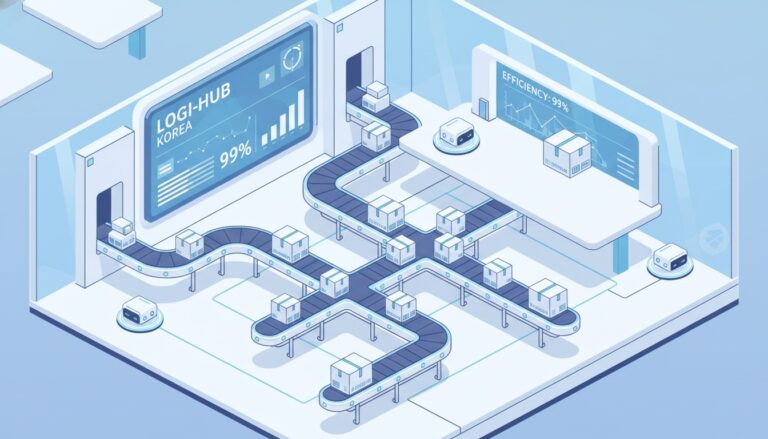
Phase 1: Introduction
Greeting: 안녕하세요! This is your Senior Editor from Daily Hangul.
If you are reading this, you are likely navigating the fast-paced world of Korean business—specifically Logistics & Retail (유통 및 물류). Perhaps you are touring a high-tech Fulfillment Center (풀필먼트 센터) in Gyeonggi-do, or you are in a boardroom discussing how to optimize Last Mile (라스트 마일) delivery efficiency with a Korean partner.
The ‘Why’: At a C2 (Advanced) level, saying “The delivery is fast” (배송이 빨라요) isn’t enough. You need to discuss throughput, bottlenecks, and automation rates. Using precise terminology doesn’t just make you sound smart; it signals that you understand the intricacies of the Korean supply chain ecosystem, which is arguably one of the most demanding in the world due to the “Dawn Delivery” (새벽배송) culture.
Transparency: This guide compiles real inquiries from logistics managers and expat executives working with Korean 3PL (Third Party Logistics) companies.
Phase 2: Deep Dive into Core Expressions
Here are three high-level expressions essential for discussing fulfillment and automation.
1. 입출고 (Ip-chul-go)
- Pronunciation: [Ip-chul-go] Sounds like ‘Eep-chul-go’ (Make the ‘p’ unreleased, like a quick stop).
- Meaning: Inbound and Outbound (Receiving and Shipping).
- Editor’s Insight: While beginners learn “들어오다” (come in) and “나가다” (go out), professionals use 입고 (receiving) and 출고 (releasing/shipping). 입출고 combines them to refer to the entire flow of goods.
- Collocation Tip: You will often hear “입출고 관리 시스템” (Inventory control system).
- Situation Check: Strictly Formal/Business. Do not use this when a friend visits your house.
2. 병목 현상 (Byeong-mok Hyeon-sang)
- Pronunciation: [Byeong-mok Hyeon-sang] ‘Byeong’ sounds like ‘Byung’ in Samsung.
- Meaning: Bottleneck phenomenon.
- Editor’s Insight: Literally “bottle neck.” In the context of warehouse automation, this is the critical word to identify pain points. If a conveyor belt is too slow for the sorting machine, that is a 병목 현상.
- Situation Check: Formal/Technical. Essential for troubleshooting meetings.
3. 최적화 (Choe-jeok-hwa)
- Pronunciation: [Choe-jeok-hwa] Sounds like ‘Cheh-juk-hwa’
- Meaning: Optimization.
- Editor’s Insight: In the era of AI and automated logistics, everything needs to be optimized. You don’t just “fix” a route; you “route-optimize” (경로 최적화) it. You optimize the “picking line” (피킹 동선 최적화).
- Situation Check: Professional. Use this to propose solutions.
Phase 3: Textbook vs. Real Business Korean
At the C2 level, precision is key. Notice how the vocabulary shifts from general descriptions to industry-specific jargon.
| Textbook / General (A1-B1) | Real Business / Logistics (C2) |
|---|---|
| 물건을 창고에 넣어요. (Putting things in the warehouse.) | 상품을 입고 처리합니다. (Processing inbound goods.) |
| 기계가 일을 다 해요. (Machines do all the work.) | 물류 자동화 설비가 가동 중입니다. (Logistics automation facilities are in operation.) |
| 재고가 얼마나 남았나요? (How much stock is left?) | 현재 재고 회전율이 어떻게 됩니까? (What is the current inventory turnover ratio?) |
| 배송 시간을 줄여야 해요. (We need to reduce delivery time.) | 리드 타임(Lead Time)을 단축해야 합니다. (We must shorten the lead time.) |
Note: In the Korean logistics sector, English loanwords like Lead Time (리드 타임), SKU, and Capa (Capacity, 캐파) are used extensively alongside Sino-Korean terms.
Phase 4: Cultural Context & Manners
The “Ppalli-Ppalli” (Hurry-Hurry) of Logistics
In Korean logistics, speed isn’t a bonus; it’s the baseline. Korea pioneered Dawn Delivery (새벽배송) and Rocket Delivery (로켓배송). When discussing automation, the implied goal is always speed and accuracy to meet these extreme consumer expectations.
Nunchi (Tact) in Operations
If you notice a bottleneck (병목 현상) in a partner’s warehouse, pointing it out bluntly can cause loss of face. Instead of saying, “Your system is slow,” try framing it as an opportunity for optimization (최적화):
* “Perhaps we can improve the throughput (처리량) by adjusting the AGV routing.”
* “AGV 동선을 조정하면 처리량을 더 늘릴 수 있을 것 같습니다.”
Phase 5: Real-Life Scenario (Roleplay)
Setting: A quarterly review meeting between a foreign client (Alex) and a Korean Logistics Center Manager (Mr. Park) regarding the new automated sorting system.
Characters:
* Alex: Foreign Executive (Fluent C2 Korean)
* Mr. Park: Korean Operations Manager
Dialogue:
(Alex points to the dashboard showing real-time metrics)
Alex: 이번 분기 풀필먼트 효율이 상당히 개선되었네요. 특히 오피킹(Oh-picking)률이 0%에 가까운 게 인상적입니다.
(Fulfillment efficiency has improved significantly this quarter. The near-zero miss-picking rate is especially impressive.)
Mr. Park: 네, 맞습니다. 지난달 도입한 DAS (Digital Assorting System) 덕분에 분류 정확도가 크게 올랐습니다.
(Yes, that’s correct. Thanks to the DAS we adopted last month, sorting accuracy has increased largely.)
Alex: 좋습니다. 다만, 입고 구역에서 간헐적인 병목 현상이 보이는데, 이 부분은 어떻게 보고 계신가요?
(Great. However, I see intermittent bottlenecks in the receiving area. How do you view this issue?)
Mr. Park: (Nodding seriously) 예리하시네요. 하역 도크의 캐파(Capa) 부족이 원인이라, 현재 스케줄링 최적화를 진행 중입니다.
(Sharp observation. A lack of capacity at the unloading dock is the cause, so we are currently optimizing the scheduling.)
Phase 6: 10-Second Shadowing Drill
Practice this sentence to sound like a logistics pro. Focus on the confident, downward intonation at the end.
“물류 자동화를 통해 / 리드 타임을 단축하고 / 운영 효율을 극대화했습니다.”
(Through logistics automation / we shortened the lead time / and maximized operational efficiency.)
- Guide:
- 물류 자동화를 (Mul-lyu Ja-dong-hwa-reul) – Pronounce ‘Mul-lyu’ smoothly as ‘Mull-lyu’.
- 리드 타임을 (Lead Time-eul) – Use the English loanword naturally.
- 극대화했습니다 (Geuk-dae-hwa-haet-seum-ni-da) – Strong emphasis on ‘Geuk’ (Max).
Phase 7: FAQ & Troubleshooting
Q: Can I use the English word “Fulfillment” in Korean?
A: Yes! 풀필먼트 (Pul-pil-meon-teu) is the standard industry term. You don’t need to translate it to “이행” (fulfillment/execution) in this context. It would actually sound awkward if you did.
Q: Is it rude to ask about “error rates”?
A: Not at all, as long as you use professional terminology like 오배송률 (Misdelivery rate) or 반품률 (Return rate). Avoid vague accusations like “Why are there mistakes?” (왜 실수가 많아요?).
Phase 8: Wrap-up
One-Liner Summary:
In Korean logistics, accuracy and speed are communicated through terms like 입출고 (In/Outbound), 병목 현상 (Bottleneck), and 최적화 (Optimization).
Action Mission:
If you work with Korean suppliers, check their email signature or company description. Do they mention SCM (Supply Chain Management) or 3PL? Next time you email them, ask about their “재고 관리 시스템” (Inventory Management System).
Engagement:
Have you ever been surprised by the speed of Korean delivery services? Tell us about your “Dawn Delivery” experience in the comments!
Phase 9: Quiz
1. Which term best describes a situation where work piles up at one specific point in the warehouse process?
A) 새벽 배송 (Dawn Delivery)
B) 병목 현상 (Bottleneck Phenomenon)
C) 재고 회전 (Inventory Rotation)
2. What is the professional way to say “Putting goods into the warehouse and taking them out”?
A) 넣고 빼기 (Putting in and taking out)
B) 왔다 갔다 (Coming and going)
C) 입출고 (Inbound & Outbound)
3. In a logistics meeting, what does “최적화” mean?
A) Optimization
B) Negotiation
C) Cancellation
(Answers: 1. B, 2. C, 3. A)
Frequently Asked Questions (FAQ)
Q: What does "입출고 (Ip-chul-go)" mean in Korean and how do you pronounce it?
A: In Korean, "입출고 (Ip-chul-go)" is pronounced [Ip-chul-go] and means: Inbound and Outbound (Receiving and Shipping).
Q: What does "병목 현상 (Byeong-mok Hyeon-sang)" mean in Korean and how do you pronounce it?
A: In Korean, "병목 현상 (Byeong-mok Hyeon-sang)" is pronounced [Byeong-mok Hyeon-sang] and means: Bottleneck phenomenon.
Q: What does "최적화 (Choe-jeok-hwa)" mean in Korean and how do you pronounce it?
A: In Korean, "최적화 (Choe-jeok-hwa)" is pronounced [Choe-jeok-hwa] and means: Optimization.







