

안녕하세요! Hello from Daily Hangul 👋
I’m your editor at Daily Hangul, and I’ve been teaching Korean for over 10 years. Today, we need to talk about something that confuses almost every foreigner who comes to Korea.
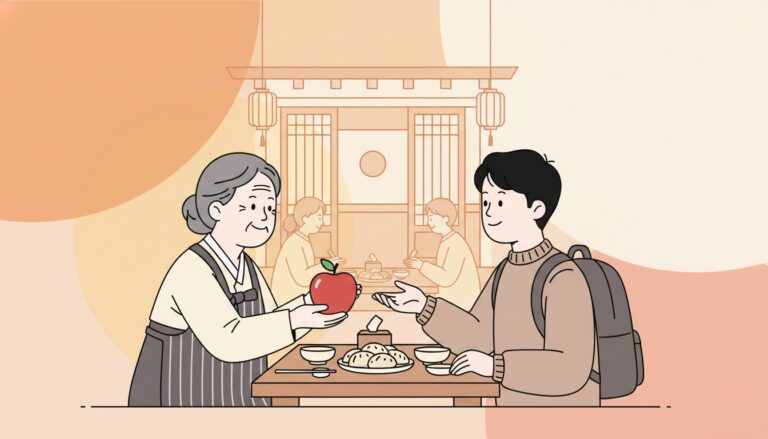
Picture this: You are at a local restaurant, eating alone. Suddenly, the owner (a friendly Imo-nim) approaches you and asks:
- “How old are you?”
- “Are you married?”
- “Why are you eating so little?”
You might freeze. “Is this an interrogation? Did I do something wrong?”
Don’t worry! This is the classic battle between Jeong (정) and Ojirap (오지랖). To Western eyes, it looks like nosiness (Ojirap). But in the Korean heart, it’s often a sign of affection and connection (Jeong).
If you understand this nuance, you won’t feel offended—you’ll feel loved. Let’s decode the “nosy” love language of Koreans.
1. The Deep Dive: decoding “Nosy” Questions 🧐
Here are the three most common phrases that sound like “Ojirap” but are actually “Jeong.”
1. 밥은 먹고 다녀요?
- Pronunciation: [Bap-eun meok-go da-nyeo-yo?]
- Tip: ‘Bap’ sounds like the ‘bop’ in ‘Be-Bop’.
- Literal Meaning: Do you go around eating rice?
- Real Nuance: “Are you taking care of yourself?”
- Editor’s Insight: This is rarely a question about the actual menu. It’s the ultimate Korean love language. If someone asks this, they are worried you might be skipping meals because you are busy or lonely.
- Situation: Casual to Polite (used by neighbors, colleagues, or elders).
2. 왜 이렇게 살이 빠졌어요?
- Pronunciation: [Wae i-reo-ke sa-ri ppa-jyeo-sseo-yo?]
- Literal Meaning: Why have you lost so much weight?
- Real Nuance: “You look tired/weak. Please stay healthy.”
- Editor’s Insight: In many Western cultures, commenting on weight is a taboo. In Korea, saying you gained weight can be rude, but saying you lost weight (when you didn’t try to diet) is an expression of concern. They think you are working too hard!
- Situation: Often used by older people to younger people.
3. 좋은 사람 없어요?
- Pronunciation: [Jo-eun sa-ram eop-seo-yo?]
- Literal Meaning: Is there no good person?
- Real Nuance: “Are you dating anyone? I want you to be happy.”
- Editor’s Insight: This is the peak of “Ojirap.” They aren’t just being snoopy; they genuinely believe that having a partner equals happiness and stability. They want to see you settled.
- Situation: Very common from older relatives or close taxi drivers!
2. Textbook vs. Real Life (B1 Level) 📊
Textbooks teach you to be polite. Real life requires you to be warm.
| Textbook Korean (Standard) | Real Life Korean (Feel the Jeong) |
|---|---|
| 건강하세요. (Please be healthy.) |
아프지 말고. (Don’t be sick/hurt.) Nuance: More emotional and protective. |
| 식사하셨습니까? (Did you have a meal? – Formal) |
밥 좀 잘 챙겨 먹어! (Make sure you eat properly!) Nuance: A command born out of love. |
| 걱정해 주셔서 감사합니다. (Thank you for your concern.) |
신경 써 주셔서 고마워요. (Thanks for paying attention to me.) Nuance: Acknowledges their effort. |
3. Cultural Context: The Art of “Nunchi” (눈치) 🧠
Ojirap (오지랖) implies crossing a line into someone’s privacy. However, Koreans often cross this line because they view you as part of their “boundary” (Uri – Us).
- The Rule: If a stranger asks personal questions with a smile and a warm tone, it is Jeong. If they ask with a judgmental face, it is Ojirap.
- Non-verbal Tip: When answering these “nosy” questions, don’t step back or cross your arms (defensive). Instead, smile shyly. This reaction tells them, “I know you are asking because you care.”
4. Real Scenario Roleplay 🎬
Setting: A regular customer (Alex) enters a small Kimbap restaurant. The owner (Auntie/Imo) greets him.
Characters:
* Alex: Foreign student (B1 level Korean).
* Imo (이모): Restaurant owner (Full of Jeong).
Dialogue:
Imo: 어머, 알렉스! 왜 이렇게 오랜만에 왔어? 살이 쏙 빠졌네!
(Oh my, Alex! Why has it been so long? You’ve lost so much weight!)
Alex: (Scratching head shyly) 아, 요즘 시험 기간이라서 좀 바빴어요.
(Ah, it’s exam period these days so I was a bit busy.)
[Ah, yo-jeum si-heom gi-gan-i-ra-seo jom ba-ppa-sseo-yo.]
Imo: 밥은 먹고 공부하는 거야? 얼굴이 반쪽이네. 여기 서비스 만두 좀 먹어.
(Are you studying while eating? Your face is half its size. Eat this service [free] dumpling.)
Alex: (Smiling brightly) 와, 감동이에요! 이모 덕분에 힘이 나요.
(Wow, I’m touched! Thanks to you, Imo, I have energy.)
[Wa, gam-dong-i-e-yo! Imo deok-bun-e hi-mi na-yo.]
5. 10-Second Shadowing Drill 🗣️
Practice this sentence to respond perfectly when someone shows “nosy” concern. Read the / as a short pause.
“걱정해 주셔서 / 감사합니다. / 덕분에 / 마음이 따뜻해요.”
- Pronunciation: Geok-jeong-hae ju-syeo-seo / gam-sa-ham-ni-da. / Deok-bun-e / ma-eu-mi tta-tteu-tae-yo.
- Meaning: Thank you for worrying about me. Thanks to you, my heart feels warm.
- Focus: Emphasize ‘따뜻해요’ (warm) to show your appreciation.
6. FAQ: Troubleshooting 🛠️
Q: Can I tell them to stop asking personal questions?
A: In a B1 level context, saying “Stop asking” (그만 물어보세요) is considered very rude to an elder. A better strategy is to deflect with a compliment or a vague answer.
* Example: “Haha, I’m focusing on my studies now!” (하하, 지금은 공부가 더 중요해요!)
Q: Why do they ask my age immediately?
A: They aren’t checking your ID. They need to know your age to decide which polite verb ending to use and how to address you (Hyung/Unni/Dongsaeng). It is actually an attempt to be polite!
7. Wrap-up & Action Mission 🎁
Today’s Summary: Korean “nosiness” is often a disguised form of “Jeong” (affection). Don’t panic; just accept the love!
🔥 Your Mission: Next time a Korean asks if you’ve eaten (밥 먹었어요?), instead of just saying “Yes,” try saying:
* “네! [Name] 님도 식사 챙겨 드세요!” (Yes! Please make sure you eat too, [Name]!)
See how their face lights up!
8. Pop Quiz 📝
1. What is the hidden meaning of “Why did you lose so much weight?”
A) You need to go to the gym.
B) I am worried about your health.
C) I am jealous of your diet.
2. Which word describes the Korean concept of “affection/connection”?
A) Han (한)
B) Jeong (정)
C) Nunchi (눈치)
3. If someone gives you extra food (Service) because you look tired, what is the best response?
A) I didn’t order this.
B) Deok-bun-e hi-mi na-yo! (Thanks to you, I have energy!)
C) Don’t look at my face.
(Answers: 1-B, 2-B, 3-B)
Frequently Asked Questions (FAQ)
Q: What does "'따뜻해요'" mean in Korean and how do you pronounce it?
A: In Korean, "'따뜻해요'" is pronounced [warm] and means: to show your appreciation.







