

Phase 1: Introduction
Hello! This is your Senior Editor at Daily Hangul.
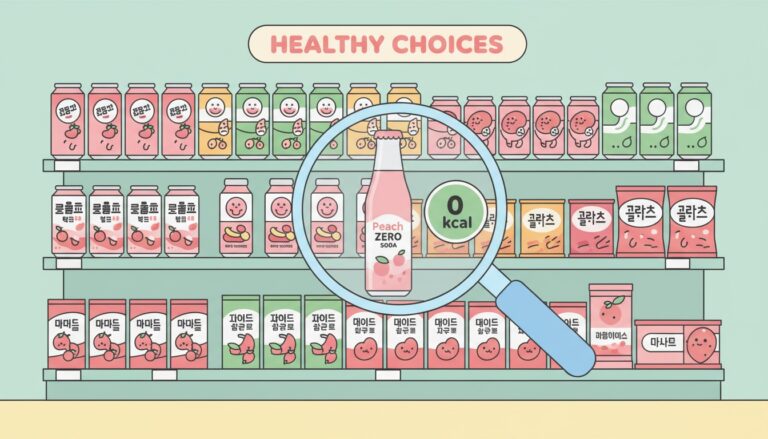
Picture this: You are on a strict diet (let’s be honest, the food in Korea is too delicious, right?). You walk into a Korean convenience store (pyeon-ui-jeom), grabbed a drink that looks healthy, but suddenly you panic.
“Is this a sugar bomb? How many calories is this?”
Your heart races. You want to ask the staff, but all you remember from your textbook is how to say “Hello” and “Thank you.”
Don’t worry. I’ve been teaching Korean for years, and I know exactly how frustrating it is when a language barrier threatens your diet goals. Today, I will teach you the essential survival phrases to check calories without breaking a sweat. These are simple, A1-level phrases that will make you sound like a local who takes care of their health.
Phase 2: Deep Dive (Core Expressions)
Here are the three most useful phrases you need right now.
1. 이거 몇 칼로리예요?
(How many calories is this?)
- Pronunciation: [I-geo myeot kal-lo-ri-ye-yo?]
- Sound Analogy:
- I-geo sounds like “E” + “Go”.
- Myeot sounds like “Mut” in “Mutt” (with a short stop at the end).
- Kal-lo-ri is easy! It sounds almost exactly like the English “Calorie.”
- Meaning: “How many calories is this?”
- Editor’s Insight: This is your sword and shield. Since “Calorie” is a loanword in Korean, you are already halfway there! You can point at anything—a sandwich, a drink, a snack—and ask this.
- Situation Check: ✅ Casual (Friends) | ✅ Polite (Staff)
2. 살 안 쪄요?
(Will I not gain weight / Is this fattening?)
- Pronunciation: [Sal an jjeo-yo?]
- Sound Analogy:
- Sal sounds like “Sal” in “Salmon.”
- Jjeo sounds like the start of “Judge” or “Jump.”
- Meaning: Literally: “Does flesh not steam/puff up?” (Real nuance: “Is this non-fattening?”)
- Editor’s Insight: This is a very common, slightly cute question. It’s not scientific. You ask this when you want reassurance. “This cake… sal an jjeo-yo?” (Hoping the answer is yes, even if it’s a lie!)
- Situation Check: ✅ Casual (Friends) | ⚠️ Use with a smile to staff.
3. 제로 슈거예요?
(Is this Zero Sugar?)
- Pronunciation: [Je-ro syu-geo-ye-yo?]
- Sound Analogy: Just say “Zero Sugar” with a Korean accent (make vowels shorter).
- Meaning: “Is it zero sugar?”
- Editor’s Insight: Korea is currently obsessed with “Zero Sugar” products. From Coke to Soju, everything has a “Zero” version. If you see the number 0 on the package, verify it with this phrase!
- Situation Check: ✅ Casual (Friends) | ✅ Polite (Staff)
Phase 3: Textbook vs. Real Life
Let’s see how a robot talks versus how a Seoulite talks.
| Textbook (Too Rigid) | Real Life (Natural & Trendy) |
|---|---|
| 이 음식의 열량은 얼마입니까? (What is the caloric content of this food?) |
이거 칼로리 높아요? (Is this high in calories?) |
| 저칼로리 음식입니까? (Is it a low-calorie food?) |
이거 다이어트 돼요? (Is this good for a diet?) |
Editor’s Note: As an A1 beginner, stick to “이거 (This)” + “칼로리 (Calorie)”. You don’t need complex grammar yet!
Phase 4: Cultural Context & Manners
💡 The “Well-being” & “Zero” Craze
In Korea, being on a diet is almost a national hobby. It’s very common to discuss calories openly. However, here is a tip on Nunchi (Reading the room):
- Don’t ask at a busy street food stall: If you are buying Tteokbokki (spicy rice cakes) from a grandmother on the street, don’t ask about calories. She won’t know, and it might seem picky. Just enjoy the cheat day!
- Convenience Stores are Safe: The part-timers at GS25, CU, or 7-Eleven are used to these questions. Feel free to ask.
Phase 5: Real Life Scenario (Roleplay)
Setting: Inside a convenience store (CU). You are holding a bottle of sweet-looking tea.
Characters:
* Minji (You): A student on a diet.
* Staff: A helpful part-timer.
(Minji brings a bottle to the counter looks worried)
Minji: 저기요… 이거 칼로리 높아요?
(Excuse me… is this high in calories?)
[Jeo-gi-yo… i-geo kal-lo-ri no-pa-yo?]
Staff: 아니요, 이거 제로 슈거예요.
(No, this is zero sugar.)
[A-ni-yo, i-geo je-ro syu-geo-ye-yo.]
Minji: 아, 진짜요? 살 안 쪄요?
(Ah, really? I won’t gain weight?)
[Ah, jin-jja-yo? Sal an jjeo-yo?]
Staff: (Laughs) 네, 괜찮아요.
(Yes, it’s okay.)
[Ne, gwaen-cha-na-yo.]
Phase 6: 10-Second Shadowing Drill
Let’s practice your intonation. In Korean questions, the end of the sentence goes up slightly.
Repeat after me (3 times):
이거 / 칼로리 / 낮아요? ⤴
(Is this / low / in calories?)
[I-geo / kal-lo-ri / na-ja-yo?]
Tip: Pause at the slash (/) marks. Raise your pitch at the arrow (⤴).
Phase 7: FAQ (Troubleshooting)
- Q: Can I just say the word “Diet” in Korean?
- A: Yes! But in Korean, “다이어트 (Da-i-eo-teu)” specifically means “trying to lose weight,” not just the food you eat. So if you say “I am diet,” people understand “I am losing weight.”
- Q: Is it rude to check the back of the package for a long time?
- A: Not at all! Everyone does it. Just don’t block the aisle if the store is crowded.
Phase 8: Wrap-up
One-Liner Summary: Use “Kallori” (Calorie) and “Zero Sugar” freely—these are magic words in Korea right now!
Your Mission for Today:
Go to a Korean market (or search for a Korean snack like “Choco Pie” on Google Images). Look for the Nutrition Information table. Can you find the number next to 칼로리 (Kcal)?
Leave a comment below telling me your favorite low-calorie Korean snack!
Phase 9: Pop Quiz
1. How do you ask “How many calories is this?”
A) I-geo eol-ma-ye-yo? (How much is this?)
B) I-geo myeot kal-lo-ri-ye-yo?
C) I-geo ma-si-sseo-yo? (Is this delicious?)
2. What does “Sal an jjeo-yo?” mean?
A) Is it spicy?
B) Is it salty?
C) Will I not gain weight / Is it not fattening?
3. True or False: It is rude to ask about calories at a convenience store.
A) True
B) False
(Answers: 1-B, 2-C, 3-B)







