

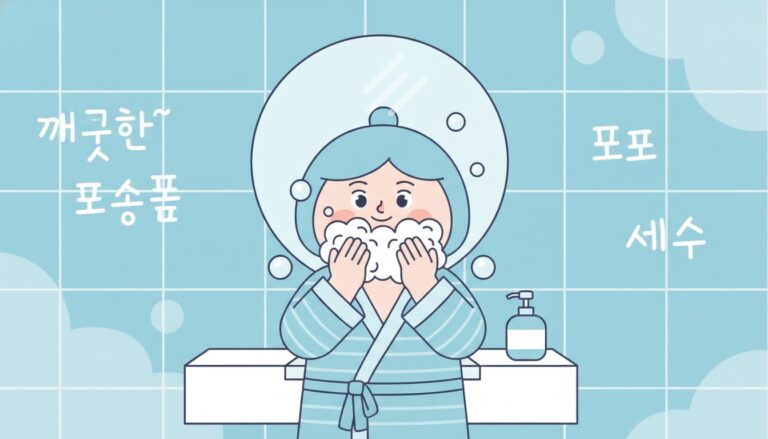
Phase 1: Intro – The “Morning Zombie” Moment
Hello! This is your Head Editor at Daily Hangul. 👋
Imagine this: You just woke up in your Airbnb in Seoul. Your hair is a mess, and your eyes are barely open. Your Korean roommate or host asks, “Did you wash?”
In English, we might just say “I’m going to the bathroom.” But in Korea, specifying what you are washing is crucial. If you use the wrong word, you might accidentally say you are washing your car instead of your face!
Today, we are tackling the most refreshing part of the Daily Routine: Washing your face (세수하다).
I’ve taught hundreds of students who get confused between “washing hands,” “washing face,” and just “washing.” Let’s clear that up so you can start your Korean morning with confidence. Let’s dive in!
Phase 2: Deep Dive – The Core Expressions
Here are the 3 words you absolutely need this morning.
1. 세수하다 (Sesu-hada)
- Pronunciation: [Se-su-ha-da]
- Se rhymes with Say.
- Su rhymes with Sue.
- Hada is soft, like ‘ha-da’.
- Meaning: To wash one’s face (specifically!)
- Editor’s Insight: This is a Sino-Korean word (washing-hand/face). It feels a bit formal but is used every day. It specifically implies using water (and maybe soap) on your face.
- Situation Check: ✅ Casual & ✅ Formal (Safe for everyone).
2. 씻다 (Ssit-da)
- Pronunciation: [Ssit-da]
- Ss sounds like a strong snake hiss 🐍.
- it sounds like ‘sit’.
- Meaning: To wash / To clean (General)
- Editor’s Insight: This is the “master verb.” You can use it for hands, face, body, or fruit. If you forget Se-su-hada, just use this!
- Situation Check: ✅ Casual & ✅ Formal.
3. 수건 (Su-geon)
- Pronunciation: [Su-geon]
- Su like Sue.
- Geon sounds like Gun, but softer.
- Meaning: Towel
- Editor’s Insight: You can’t wash without drying! In Korea, asking for a su-geon is essential survival Korean.
Phase 3: Textbook vs. Real Life
Textbooks make you sound like a robot. Let’s make you sound like a local.
| Textbook (Correct but Stiff) 🤖 | Real Life (Natural) ✨ |
|---|---|
| 얼굴을 씻으러 가요. (I am going to wash my face.) |
세수하고 올게. (I’ll do face-wash and come back.) |
| 비누가 어디에 있어요? (Where is the soap located?) |
폼클렌징 있어? (Do you have foam cleanser?) |
💡 Pro Tip: Young Koreans rarely use bar soap (비누) for their face. They use “Foam Cleansing” (폼클렌징). It’s a Konglish word you should know!
Phase 4: Cultural Context – The “Wet Floor” Shock
Before you run to the bathroom to practice Sesu-hada, wait!
1. The Wet Floor Culture 🚿
In many Western countries, the bathroom floor is dry. In Korea, most bathrooms are “wet rooms.” There is a drain on the floor, and we often shower standing right next to the sink.
* Manner Tip: Always wear the bathroom slippers (욕실 슬리퍼) provided. Do not walk in barefoot if the floor is wet, and definitely do not wear your house socks in there!
2. The 10-Step Skincare
Koreans take washing seriously. “Just water” isn’t usually enough. If you stay at a Korean friend’s house, you might see 5 different bottles by the sink. Don’t be overwhelmed—just ask which one is the “Foam (폼)”!
Phase 5: Real Life Scenario (Roleplay)
Setting: Morning at a Guest House. You meet your Korean friend, Minji, in the hallway.
Characters:
* You: Still sleepy.
* Minji: Wide awake.
Minji: (Looking at your messy hair)
잘 잤어?
(Jal jasseo? / Did you sleep well?)
You: (Rubbing eyes)
응… 지금 세수하러 가.
(Eung… jigeum sesu-ha-reo ga.)
Yeah… I’m going to wash my face now.
Minji: (Pointing to the bathroom)
수건은 저기에 있어.
(Su-geon-eun jeo-gi-e isseo.)
The towel is over there.
You: (Smiling)
고마워! 금방 씻고 올게.
(Gomawo! Geumbang ssit-go ol-ge.)
Thanks! I’ll wash quickly and come back.
Phase 6: 10-Second Shadowing Drill
Let’s train your mouth muscle memory. Read this out loud 3 times. Focus on the pause.
“Wait, let me wash my face first.”
잠깐만요, / 세수하고 / 올게요.
[Jam-kkan-man-yo, / se-su-ha-go / ol-ge-yo]
- Intonation Tip: Raise your pitch slightly on “yo” (yo↑) to sound polite and friendly.
Phase 7: FAQ – Don’t Make This Mistake!
Q: Can I use “세수하다” when I wash my hands?
A: No! ❌
* Face = 세수하다 (Sesu-hada)
* Hands = 손을 씻다 (Soneul ssit-da)
* Body/Shower = 샤워하다 (Sya-wo-hada) or 목욕하다 (Mogyok-hada)
If you tell a Korean “I need to sesu my hands,” they will laugh (in a nice way), because su literally means face-washing water in this context!
Phase 8: Wrap-up & Mission
Summary:
1. 세수하다 = Wash face.
2. 씻다 = Wash (general).
3. Don’t forget the bathroom slippers!
🚀 Today’s Mission:
When you go to the bathroom tomorrow morning, look in the mirror and say out loud: “세수하자!” (Let’s wash face!). It’s the best way to start a Korean morning.
Have you ever been confused by Korean bathroom switches or slippers? Tell me in the comments! 👇
Phase 9: Pop Quiz
1. Which word means “Towel”?
a) 비누 (Binu)
b) 수건 (Su-geon)
c) 침대 (Chim-dae)
2. You want to tell your friend you are going to wash your face. You say:
a) 세수하러 가. (Sesu-ha-reo ga)
b) 샤워하러 가. (Sya-wo-ha-reo ga)
c) 밥 먹으러 가. (Bap meo-geu-reo ga)
3. True or False: You should wear your socks inside a wet Korean bathroom.
a) True
b) False
(Answers: 1-b, 2-a, 3-b)
Frequently Asked Questions (FAQ)
Q: What does ""세수하자!"" mean in Korean and how do you pronounce it?
A: In Korean, ""세수하자!"" is pronounced [Let's wash face!] and means: . It’s the best way to start a Korean morning.







