

Phase 1: Introduction
안녕하세요! Daily Hangul’s Senior Editor here.
So, you’ve mastered ordering Bibimbap and you can hold a decent conversation about K-Dramas. But are you ready to tackle the spine of the Korean Peninsula? I’m talking about the Baekdudaegan (백두대간)—the massive mountain range stretching from Baekdusan to Jirisan.
I remember one of my advanced students, Thomas from Switzerland, who was an avid alpinist. He thought his physical fitness would translate perfectly, but he struggled with the social and linguistic nuances of Korean hiking culture. He didn’t know how to respond when an Ahjussi offered him Makgeolli at 10 AM, or why everyone kept lying to him saying “we’re almost there” (spoiler: they weren’t).
At the C1 (Advanced) level, it’s not just about saying “I’m climbing.” It’s about expressing grit, understanding the terrain descriptions, and bonding with fellow hikers on the ridge. This guide will prepare you for those high-altitude interactions.
Phase 2: Deep Dive into Core Expressions
Here are three advanced expressions you need when your legs are burning, but your spirit is high.
1. 종주 (Jongju) / 종주하다
- Pronunciation: [Jong-ju] + Think of ‘Jong’ like a church bell ‘Dong’, and ‘Ju’ like ‘Jewel’ without the ‘el’.
- Meaning: To traverse / Cross-country hiking
- Editor’s Insight: You don’t just “hike” (등산하다) the Baekdudaegan; you “traverse” it. This word implies a long, continuous journey from a starting point to an end point, usually covering multiple peaks. Using this word instantly earns you respect as a serious trekker.
- Situation Check: Formal & Casual friendly.
- Ex: “이번 목표는 백두대간 종주입니다.” (My goal this time is the Baekdudaegan traverse.)
2. 깔딱고개 (Kkalttak-gogae)
- Pronunciation: [Kkal-ttak Go-gae] + The ‘Kkal’ is a tense, sharp sound at the back of your throat.
- Meaning: The “Breathless Pass” (A very steep section just before the summit)
- Editor’s Insight: This is a vivid onomatopoeia. “깔딱” mimics the sound of someone gasping for their last breath. It refers to the hardest, steepest part of the trail where you feel like you might pass out. Every major mountain in Korea has a legendary Kkalttak-gogae.
- Situation Check: Very common among hikers.
- Ex: “여기 깔딱고개만 넘으면 능선이에요!” (Once we pass this breathless slope, it’s the ridgeline!)
3. 낙오하다 (Nago-hada)
- Pronunciation: [Na-go-ha-da]
- Meaning: To fall behind / To drop out of the race
- Editor’s Insight: In a team hike or a long traverse, the fear isn’t just pain—it’s being left behind. This is a C1 level verb used in military or competitive contexts, but hikers use it to describe someone who couldn’t finish the course due to exhaustion or injury.
- Situation Check: Serious/Formal contexts.
- Ex: “부상으로 아쉽게 낙오했습니다.” (Unfortunately, I had to drop out due to an injury.)
Phase 3: Textbook vs. Real Life (Hiking Edition)
Textbook Korean is polite but lacks the sweat and grit of the trail. Here is how to sound like a veteran.
| Textbook Korean (Standard) | Real Hiker Korean (Natural/Witty) |
|---|---|
| 정상까지 얼마나 남았습니까? (How much is left to the peak?) |
아직 멀었나요? / 다 왔나요? (Is it still far? / Are we there yet?) |
| 조심해서 가세요. (Please go carefully.) |
안산하세요! / 안산! (Abbreviation for 안전한 산행 – Have a safe hike!) |
| 힘들어서 못 가겠어요. (I can’t go because it’s hard.) |
퍼졌어요 / 당 떨어졌어요. (I’m spread out (exhausted) / My sugar dropped.) |
Editor’s Note: “안산하세요” (An-san-ha-se-yo) is the secret handshake of Korean hikers. If you say this to a passing hiker, you are officially an insider.
Phase 4: Cultural Context & Manners
The “Korean Hiker’s Lie”
If you ask a descending hiker, “정상까지 얼마나 남았어요?” (How far to the peak?), 90% of them will answer: “거의 다 왔어요! 좀만 더 가면 돼요.” (Almost there! Just a little more.)
Don’t trust it.
This isn’t malicious; it’s a cultural form of encouragement (Gaslighting? Maybe slightly). They want to give you hope. In a C1 context, you can jokingly reply, “거짓말이시죠?” (You’re lying, right?) and share a laugh.
Food Sharing (Jeong – 정)
On the Baekdudaegan trail, shelters (Daepiso) are communal. If you open a pack of food, it is polite to offer a bite to the person next to you, even if they are a stranger. You don’t need a full conversation, just a gesture and “좀 드실래요?” (Would you like some?)
Phase 5: Real-Life Scenario (Roleplay)
Setting: On a steep ridge (능선) of Jirisan. You are exhausted, meeting a hiker coming down.
Characters:
* Alex (You): An exhausted foreign hiker attempting the traverse.
* Hiker (Korean): An energetic middle-aged expert.
Alex: (Gasping for air, leaning on trekking poles)
“안녕하세요… 혹시 대피소까지 얼마나 더 가야 하죠?”
(Hello… By any chance, how much further to the shelter?)
[An-nyeong-ha-se-yo… Hok-si dae-pi-so-kka-ji eol-ma-na deo ga-ya ha-jyo?]
Hiker: (Smiling widely)
“아이고, 고생하시네! 이 깔딱고개만 넘으면 금방이에요. 한 20분?”
(Oh my, you’re working hard! Once you pass this steep slope, it’s really close. Maybe 20 minutes?)
[Ai-go, go-saeng-ha-si-ne! I kkal-ttak-go-gae-man neom-eu-myeon geum-bang-i-e-yo. Han 20-bun?]
Alex: (Wiping sweat, skeptical)
“정말이죠? 한국 분들 ‘금방이다’는 믿기가 힘들어서요.” (웃음)
(Really? It’s hard to trust Koreans when they say ‘it’s close’. (Laughs))
[Jeong-mal-i-jyo? Han-guk bun-deul ‘geum-bang-i-da’-neun mit-gi-ga him-deul-eo-seo-yo.]
Hiker: (Laughs heartily and hands over a cucumber)
“이번엔 진짜라니까! 자, 오이 하나 먹고 힘내요! 안산!”
(I mean it this time! Here, eat this cucumber and cheer up! Safe hiking!)
[I-beon-en jin-jja-ra-ni-kka! Ja, o-i ha-na meok-go him-nae-yo! An-san!]
Phase 6: 10-Second Shadowing Drill
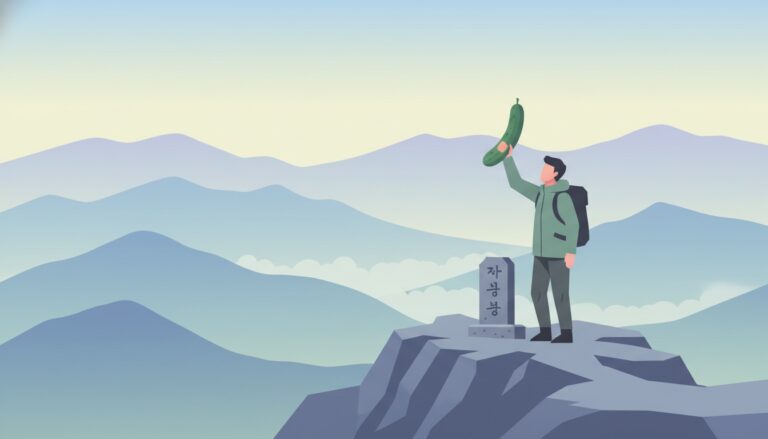
Read this aloud to practice breath control and intonation. Imagine you are standing on the peak, looking at the clouds below.
“드디어 / 백두대간의 / 능선에 / 올라섰습니다. // 가슴이 / 뻥 / 뚫리는 기분이에요!”
(Finally / I stood upon / the ridge of / Baekdudaegan. // It feels like / my chest / is bursting open (refreshing)!)
- Focus: Pause at the
/marks. Emphasize ‘뻥 (Ppeong)’ with a strong burst of air to sound authentic.
Phase 7: FAQ & Troubleshooting
Q: Can I use “등산하다” (to hike) for Baekdudaegan?
A: You can, but it sounds a bit casual. Using “종주하다” (to traverse) or “대장정” (great long journey) fits the scale of the challenge much better.
Q: Is it rude to overtake someone on a narrow trail?
A: Not if you announce it. Don’t just push past. Say “먼저 지나가겠습니다” (I will pass first) or “잠시만요” (Excuse me/Just a moment) clearly before passing.
Phase 8: Wrap-up
One-Liner Summary:
When tackling Korea’s toughest trails, remember to say “안산하세요” to fellow hikers and never fully trust the phrase “다 왔어요.”
Action Mission:
Next time you are even on a small hill in your neighborhood, find a steep section and tell yourself in Korean: “여기가 바로 깔딱고개구나!” (So this is the breathless pass!)
Tell me in the comments:
Have you ever been “tricked” by a local telling you the destination is “just around the corner”? Share your story!
Phase 9: Pop Quiz
1. Which word best describes a long-distance, multi-day hike across a mountain range?
a) 산책 (Sanchaek)
b) 종주 (Jongju)
c) 소풍 (Sopung)
2. What does “안산하세요” mean?
a) Please don’t buy mountains.
b) Have a safe hike.
c) Let’s go to Ansan city.
3. You are at the steepest, hardest part of the trail. What do you call this?
a) 꽃길 (Flower road)
b) 평지 (Flat land)
c) 깔딱고개 (Breathless pass)
(Answers: 1.b, 2.b, 3.c)
Frequently Asked Questions (FAQ)
Q: What does "종주 (Jongju) / 종주하다" mean in Korean and how do you pronounce it?
A: In Korean, "종주 (Jongju) / 종주하다" is pronounced [Jong-ju] and means: To traverse / Cross-country hiking
Q: What does "깔딱고개 (Kkalttak-gogae)" mean in Korean and how do you pronounce it?
A: In Korean, "깔딱고개 (Kkalttak-gogae)" is pronounced [Kkal-ttak Go-gae] and means: The "Breathless Pass" (A very steep section just before the summit)
Q: What does "낙오하다 (Nago-hada)" mean in Korean and how do you pronounce it?
A: In Korean, "낙오하다 (Nago-hada)" is pronounced [Na-go-ha-da] and means: To fall behind / To drop out of the race







