

Hello! This is your Daily Hangul Editor.
Have you ever had that panic moment? You’re getting ready for a date or an important meeting, you pull up your jacket zipper, and… snap? The zipper splits open, or worse, the slider comes right off in your hand.
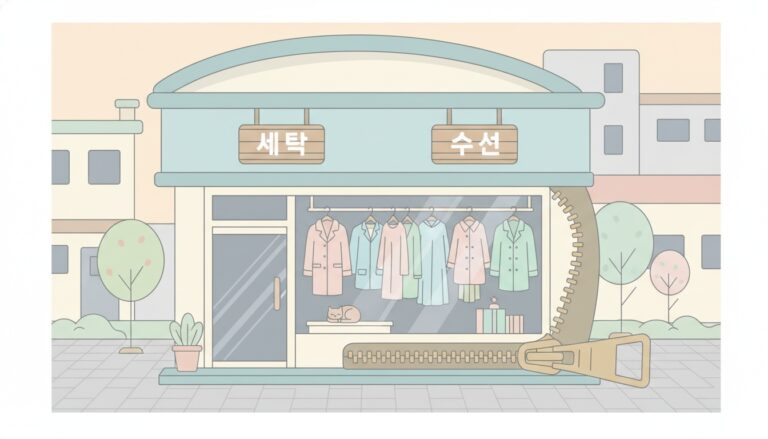
In Korea, you don’t need to throw that jacket away! You just need to find a local “세탁소” (Setakso – Dry Cleaner) or “수선집” (Suseon-jip – Repair Shop).
But walking in and just holding up a broken jacket can be awkward. Today, I’ll teach you the survival phrases to get that zipper fixed without the awkward silence. As a veteran tutor, I’ve seen students sweat over this, but trust me, it’s easier than you think!
Phase 2: Deep Dive (Core Expressions)
Here are the only 3 phrases you truly need. Forget the complex grammar for now; let’s focus on getting your jacket fixed.
1. 지퍼가 고장 났어요 (The zipper is broken)
- Pronunciation: [Jipeo-ga gojang nasseoyo]
- Sound-alike: Gee-puh-ga Go-jang (like ‘Django’) nah-ssuh-yo
- Meaning: “The zipper broke.”
- Editor’s Insight: “고장 (Gojang)” means “breakdown.” You can use this for zippers, phones, or even elevators! It’s a magic word for “it’s not working.”
- Situation Check: ✅ Casual / ✅ Polite
2. 이거 고쳐 주세요 (Please fix this)
- Pronunciation: [Igeo gochyeo juseyo]
- Sound-alike: Ee-guh Go-chuh Ju-se-yo
- Meaning: “Please fix this one.”
- Editor’s Insight: This is your MVP phrase. “주세요 (Juseyo)” means “Please give/do for me.” You are politely asking for help. If you forget everything else, just point and say this!
- Situation Check: ✅ Essential for service interactions.
3. 언제 돼요? (When will it be done?)
- Pronunciation: [Eonje dwaeyo?]
- Sound-alike: Un-jay Dwae-yo?
- Meaning: “When is it possible/done?”
- Editor’s Insight: Koreans love speed (“8282” culture). Asking this ensures you know exactly when to come back so you aren’t waiting around.
- Situation Check: ✅ Standard polite question.
Phase 3: Textbook vs. Real Life
Textbooks often teach you formal sentences that sound a bit robotic in a small neighborhood shop. Here is how to sound like a local.
| Textbook Korean (Formal) | Real Life Korean (Natural) |
|---|---|
| 지퍼 수선을 부탁합니다. (I request a zipper repair.) | 지퍼 좀 봐 주세요. (Please take a look at the zipper.) |
| 수리 비용은 얼마입니까? (What is the repair cost?) | 얼마예요? (How much is it?) |
| 수선이 가능합니까? (Is repair possible?) | 이거 돼요? (Can you do this?) |
Editor’s Note: For A1 beginners, “이거 돼요?” (Igeo dwaeyo?) is a lifesaver. It’s short, simple, and covers almost any request context!
Phase 4: Cultural Context & Manners
1. The Magic Title: “Sajangnim”
In a dry cleaner, never call the owner “Hey” or just “Excuse me.” Call them “사장님” (Sajangnim – Boss/Owner). It shows respect and acknowledges their business ownership. A happy Sajangnim might even fix your zipper faster!
2. Don’t be offended by “Bluntness”
Korean shop owners often speak quickly and loudly. If they just say “내일 와요” (Come tomorrow) without a smile, they aren’t being rude! That’s just the busy, efficient “K-Style” service. They are focused on the job.
Phase 5: Real Life Scenario (Roleplay)
Setting: A small neighborhood dry cleaner (세탁소). You are holding a jacket.
You (Customer): (Walking in and showing the jacket)
안녕하세요! 지퍼가 고장 났어요.
(An-nyeong-ha-se-yo! Jipeo-ga gojang nasseoyo.)
“Hello! The zipper is broken.”
Sajangnim (Owner): (Looking closely)
어디 봐요… 아, 이거 전체 다 바꿔야 해요.
(Eodi bwayo… Ah, igeo jeonche da bakkwoya haeyo.)
“Let me see… Ah, we need to replace the whole thing.”
You: 아… 얼마예요?
(Ah… Eolmayeyo?)
“Ah… How much is it?”
Sajangnim: 5천 원이에요.
(O-cheon won-ie-yo.)
“It’s 5,000 won.”
You: 네, 고쳐 주세요.
(Ne, gochyeo juseyo.)
“Okay, please fix it.”
Phase 6: 10-Second Shadowing Drill
Read this out loud to practice your rhythm. Focus on the pauses /.
“Please fix this quickly.”
이거 / 빨리 / 고쳐 주세요.
[Igeo / ppalli / gochyeo juseyo]
(Tip: Emphasize “Ppalli” if you are in a hurry!)
Phase 7: FAQ & Troubleshooting
- Q: Can I use “고쳐 주세요” for a broken heel on my shoe?
- A: Yes! But shoe repairs are usually done at a specific “구두 수선” (Shoe Repair) booth, not a regular dry cleaner. The phrase remains the same.
- Q: Do I pay now or later?
- A: Usually, you pay after the repair is done (선불 vs 후불). But offering to pay first is never rude!
Phase 8: Wrap-up
One-Liner Summary:
When your zipper breaks, find a “Sajangnim” and say “Igeo gochyeo juseyo!”
Action Mission:
Check your closet! Do you have any clothes with loose buttons or stuck zippers? Take one to a local cleaner this week just to practice saying, “이거 돼요?” (Can you do this?)”
Let’s Chat:
Have you ever successfully fixed clothes in Korea? Tell me your story in the comments!
Phase 9: Pop Quiz
1. How do you respectfully call the owner of the shop?
a) Ah-jeos-si
b) Sajangnim
c) Chingu
2. Which phrase means “It is broken”?
a) Gojang nasseoyo
b) Baegopa yo
c) Sarang haeyo
3. If you want to ask “How much is it?”, you say:
a) Eolmayeyo?
b) Eonje dwaeyo?
c) Mwoyeyo?
(Answers: 1-b, 2-a, 3-a)
Frequently Asked Questions (FAQ)
Q: What does "지퍼가 고장 났어요 (The zipper is broken)" mean in Korean and how do you pronounce it?
A: In Korean, "지퍼가 고장 났어요 (The zipper is broken)" is pronounced [Jipeo-ga gojang nasseoyo] and means: "The zipper broke."
Q: What does "이거 고쳐 주세요 (Please fix this)" mean in Korean and how do you pronounce it?
A: In Korean, "이거 고쳐 주세요 (Please fix this)" is pronounced [Igeo gochyeo juseyo] and means: "Please fix this one."
Q: What does "언제 돼요? (When will it be done?)" mean in Korean and how do you pronounce it?
A: In Korean, "언제 돼요? (When will it be done?)" is pronounced [Eonje dwaeyo?] and means: "When is it possible/done?"







