

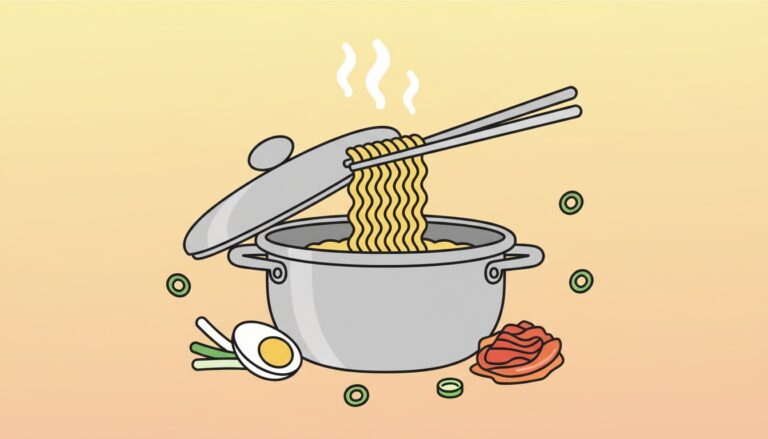
Introduction: The Soul of Korean Late-Night Snacks
안녕하세요! 매일한글 에디터입니다. (Hello! This is your Daily Hangul Editor.)
Let’s be honest. You’ve probably cooked Korean Ramyun (라면) hundreds of times. But if you are still just following the instructions on the back of the packet like a robot, you are missing out on the true soul of Korean cuisine.
Imagine this: You’re at a pension (resort) with Korean friends. Someone volunteers to cook Ramyun. If you just boil water and dump the noodles in, you’re merely “feeding” them. But if you know the secrets of “water control” (물 조절) and the “golden timing” (골든 타임), you become the hero of the night.
This lesson isn’t about how to boil water. It’s about the C2-level nuances of texture, broth depth, and the creative “hacks” that Koreans swear by. Let’s upgrade your kitchen vocabulary from “survival mode” to “master chef mode.”
Phase 2: Deep Dive into Core Expressions (Advanced)
These are phrases you won’t find in beginner textbooks, but you will hear constantly on Korean cooking shows or from foodies.
1. 꼬들꼬들하다 (Kkodeul-kkodeul-hada)
- Pronunciation: [Kko-deul-kko-deul-ha-da] (Think of the ‘kk’ as a sharp, tense sound, like a bird pecking wood.)
- Meaning:
- Literal: Firm / Hard.
- Real Nuance: Al dente. It refers to noodles that are slightly undercooked, retaining a firm, chewy texture. This is the holy grail for many Koreans. The opposite is 퍼지다 (peojida – mushy/overcooked).
- Editor’s Insight: If you serve soggy noodles to a Korean, they might smile politely, but inside, they are crying. Asking, “꼬들하게 해 줄까?” (Do you want it al dente?) shows you truly understand Ramyun culture.
- Situation: Casual (Friends/Family) & Restaurant ordering.
2. 국물이 우러나다 (Gungmuri ureonada)
- Pronunciation: [Gung-mu-ri u-reo-na-da]
- Meaning:
- Literal: The broth oozes out.
- Real Nuance: The flavor has fully developed/infused. It implies that the ingredients have steeped long enough to create a deep, rich taste, not just water mixed with powder.
- Editor’s Insight: Use this when adding extra ingredients like green onions (파) or brisket (차돌박이). “파를 먼저 볶아야 국물이 제대로 우러나요.” (You must stir-fry the green onions first for the broth to properly develop.)
- Situation: All situations (Describing food quality).
3. 별미 (Byeolmi)
- Pronunciation: [Byeol-mi]
- Meaning:
- Literal: Special taste.
- Real Nuance: A delicacy / A unique treat. It’s often used for non-standard recipes or seasonal variations.
- Editor’s Insight: When you make a “unique recipe” (like Ramyun mixed with milk or tomato sauce), and it tastes surprisingly good, you say “이거 완전 별미네!” (This is a total delicacy!).
- Situation: Casual to Formal (Complimenting food).
Phase 3: Textbook vs. Real Life (C2 Level)
At the C2 level, you stop stating facts and start expressing judgment and sensory details.
| Textbook / Standard (B1) | Real Life / Native Vibe (C2) | Nuance Check |
|---|---|---|
| 라면을 끓여 주세요. (Please cook ramyun.) | 라면 하나 끓여 올게. (I’ll whip up a ramyun.) | ‘끓여 오다’ implies the service of cooking and bringing it. |
| 면이 너무 익었어요. (The noodles are too cooked.) | 면이 다 불었어 / 퍼졌어. (The noodles are all swollen/mushy.) | ‘불다’ is the specific verb for noodles expanding in water. |
| 국물이 맛있어요. (The broth is delicious.) | 국물이 끝내주네 / 해장되네. (The broth is killer / cures my hangover.) | ‘해장’ (hangover cure) is the ultimate compliment for hot soup. |
| 남은 재료를 넣었어요. (I put in leftover ingredients.) | 냉장고 털어서 만들었어. (I raided the fridge to make this.) | Commonly known as ‘냉파’ (Fridge raiding). |
Phase 4: Cultural Context & Manners
1. The “Modisumer” (모디슈머) Culture
Koreans love to modify standard recipes. You might know Chapaguri (from the movie Parasite), but C2 learners should know terms like “꿀조합” (Honey combination / Perfect pairing).
* Tip: If you add cheese, milk, or seafood, don’t just call it Ramyun. Call it “나만의 레시피” (My own recipe). It shows pride in your creation.
2. The Sound of Satisfaction (면치기 – Myeon-chigi)
In many Western cultures, slurping is rude. In Korea, “면치기” (Slurping noodles without breaking the strand) is often seen on TV as a sign of enjoying the food.
* Manner Check: However, in a quiet office setting or a formal date, excessively loud slurping can still be frowned upon. Read the room (Use your Nunchi)! If you are with close friends, slurp away to show it’s delicious.
Phase 5: Real-Life Scenario (Roleplay)
Setting: Late night at a friend’s house. Deciding how to cook the last packet of Ramyun.
Characters:
* Minji (Native Korean): Very particular about her noodles.
* Alex (You – C2 Learner): Confident in Korean cooking hacks.
Dialogue:
(Alex is holding the pot, ready to boil water)
Minji: 야, 물 너무 많은 거 아니야? 나 한강 라면 딱 질색인데.
(Ya, mul neomu maneun geo aniya? Na Han-gang Ramyun ttak jilsaeginde.)
(Hey, isn’t that too much water? I absolutely hate “Han River Ramyun” (watery ramyun).)
Alex: 걱정 마. 나만의 비법이 있어. 물이 끓을 때 스프를 먼저 넣어야 발연점이 높아져서 면이 더 쫄깃해지거든.
(Geokjeong ma. Namanui bibeobi isseo. Muri kkeureul ttae seupeureul meonjeo neoeoya baryeonjeomi nopajyeoseo myeoni deo jjolgit-haejigeodeun.)
(Don’t worry. I have a secret trick. If you put the powder in first, the smoke point/boiling point rises, making the noodles chewier.)
Minji: 오, 이론은 그럴듯한데? 근데 나 꼬들면 좋아하는 거 알지? 퍼지면 안 먹는다.
(O, ironeun geureoldeushan-de? Geunde na kkodeul-myeon joahaneun geo alji? Peojimyeon an meongneunda.)
(Oh, the theory sounds plausible? But you know I like al dente, right? If it’s mushy, I’m not eating it.)
Alex: 당연하지. 마지막에 식초 한 방울 넣어서 탱글탱글함을 살릴 거야. 믿고 기다려 봐.
(Dangyeonhaji. Majimage sikcho han bang-ul neoseo taeng-geul-taeng-geul-ham-eul sallil geoya. Mitgo gidaryeo bwa.)
(Of course. I’m going to add a drop of vinegar at the end to bring out the bounciness. Trust me and wait.)
Phase 6: 10-Second Shadowing Drill
Read this aloud to practice the rhythm of explaining a recipe confidently.
“면이 익기 직전에 / 찬바람을 쐬어 주면 / 면발이 훨씬 더 / 쫄깃하고 탱글탱글해져요.”
- Romanization: Myeoni ikgi jikjeone / chanbarameul ssoeeo jumyeon / myeonbari hwolssin deo / jjolgit-hago taeng-geul-taeng-geul-haejyeoyo.
- Meaning: If you expose the noodles to cold air / right before they are cooked, / the noodle texture becomes much more / chewy and bouncy.
- Key Point: Emphasize “직전에” (right before) and “훨씬” (much more).
Phase 7: FAQ & Troubleshooting
Q: Can I use the word “꼬들꼬들하다” to describe rice?
A: Yes! If you like rice with less water (firm grains), you can say “꼬들밥” (Kkodeul-bap). It’s the opposite of “진밥” (Jin-bap – soft/sticky rice). Knowing this distinction is very high-level!
Q: Is it rude to drink the broth straight from the bowl?
A: In a casual setting (home, bunshik-jip), lifting the bowl with two hands to drink the broth is seen as a compliment to the chef (it means it’s tasty!). Just don’t make a mess.
Phase 8: Wrap-up & Action Item
Today’s One-Liner:
Instead of “맛있어요” (It’s delicious), try “면발이 살아있네!” (The noodles are alive/perfectly textured!).
Your Mission:
Next time you cook noodles (even pasta!), try explaining the process in Korean to yourself using “우러나다” (infuse) and “꼬들꼬들하다” (al dente).
Editor’s Question:
Do you prefer 꼬들면 (Firm noodles) or 퍼진면 (Soft noodles)? Tell me in the comments!
Phase 9: Quiz
1. What is the slang for Ramyun that has too much water and tastes bland?
A) 꿀조합 (Honey combo)
B) 한강 라면 (Han River Ramyun)
C) 볶음면 (Stir-fried noodles)
2. Which expression describes the state of noodles that have been left in the broth too long?
A) 면이 불었다 (The noodles are swollen)
B) 면이 쫄깃하다 (The noodles are chewy)
C) 국물이 우러났다 (The broth infused)
3. Which ingredient did Alex say he would add to make the noodles “bouncy” (탱글탱글)?
A) Milk (우유)
B) Vinegar (식초)
C) Sugar (설탕)
👉 Click for Answers
- B (It implies there is as much water as the Han River.)
- A (불다 is the verb for noodles absorbing liquid and expanding.)
- B (A common chemical trick to tighten the gluten!)
Frequently Asked Questions (FAQ)
Q: What does "꼬들꼬들하다 (Kkodeul-kkodeul-hada)" mean in Korean and how do you pronounce it?
A: In Korean, "꼬들꼬들하다 (Kkodeul-kkodeul-hada)" is pronounced [Kko-deul-kko-deul-ha-da] and means: Literal: Firm / Hard.
Q: What does "국물이 우러나다 (Gungmuri ureonada)" mean in Korean and how do you pronounce it?
A: In Korean, "국물이 우러나다 (Gungmuri ureonada)" is pronounced [Gung-mu-ri u-reo-na-da] and means: Literal: The broth oozes out.
Q: What does "별미 (Byeolmi)" mean in Korean and how do you pronounce it?
A: In Korean, "별미 (Byeolmi)" is pronounced [Byeol-mi] and means: Literal: Special taste.







