

Hello! I’m your Daily Hangul Editor.
Have you ever walked into a busy Tteokbokki place in Seoul, clutching a Tupperware container in your bag, heart pounding? You want to order takeout, but you don’t want the mountain of plastic waste that comes with it. You want to ask the owner to put the food in your container, but you’re paralyzed.
“What if they refuse?”
“What if I hold up the line?”
“How do I say this politely without sounding demanding?”
If you’ve felt this hesitation, you are already part of the movement. Today, we are diving deep into the “Yonggi-nae” (용기내) campaign. This isn’t just about saving the planet; it’s a linguistic goldmine for C2 learners. It involves high-context punning, sophisticated polite requests, and the cultural confidence to go against the flow of convenience.
Let’s turn your eco-anxiety into eco-fluency.
Phase 1: Deep Dive into Core Expressions
At the C2 level, you aren’t just learning words; you are learning wit. The core of Korea’s zero-waste movement lies in a brilliant homonym.
1. 용기 내다 [Yonggi naeda]
- Pronunciation: Yong-gi nae-da (The ‘Yong’ sounds like the ‘yo’ in ‘yonder’ with an ‘ng’ ending; ‘gi’ is sharp like ‘guinness’ but with an ‘ee’ sound.)
- Meaning:
- To show courage / To be brave.
- To bring/submit a container (implied meaning in this campaign context).
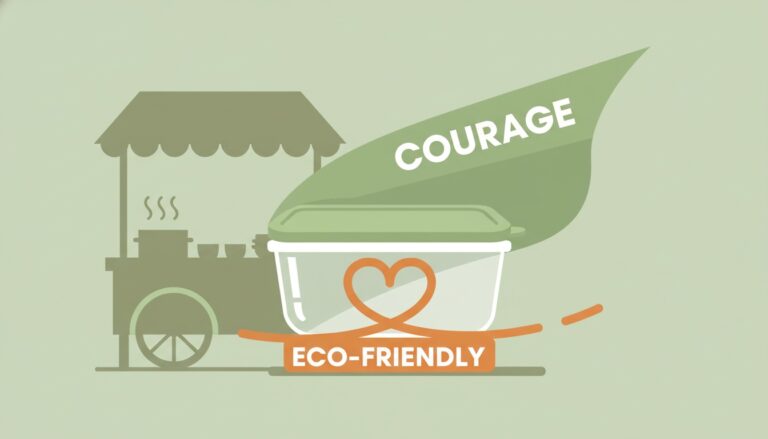
- Editor’s Insight: The word 용기 (Yonggi) means both ‘courage’ (勇氣) and ‘container’ (容器). The campaign slogan “용기내!” is a clever double entendre: “Show some courage!” and “Bring out your container!” Use this pun to bond with shop owners. It shows you understand Korean wordplay deeply.
- Situation Check: Used in slogans, hashtags, or when encouraging a friend. Do not use the pun directly to an elderly shop owner unless you’ve established rapport.
2. 혹시 가져온 용기에 담아주실 수 있을까요? [Hoksi gajyeoon yonggie damajul su isseulkkayo?]
- Pronunciation: Hok-shi ga-jyeo-on yong-gi-e da-ma-ju-shil su i-sseul-kka-yo?
- Meaning: By any chance, would it be possible to put it in the container I brought?
- Editor’s Insight: Notice the layering of softening agents: 혹시 (Hoksi – by any chance) + ~(으)ㄹ 수 있을까요? (Would it be possible…?). At an advanced level, you don’t just ask for what you want; you acknowledge the inconvenience you might be causing. This phrasing respects the owner’s workflow while making your request clear.
- Situation Check: Essential for Formal/Polite situations (Restaurants, Cafes, Bakeries).
3. 일회용품은 빼고 내용물만 주세요. [Ilhoeyongpumeun ppaego naeyongmulman juseyo.]
- Pronunciation: Il-hoe-yong-pum-eun ppae-go nae-yong-mul-man ju-se-yo.
- Meaning: Please exclude disposables and just give me the contents.
- Editor’s Insight: 내용물 (Naeyongmul) means ‘contents.’ This is a precise, formal way to say, “I don’t need the side dishes, the plastic spoon, or the fancy wrapping—just the food.” It sounds much more sophisticated than saying “No plastic, please.”
Phase 2: Textbook vs. Real Life (C2 Edition)
At the advanced level, your goal is to sound considerate, not just grammatically correct.
| Textbook (Grammatically Correct) | Real Life (Eco-Insider Vibe) |
|---|---|
| 포장해 주세요. (Please pack this to go.) |
텀블러 가져왔는데, 여기에 담아주시면 할인되나요? (I brought my tumbler; is there a discount if you put it in here?) |
| 비닐봉지 필요 없어요. (I don’t need a plastic bag.) |
장바구니 있어서 봉투는 괜찮아요. (I have a shopping bag, so the [plastic] bag is fine.) |
| 이 통에 넣어 주세요. (Put it in this box.) |
제가 용기를 좀 챙겨 왔는데, 번거로우시겠지만 여기에 부탁드려도 될까요? (I brought some containers; sorry to bother you, but could I ask you to put it in here?) |
Editor’s Note: The last Real Life example uses 번거로우시겠지만 (I know it’s a hassle, but…). This is a “Magic Shield” phrase for C2 learners. It disarms any annoyance the shop owner might feel about handling a non-standard container.
Phase 3: Cultural Context & Manners
1. The “Nunchi” of Volume:
Before you hand over your container, estimate the volume (용량) of the food. If you bring a 500ml box for a 1-liter stew, you are putting the owner in a very awkward position (creating burden or 부담). Always bring a container slightly larger than you think you need. It shows you are prepared and considerate.
2. Hygiene is King:
Ensure your container is spotless. In Korea, handing a stranger a slightly stained or wet container is considered rude. It implies you don’t respect their food. Hand it over with two hands as a sign of respect.
3. The “Peak Hour” Etiquette:
If the lunch rush is insane and the staff is running around, maybe skip the Zero Waste request just for today. Reading the room (분위기 파악) is a hallmark of a fluent speaker.
Phase 4: Roleplay Script
Setting: A popular Banchan (Side dish) store at a local market.
Characters: Alex (C2 Learner, eco-conscious), Sajangnim (Shop Owner, busy but friendly).
Alex: (Smiling, holding out a glass container with two hands)
사장님, 안녕하세요! 멸치볶음 5,000원어치만 주세요.
(Boss, hello! Please give me 5,000 won worth of stir-fried anchovies.)
Sajangnim: 네, 어서 오세요~ 포장이죠?
(Yes, welcome~ To go, right?)
Alex: 네, 그런데 사장님, 혹시 제가 가져온 용기에 담아주실 수 있을까요? 쓰레기를 좀 줄여보려고요.
(Yes, but Boss, could you possibly put it in the container I brought? I’m trying to reduce waste.)
Sajangnim: (Surprised but impressed) 아이고, 젊은 분이 기특하네. 용기 내셨네요? (Laughs)
(Oh my, a young person doing good. You showed courage/brought a container?)
Alex: (Laughing along) 네, 용기 내서 용기 가져왔습니다. 번거롭게 해 드려서 죄송해요.
(Yes, I worked up the courage to bring the container. Sorry for the hassle.)
Sajangnim: 아니에요, 오히려 고맙지. 내가 꽉꽉 눌러서 더 많이 줄게요!
(No no, I’m thankful actually. I’ll pack it tight and give you extra!)
Phase 5: 10-Second Shadowing
Practice this sentence to explain why you are doing this effortlessly.
“It creates a bit of hassle to carry containers around, but I feel proud that I’m reducing plastic waste.”
Korean: “용기를 들고 다니는 게 / 좀 번거롭긴 하지만, / 플라스틱을 줄이니까 / 마음이 뿌듯하더라고요.”
Pronunciation Guide:
* Yong-gi-reul deul-go da-ni-neun ge / jom beon-geo-rop-gin ha-ji-man, / peul-la-seu-ti-geul ju-ri-ni-kka / ma-eu-mi ppu-deu-ta-deo-ra-go-yo.
Key Point: Emphasize 번거롭긴 하지만 (hassle, but…) and 뿌듯하더라고요 (proud/fulfilled). Drop your pitch slightly at the end for a humble, reflective tone.
Phase 6: FAQ & Troubleshooting
Q: Can I use these phrases at major franchises like Starbucks or McDonald’s?
A: For cafes (Starbucks), yes! Say “텀블러에 담아주세요” (Please put it in the tumbler). You often get a 300-500 KRW discount. However, for food franchises (McDonald’s, etc.), they often refuse personal containers due to strict internal Hygiene Regulations (위생 규정). Stick to local markets or independent stores for food containers.
Q: Is “용기 내다” too informal for a boss?
A: The pun itself is witty, but telling a boss “용기 내세요!” (Show courage!) can sound patronizing. However, if your company is doing an eco-campaign, using the phrase “우리 팀도 용기 내 볼까요?” (Shall our team also try the ‘Yonggi’ challenge?) is excellent corporate soft skills.
Phase 7: Wrap-up
Summary: ordering with your own container requires the “Magic Shield” phrase (번거로우시겠지만) and the confidence to use the “Yonggi” pun.
Action Mission: Next time you go to a cafe, don’t just hand over your tumbler silently. Ask: “개인 컵 할인도 적용되나요?” (Does the personal cup discount apply?). Even if you know it does, it’s great practice!
Question: Have you ever successfully used the “Yonggi-nae” challenge in Korea? Tell me your success (or awkward failure) stories in the comments!
Phase 8: Quiz
1. What is the double meaning of ‘Yonggi’ (용기)?
a) Delicious & Spicy
b) Container & Courage
c) Discount & Freebie
d) Plastic & Paper
2. Which phrase is the most polite way to ask a shop owner to use your container?
a) 여기 담아. (Put it here.)
b) 용기 가져왔으니까 깎아주세요. (I brought a container so give me a discount.)
c) 번거로우시겠지만, 가져온 용기에 부탁드려도 될까요? (Sorry for the hassle, but could I ask you to use this container?)
d) 일회용품 싫어요. (I hate disposables.)
3. What does “뿌듯하다” mean in the context of eco-action?
a) Feeling annoyed by the inconvenience.
b) Feeling hungry for the food.
c) Feeling proud and fulfilled inside.
d) Feeling angry at the plastic waste.
Click to see answers
1. b) Container & Courage
2. c) This uses the “Magic Shield” phrase.
3. c) Feeling proud and fulfilled inside.
Frequently Asked Questions (FAQ)
Q: What does "용기 내다 [Yonggi naeda]" mean in Korean and how do you pronounce it?
A: In Korean, "용기 내다 [Yonggi naeda]" is pronounced [Yong-gi nae-da (The 'Yong' sounds like the 'yo' in 'yonder' with an 'ng' ending; 'gi' is sharp like 'guinness' but with an 'ee' sound.] and means: To show courage / To be brave.
Q: What does "혹시 가져온 용기에 담아주실 수 있을까요? [Hoksi gajyeoon yonggie damajul su isseulkkayo?]" mean in Korean and how do you pronounce it?
A: In Korean, "혹시 가져온 용기에 담아주실 수 있을까요? [Hoksi gajyeoon yonggie damajul su isseulkkayo?]" is pronounced [Hok-shi ga-jyeo-on yong-gi-e da-ma-ju-shil su i-sseul-kka-yo?] and means: By any chance, would it be possible to put it in the container I brought?
Q: What does "일회용품은 빼고 내용물만 주세요. [Ilhoeyongpumeun ppaego naeyongmulman juseyo.]" mean in Korean and how do you pronounce it?
A: In Korean, "일회용품은 빼고 내용물만 주세요. [Ilhoeyongpumeun ppaego naeyongmulman juseyo.]" is pronounced [Il-hoe-yong-pum-eun ppae-go nae-yong-mul-man ju-se-yo.] and means: Please exclude disposables and just give me the contents.







