

안녕하세요! This is your Head Editor at Daily Hangul. 👋
So, you’ve been invited to a Korean friend’s house for Chuseok (추석) or Seollal (설날). You are excited about the culture, the Hanbok, and the vibes. But then, you see it.
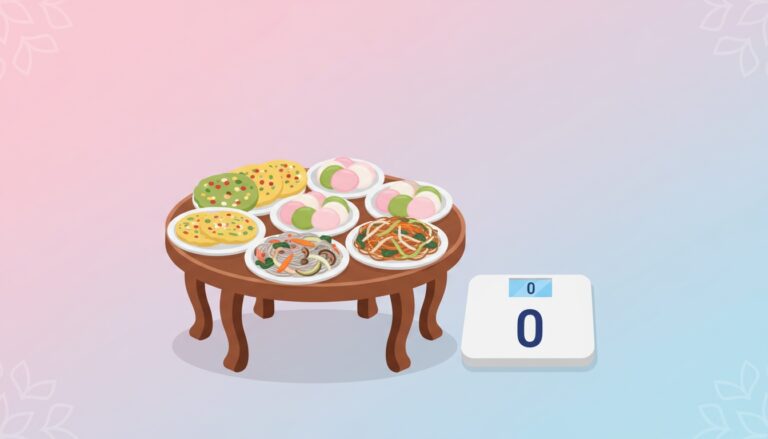
The Table. 🥘🍖🥟
It is groaning under the weight of Jeon (pancakes), Galbi-jjim (braised ribs), and Songpyeon (rice cakes). Your host’s mother keeps putting food on your plate, saying “Eat more, you look thin!”
In this unit, we are tackling a very specific, high-level struggle: How to talk about calories and dieting during a Korean holiday without ruining the mood.
If you only know “배불러요 (I’m full),” you might sound a bit cold. Today, I’ll teach you how to complain about weight gain like a true Korean Inssa (Insider). Let’s dive in!
1. Phase 1: The Situation (Why this matters)
In Korea, Food is Love. Especially during traditional holidays, refusing food can sometimes be interpreted as refusing affection (Jeong).
However, Koreans also love talking about health and diets. The key B2 (Intermediate) skill here is The Paradox: complaining about getting fat while continuing to eat happily. If you can master this irony, you will have everyone at the table laughing and saying, “Wow, you’re basically Korean!”
2. Phase 2: Deep Dive into Core Expressions
Here are the top 3 expressions to handle the “Holiday Calorie” conversation.
1. 맛있으면 0칼로리 (Masisseumyeon 0-kal-lo-ri)
- Pronunciation: [Ma-sit-sseu-myeon yeong-kal-lo-ri] Sounds like: “Ma-sit” (delicious) + “su-myun” + “young calorie”.
- Meaning: “If it tastes delicious, it has 0 calories.”
- Editor’s Insight: This is a legendary phrase popularized by a Korean comedian. It is the ultimate excuse. Use this when you reach for that 10th piece of Jeon even though you said you were full.
- Situation Check: ✅ Casual / ✅ Semi-Formal (Use it to lighten the mood with elders too!)
2. 급찐급빠 (Geup-jjin-geup-bba)
- Pronunciation: [Geup-jjin-geup-bba]
- Meaning: “Rapidly gained, rapidly lost.”
- Editor’s Insight: This is a perfect B2/C1 slang. It’s an abbreviation of 급하게 찐 살은 급하게 빠진다 (Weight gained quickly is lost quickly). It’s the hopeful mantra of every Korean after a holiday binge.
- Situation Check: ✅ Friends / ⚠️ Coworkers (Close) / ❌ Very Formal Elders (might not understand the slang)
3. 배 터질 것 같아요 (Bae teo-jil geot ga-ta-yo)
- Pronunciation: [Bae tuh-jil-gut ga-ta-yo] “Teo” sounds like the start of “Touch”.
- Meaning: “I feel like my stomach is going to explode.”
- Editor’s Insight: “배불러요 (I’m full)” is boring. “배 터질 것 같아요” is dramatic and appreciative. It implies, “You gave me so much delicious food that I physically cannot contain it.”
- Situation Check: ✅ All Situations (Standard polite form)
3. Phase 3: Textbook vs. Real Life
Let’s upgrade your Korean from “Classroom Robot” to “Hongdae Local.”
| Textbook Korean (A bit stiff) | Real Korean (Natural & Witty) |
|---|---|
| 저는 다이어트를 하고 있습니다. (I am doing a diet.) |
저 오늘만 치팅 데이 하려고요. (I’m going to make just today my ‘cheating day’.) |
| 음식이 너무 많습니다. (There is too much food.) |
와, 상다리 부러지겠어요! (Wow, the table legs might break! Idiom) |
| 운동을 해야 합니다. (I must exercise.) |
명절 끝나고 헬스장 기부 천사 예약이에요. (I’m destined to be a ‘donation angel’ at the gym after the holidays. Implying paying for a gym membership and barely going) |
💡 Editor’s Note: The term “치팅 데이 (Cheating Day)” is widely used in Korea now. It sounds much more natural than saying strict diet phrases during a party.
4. Phase 4: Cultural Context & Manners
The Art of “Nunchi” (눈치) at the Dinner Table
When worrying about calories in front of elders who prepared the food:
- Never reject the first offering. Even if you are on a strict diet, take a small piece. Rejecting immediately can hurt the cook’s pride.
- Blame the food’s deliciousness. Don’t say “I don’t want to get fat.” Say “It’s so tasty that I can’t stop eating, and I’m worried about my weight!” This turns a refusal into a compliment.
- The “Belly Rub” Gesture: When saying “배 터질 것 같아요,” gently rubbing your stomach in a circular motion adds a non-verbal cue of satisfaction.
5. Phase 5: Real-Life Roleplay
Scenario: You are at a friend’s house for Chuseok. You are incredibly full, but the friend’s mom offers more rice cakes (Songpyeon).
- Korean Mom: 아이고, 왜 안 먹어? 송편 더 먹어. (Oh my, why aren’t you eating? Have more Songpyeon.)
- You (Student): (Rubbing stomach w/ a smile) 어머님, 진짜 너무 맛있어서 계속 먹다가 배 터질 것 같아요!
(Mother, it’s truly so delicious I kept eating and now I think my stomach will explode!) - Korean Mom: 에이, 맛있게 먹으면 살 안 쪄. 하나만 더 해. (Ey, if you enjoy it, you won’t gain weight. Have just one more.)
- You (Student): (Laughing) 맞아요. 맛있으면 0칼로리죠? 딱 하나만 더 먹고 내일부터 ‘급찐급빠’ 해야겠어요.
(That’s right. If it’s tasty, it’s 0 calories, right? I’ll have just one more and do the ‘quick gain quick loss’ routine starting tomorrow.)
6. Phase 6: 10-Second Shadowing Drill
Read this out loud to practice the rhythm of a “guilty but happy” eater.
“명절이니까 / 오늘은 걱정 없이 먹고, / 다이어트는 / 내일부터 하려고요!”
(Since it’s a holiday / I’ll eat without worry today, / and the diet / I plan to start tomorrow!)
Pronunciation Tips:
* Pause at the / marks.
* Put a slight stress on “내일부터” (starting tomorrow) to emphasize your procrastination!
7. Phase 7: FAQ & Troubleshooting
Q: Can I use “살 쪘어요 (I gained weight)” as a greeting?
A: Be careful! Close friends often say “너 살 찐 것 같아?” (Did you gain weight?) as a joke, but it can be rude if you aren’t very close. However, saying it about yourself (“아, 나 살 찐 것 같아” – I think I gained weight) is a great conversation starter to bond over holiday food struggles.
Q: Is “Cheating Day” really understood?
A: Yes! Younger generations and anyone interested in health/fitness will understand “치팅 데이.”
8. Phase 8: Wrap-up
One-Liner Summary:
Holiday calories don’t count if you say “맛있으면 0칼로리” with confidence!
🚀 Your Mission:
Next time you are eating something high-calorie with a Korean friend (even if it’s just fried chicken), say: “다이어트는 내일부터! (Diet starts tomorrow!)” Watch them nod in agreement.
Don’t forget to leave a comment: What is your favorite Korean holiday food that ruins your diet? 👇
9. Pop Quiz 📝
1. What does the slang “급찐급빠 (Geup-jjin-geup-bba)” mean?
A) Eat quickly, run quickly.
B) Rapidly gained weight, rapidly lost weight.
C) Urgent party, urgent bye-bye.
2. How do you politely say “I am incredibly full” using a metaphor?
A) 배 아파요 (My stomach hurts.)
B) 배 고파요 (I am hungry.)
C) 배 터질 것 같아요 (My stomach is going to explode.)
3. Complete the sentence: “If it tastes good, it is _______.”
A) 1000 Calories
B) Healthy
C) 0 Calories
Click for Answers
1. B, 2. C, 3. C
Frequently Asked Questions (FAQ)
Q: What does "급찐급빠 (Geup-jjin-geup-bba)" mean in Korean and how do you pronounce it?
A: In Korean, "급찐급빠 (Geup-jjin-geup-bba)" is pronounced [Geup-jjin-geup-bba] and means: "Rapidly gained, rapidly lost."
Q: What does "배 터질 것 같아요 (Bae teo-jil geot ga-ta-yo)" mean in Korean and how do you pronounce it?
A: In Korean, "배 터질 것 같아요 (Bae teo-jil geot ga-ta-yo)" is pronounced [Bae tuh-jil-gut ga-ta-yo] and means: "I feel like my stomach is going to explode."







