

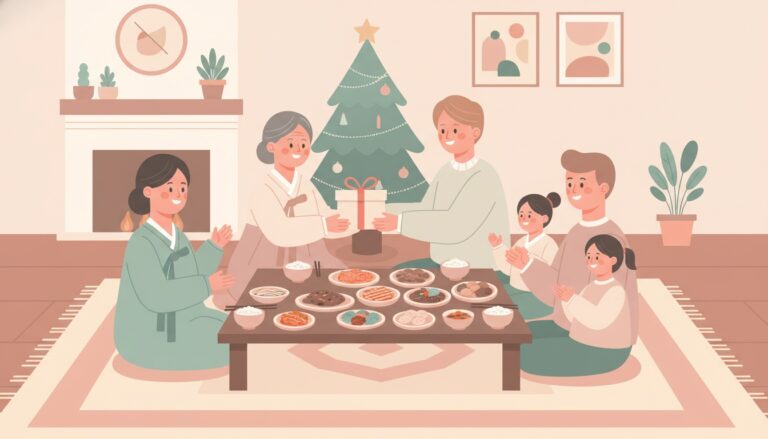
Phase 1: Welcome to the Holiday Chaos (and Love)! 👋
Hello! This is your Senior Editor from Daily Hangul.
Imagine this: It’s Chuseok (Korean Thanksgiving) or Seollal (Lunar New Year). You’ve been invited to a Korean friend’s hometown. You are excited, but then you see the highway… it’s a giant parking lot.
When you finally arrive, a room full of smiling elders is looking at you. Your heart starts racing. “What do I say? Do I just smile? Do I bow?”
Don’t panic! Visiting a hometown (고향 방문하기) is the ultimate level of Korean hospitality. If you nail the first 30 seconds, you’re not just a guest; you’re family. Today, I’ll teach you the survival phrases that will make Korean grandmothers want to feed you even more (if that’s possible!).
Note: These tips come from real stories of my students who survived the holiday traffic and the endless food! 🍱
Phase 2: Essential Phrases for the Trip Home (Deep Dive) 🧐
Here are the top 3 expressions you need for an A2 (Beginner) level learner.
1. 차가 너무 막혀요 (Cha-ga neo-mu ma-kyeo-yo)
- Pronunciation: Cha-ga nuh-moo ma-kyuh-yo
- Tip: Think of ‘ma’ as in ‘mom’ and ‘kyeo’ like ‘kyo’ in Tokyo.
- Meaning:
- Literal: The cars are blocked too much.
- Real Nuance: “The traffic is terrible!” (This is the #1 conversation starter during holidays).
- Editor’s Insight: During Korean holidays, saying this is like talking about the weather in the UK. It builds instant empathy. Everyone suffers in traffic together!
- Situation Check: ✅ Casual (Friends) | ✅ Formal (Elders/Parents) – Just make sure to keep the ‘yo’ at the end.
2. 초대해 주셔서 감사합니다 (Cho-dae-hae ju-shyeo-seo gam-sa-ham-ni-da)
- Pronunciation: Cho-day-hay ju-shyu-suh gam-sa-ham-ni-da
- Tip: ‘Ju-shyeo-seo’ can be a tongue twister. Break it down: Ju + shyu + suh.
- Meaning:
- Literal: Because you invited me, thank you.
- Real Nuance: “Thank you so much for having me.”
- Editor’s Insight: This is the magic phrase to say the moment you walk through the door. It shows you have manners (예의).
- Situation Check: ❌ Casual (Don’t say this to a close friend, it’s too stiff) | ✅ Formal (Perfect for parents/elders).
3. 빈손으로 오기 뭐해서… (Bin-so-neu-ro o-gi mwo-hae-seo…)
- Pronunciation: Bin-so-neu-ro oh-ghi mwo-hay-suh…
- Tip: Trail off at the end. Don’t finish the sentence sharply.
- Meaning:
- Literal: Coming with empty hands felt a bit ‘what’ (awkward), so…
- Real Nuance: “I couldn’t come empty-handed, so I brought this small gift.”
- Editor’s Insight: You never visit a Korean home empty-handed during holidays. You usually bring fruit, spam sets, or toilet paper. Hand the gift over while saying this shyly.
- Situation Check: ✅ Casual | ✅ Formal
Phase 3: Textbook vs. Real Life 🥊
Let’s see how a robot talks vs. how a real person talks during the holidays.
| Textbook Korean 🤖 | Real Life Korean 🇰🇷 |
|---|---|
| 고향에 잘 다녀오셨습니까? (Did you return from your hometown well?) |
고향 잘 다녀왔어요? (Did you have a good trip home?) |
| 교통 체증이 심했습니다. (The traffic congestion was severe.) |
차가 진짜 많이 막혔어요. (Cars were really blocked up.) |
| 이것은 선물입니다. (This is a gift.) |
오다가 하나 샀어요. (I just picked this up on the way.) |
Editor’s Note: Use the “Real Life” expressions to sound humble and natural. Saying “This is a gift” directly can feel a bit too transactional in Korea.
Phase 4: Cultural Context & Manners (Nunchi Time) 🧠
🎁 The Art of the Gift (Seonmul)
When visiting a hometown, bringing a gift is mandatory.
* Safe Bets: A box of Spam (yes, really!), Tuna cans, expensive fruit (pears/apples), or health supplements (Red Ginseng).
* Gesture: Always hand the gift over with two hands. It shows respect.
🙇 The Bow (Jeol)
If it is Seollal (Lunar New Year), you might see people doing a deep bow to the floor called Sebae (세배).
* Context: If you are a close friend, you might be invited to bow too. If you do, say “새해 복 많이 받으세요” (Happy New Year).
* Don’t panic: If you are a foreigner, a polite standing bow (bending your waist) is usually enough and very appreciated.
Phase 5: Roleplay Scenario 🎬
Setting: Alex (Foreigner) arrives at his friend Min-su’s parents’ house in Busan.
Characters:
* Alex: A2 Level Learner
* Mother: Min-su’s Mom (Very welcoming)
(Door opens. Alex enters and bows politely.)
Alex: 어머니, 안녕하세요! 초대해 주셔서 감사합니다.
(Mother, hello! Thank you for inviting me.)
Mother: 어머, 알렉스 왔구나! 오느라 힘들었지?
(Oh my, Alex is here! Was it hard coming here?)
Alex: 네, 차가 좀 막혔어요. 하지만 괜찮아요!
(Yes, the traffic was a bit bad. But I’m okay!)
(Alex holds out a box of oranges with two hands.)
Alex: 이거… 빈손으로 오기 뭐해서 과일 좀 샀어요.
(Here… I couldn’t come empty-handed, so I bought some fruit.)
Mother: 아이구, 뭐 이런 걸 사 왔어! 어서 들어와.
(Aigoo, why did you buy something like this! Come on in.)
Phase 6: 10-Second Shadowing Drill 🗣️
Let’s practice the rhythm. Read this aloud while imagining you are exhausted from a 5-hour drive but happy to see family.
“Holiday traffic is no joke!”
명절에는 / 차가 / 정말 / 많이 / 막혀요.
[Myeong-jeol-e-neun / cha-ga / jeong-mal / ma-ni / ma-kyeo-yo]
- Focus Point: Stress the word 정말 (Jeong-mal) to emphasize how bad the traffic was!
Phase 7: FAQ & Troubleshooting 🚑
Q: Can I call my friend’s parents “Mom” (Eomeoni) and “Dad” (Abeoji)?
A: YES! In fact, it’s better than trying to say “Mr. Kim.” Calling them 어머니 (Mother) and 아버지 (Father) creates an instant bond. They will love it.
Q: What if I don’t like the food?
A: Holiday food is huge. Even if you are full, try a little bit of everything. The magic phrase is: “배부르지만 너무 맛있어요!” (I’m full, but it’s so delicious!).
Phase 8: Wrap-up & Mission 🚀
Today’s Summary:
When visiting a hometown, complain about traffic politely, bring a gift (using two hands!), and call the parents Mother/Father.
🔥 Your Mission:
Next time you hand something to anyone (even a cashier), try using two hands. It’s a great way to practice the “manner muscle memory” needed for the holidays!
Comments:
Have you ever been stuck in Korean traffic? Tell me your horror story in the comments below! 👇
Phase 9: Pop Quiz 📝
1. Which phrase is best to use when giving a gift?
A) 이거 비싼 거예요. (This is expensive.)
B) 빈손으로 오기 뭐해서… (I couldn’t come empty-handed…)
C) 선물 받아라! (Take the gift!)
2. What is the most common topic to complain about during holidays?
A) The weather
B) The internet speed
C) The traffic (차가 막혀요)
3. How should you address your friend’s parents?
A) Hey You
B) Mr. and Mrs.
C) Eomeoni (Mother) / Abeoji (Father)
(Answers: 1-B, 2-C, 3-C)
Frequently Asked Questions (FAQ)
Q: What does "차가 너무 막혀요 (Cha-ga neo-mu ma-kyeo-yo)" mean in Korean and how do you pronounce it?
A: In Korean, "차가 너무 막혀요 (Cha-ga neo-mu ma-kyeo-yo)" is pronounced [Cha-ga nuh-moo ma-kyuh-yo] and means: a key conversational Korean expression covered in this lesson.
Q: What does "초대해 주셔서 감사합니다 (Cho-dae-hae ju-shyeo-seo gam-sa-ham-ni-da)" mean in Korean and how do you pronounce it?
A: In Korean, "초대해 주셔서 감사합니다 (Cho-dae-hae ju-shyeo-seo gam-sa-ham-ni-da)" is pronounced [Cho-day-hay ju-shyu-suh gam-sa-ham-ni-da] and means: a key conversational Korean expression covered in this lesson.
Q: What does "빈손으로 오기 뭐해서... (Bin-so-neu-ro o-gi mwo-hae-seo...)" mean in Korean and how do you pronounce it?
A: In Korean, "빈손으로 오기 뭐해서... (Bin-so-neu-ro o-gi mwo-hae-seo...)" is pronounced [Bin-so-neu-ro oh-ghi mwo-hay-suh...] and means: a key conversational Korean expression covered in this lesson.







