

Hello, this is Daily Hangul! (안녕하세요, 매일한글입니다!)
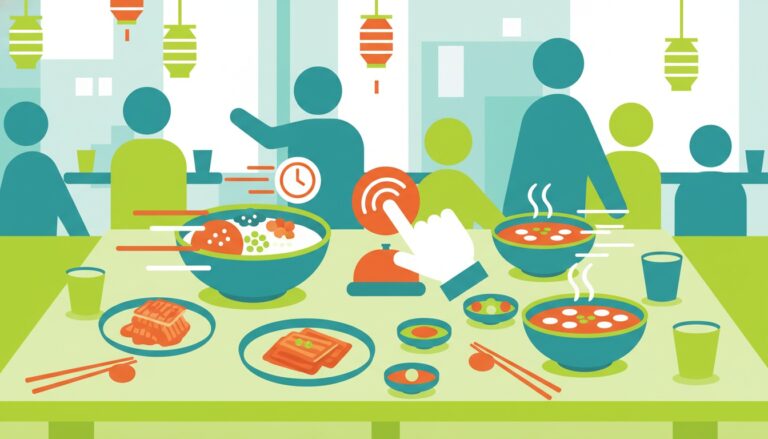
Have you ever heard the phrase “Ppalli-ppalli” (빨리빨리)? It literally means “Hurry, hurry!” and it is the heartbeat of modern Korea. Nowhere is this more visible than in a Korean restaurant during lunch hour.
📖 The “Hungry Visitor” Case (Synthetic Case)
(This is a compiled example based on common mistakes observed in multiple learners)
The Situation: A learner named “Alex” went to a busy Kimchi Stew restaurant in Seoul. He sat down and waited politely for the server to come to his table, just like he would in a fine dining restaurant in Europe.
The Problem: 10 minutes passed. No one came. People who arrived after him were already eating.
The Reality: In busy Korean places, silence is often invisible. Alex didn’t know he had to actively signal or shout to get attention.
Textbooks often teach you formal phrases like “Jeogi iseumnida” (Here I am), but in reality, if you are too quiet, you might starve during the lunch rush! Today, we will learn the “Survival Kit for Fast Ordering” so you can eat as quickly as a local.
📝 At a Glance (한눈에 보는 요약)
- Today’s Key Phrases:
- Yeogiyo (Excuse me / Over here!)
- Igeo juseyo (Please give me this)
- Geum-bang naowayo? (Does it come out quickly?)
- Safe Zone: Casual dining, lunch spots, cafes (Not for formal business meetings with CEOs).
- Difficulty: B1 (Intermediate). You know the words, but the timing and volume are key here.
📚 Table of Contents
- Today’s Deep Dive: 3 Key Phrases
- Textbook vs. Real Korean
- Tutor’s Analysis: The Speed Thermometer
- Real Role Play: Lunch at a Kimbap Shop
- Shadowing Challenge
- FAQ & Wrap-up
💡 Today’s Deep Dive (오늘의 핵심 표현)
1. 여기요 (Yeogiyo)
- Meaning: Excuse me / Over here (Literal: Here)
- Usage & Register:
- Who: To staff in a restaurant.
- Tone: Polite but firm (Haeyo-che / 해요체).
- Tutor’s Secret Note:
- In Western culture, waving or shouting might be rude. In Korea, it is necessary in busy places. If there is no call bell on the table, you must say this loud enough to cut through the noise.
- Warning: Do not snap your fingers. That is considered very rude!
- Pronunciation Clinic:
- Don’t say “Yogi-yo” like a yogi bear. It’s Yeo (여) – open your mouth vertically.
- [Yeo-gi-yo] (Pitch goes up at the end ↗)
- Examples:
- Travel: 저기요, 주문할게요! (Jeogiyo, jumun-halgeyo!) – Excuse me, I will order!
- Restaurant: 여기요, 물 좀 주세요. (Yeogiyo, mul jom juseyo.) – Excuse me, please give me some water.
- Cafe: 여기요, 냅킨 있나요? (Yeogiyo, naepkin innayo?) – Excuse me, do you have napkins?
- Alternatives:
- 사장님 (Sajangnim) – Boss (Very friendly, commonly used even if they aren’t the owner).
- 이모님 (Imonim) – Auntie (Friendly, used for older female servers in casual diners).
- Mini Quiz:
- Situation: You dropped your spoon. You call the staff: “_______, spoon please!”
Click to see answer
여기요 (Yeogiyo) or 사장님 (Sajangnim)
- Situation: You dropped your spoon. You call the staff: “_______, spoon please!”
2. 이거 주세요 (Igeo juseyo)
- Meaning: Please give me this.
- Usage & Register:
- Who: To staff when ordering.
- Tone: Polite standard (Haeyo-che / 해요체).
- Tutor’s Secret Note:
- When the menu is in Korean and you can’t read it fast, pointing at a picture or another table’s food and saying “Igeo juseyo” is the ultimate survival hack.
- Pronunciation Clinic:
- Link the sounds: [I-geo] not [I-keo]. The ‘g’ is soft.
- Examples:
- Restaurant: 이거 하나 주세요. (Igeo hana juseyo.) – Please give me one of this.
- Street Food: 이거 매워요? (Igeo maewoyo?) – Is this spicy?
- Shopping: 이거 얼마예요? (Igeo eolmayeyo?) – How much is this?
- Alternatives:
- 저거랑 같은 거 주세요. (Jeogeorang gateun geo juseyo.) – Please give me the same thing as that (over there).
- Mini Quiz:
- Situation: You want the Bibimbap on the menu picture. You point and say: “_______.”
Click to see answer
이거 주세요 (Igeo juseyo)
- Situation: You want the Bibimbap on the menu picture. You point and say: “_______.”
3. 금방 나와요? (Geum-bang naowayo?)
- Meaning: Will it come out soon? / Is it quick?
- Usage & Register:
- Who: To staff when you are in a rush.
- Tone: Polite question.
- Tutor’s Secret Note:
- Koreans ask this A LOT. If the server says “Ne (Yes),” it usually means 5-10 minutes. If they hesitate, order something else (like Bibimbap or Stew).
- Pronunciation Clinic:
- Geum-bang (Lips must close firmly on ‘m’ and ‘ng’).
- Examples:
- Lunch Rush: 비빔밥 금방 나와요? (Bibimbap geum-bang naowayo?) – Does Bibimbap come out quickly?
- Checking Order: 제 음식 금방 나와요? (Je eumsik geum-bang naowayo?) – Is my food coming out soon?
- Comparison: 뭐가 제일 빨리 돼요? (Mwoga jeil ppalli dwaeyo?) – What is made the fastest?
- Alternatives:
- 얼마나 걸려요? (Eolmana geollyeoyo?) – How long does it take?
- Mini Quiz:
- Situation: You have a bus to catch in 20 minutes. You ask: “Is this menu item fast?” -> “Igeo _______?”
Click to see answer
금방 나와요? (Geum-bang naowayo?)
- Situation: You have a bus to catch in 20 minutes. You ask: “Is this menu item fast?” -> “Igeo _______?”
🆚 Textbook vs. Reality (교과서 vs 현실 한국어)
In a bustling lunch spot, polite textbook waiting doesn’t work. You need to be proactive.
| Context | 📘 Book Korean (Textbook) | 🚀 Real Korean (Survival) |
|---|---|---|
| Calling Staff | (Waiting for eye contact) | (Pressing the Bell) Ding-dong! or “Sajangnim!” (Boss!) |
| Ordering | 메뉴판 좀 보여주세요. (Menupan jom boyeojuseyo – Show me the menu please) |
“여기 주문이요!” (Yeogi jumun-iyo! – Order here!) |
| Checking Speed | 시간이 얼마나 걸립니까? (Sigani eolmana geollimnikka?) |
“이거 빨리 돼요?” (Igeo ppalli dwaeyo? – Can this be done fast?) |
Situation Checklist:
* Fine Dining: Use Book Korean.
* Kimbap Cheonguk / BBQ Place: Use Real Korean.
🌡️ Tutor’s Analysis: The “Urgency” Thermometer
How do you push for speed without being rude? Let’s look at the nuance levels.
| Level | Expression (Korean/Romanization) | Nuance (Feeling) | Recommended For |
|---|---|---|---|
| 1 (Calm) | 언제 나올까요? (Eonje naolkkayo?) | “I’m just curious about the time.” | Fine dining, date |
| 2 (Standard) | 금방 나와요? (Geum-bang naowayo?) | “I have a schedule, checking efficiently.” | Lunch, quick meal |
| 3 (Urgent) | 빨리 좀 부탁드려요. (Ppalli jom butakdeuryeoyo.) | “Please hurry, I really need it.” | When late for a train |
| 4 (Rude) | 아직 안 나왔어요? (Ajik an nawasseoyo?) | “Why isn’t it here yet?” (Complaining) | Only if food is 20+ min late |
🎭 Real Life Role Play (실전 시나리오)
Situation: It is 12:30 PM (Peak Lunch Time) at a busy Kimbap restaurant near a subway station.
- Guest (You): (Entering and sitting immediately) 여기요! 주문할게요.
- (Yeogiyo! Jumun-halgeyo.) – Excuse me! I’ll order.
- Staff (Auntie): 네, 뭐 드릴까요?
- (Ne, mwo deurilkkayo?) – Yes, what can I get you?
- Guest (You): 불고기 덮밥 하나 주세요. 혹시 금방 나와요?
- (Bulgogi deopbap hana juseyo. Hoksi geum-bang naowayo?) – One Bulgogi rice bowl, please. Does it come out quickly?
- Staff (Auntie): 네, 금방 돼요. 물은 셀프예요!
- (Ne, geum-bang dwaeyo. Mureun selpeu-yeyo!) – Yes, it’s fast. Water is “self” (self-service)!
- Guest (You): 아, 네. 감사합니다.
- (Ah, ne. Gamsahamnida.) – Ah, okay. Thank you.
💡 Culture Tip: Did you notice “Mureun Self” (Water is Self)? In many casual Korean restaurants, you must get your own water and side dishes from a service station. Don’t wait for water to be served!
🗣️ Shadowing Challenge (따라 말하기)
Try saying this block 3 times to get the rhythm of a busy restaurant.
Script:
“사장님, 여기 불고기 하나 주세요! 빨리 부탁드려요!”
(Sajangnim, yeogi Bulgogi hana juseyo! Ppalli butakdeuryeoyo!)
- [ ] Slow speed (Focus on pronunciation)
- [ ] Normal speed (Imagine talking to a friend)
- [ ] Real Speed (Imagine the restaurant is noisy!)
📢 Pronunciation Point:
* Ppalli (빨리) requires a tense ‘Pp’ sound. Build pressure behind your lips before popping them open. It’s not ‘bali’ (Bali island), it’s Ppalli!
❓ FAQ (자주 묻는 질문)
Q1: Is it really okay to shout “Yeogiyo” across the room?
* A: Yes! In busy, casual restaurants (like BBQ places or noodle shops), it is expected. If you don’t call, they think you are still deciding. Just keep your tone polite, not angry.
Q2: What if there is a bell on the table?
* A: Always use the bell (Ding-dong) first. It’s the magic button. Only shout if the bell is broken or they don’t hear it after 2 tries.
Q3: Can I say “Ppalli-ppalli” to the chef?
* A: No, saying just “Ppalli-ppalli!” to a person can sound like you are commanding a subordinate. Use “Ppalli butakdeuryeoyo” (Please hurry) to be polite.
🏁 Wrap-up & Action Item
Today’s Summary: To eat fast in Korea, you must be active. Call staff with “Yeogiyo,” point with “Igeo juseyo,” and check speed with “Geum-bang naowayo?”
🚀 Today’s Mission:
* Next time you watch a K-Drama or Youtube eating show (Mukbang), listen for the sound of the “Ding-dong” bell or someone shouting “Sajangnim!”
💬 Comment below:
Have you ever waited too long in a restaurant because you were too shy to call the waiter? Share your story!
🧩 Final Quiz
1. Which phrase is BEST to get a waiter’s attention in a noisy place?
a) Annyeonghaseyo
b) Yeogiyo
c) Mianhaeyo
2. What does “Water is Self” mean in Korea?
a) The water is expensive.
b) You must pour water for the waiter.
c) You must get the water yourself.
3. Fill in the blank: To ask if food comes fast, say “_______ naowayo?”
(Hint: Gold-Room)
✨ Click to Check Answers
1. b) Yeogiyo
2. c) You must get the water yourself.
3. Geum-bang (금방)
Frequently Asked Questions (FAQ)
Q: What does "여기요 (Yeogiyo)" mean in Korean and how do you pronounce it?
A: In Korean, "여기요 (Yeogiyo)" is pronounced [see lesson guide] and means: Excuse me / Over here (Literal: Here)
Q: What does "이거 주세요 (Igeo juseyo)" mean in Korean and how do you pronounce it?
A: In Korean, "이거 주세요 (Igeo juseyo)" is pronounced [see lesson guide] and means: Please give me this.
Q: What does "금방 나와요? (Geum-bang naowayo?)" mean in Korean and how do you pronounce it?
A: In Korean, "금방 나와요? (Geum-bang naowayo?)" is pronounced [see lesson guide] and means: Will it come out soon? / Is it quick?







