

Introduction
Hello, I’m Daily Hangul!
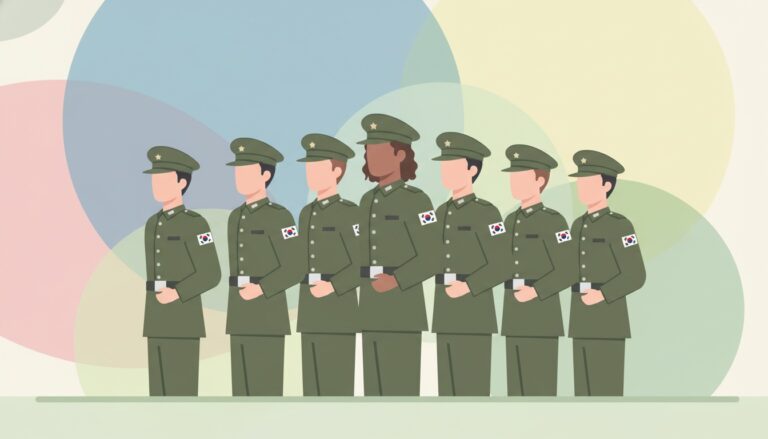
Have you ever watched the Korean news and felt like you were listening to a completely different language compared to your K-Dramas? While dramas show romance, real modern Korea is facing huge structural changes. One of the hottest topics right now is “demographics” (인구, In-gu) and the “military” (군대, Gun-dae).
Recently, I’ve noticed a pattern among my advanced students. (Synthesized Case) Many learners who read Korean newspapers ask me: “Teacher, I saw the word ‘Da-mun-hwa’ regarding the army. Does this mean the rules are changing?”
Today, we are stepping away from survival travel Korean and diving into C2-level Social Korean. These are the words you need to understand news articles, discuss social issues, or talk about the future of Korea with your Korean friends. Let’s learn the language of a changing Korea.
At a Glance: Today’s Summary
- Key Expressions:
- 다문화 가정 (Multicultural Family)
- 입대하다 (To Enlist)
- 융화되다 (To Harmonize/Blend in)
- 사회 진출 (Entry into Society)
- Safe Zone: Formal discussions, News analysis, Debates, University assignments.
- Difficulty: ⭐⭐⭐⭐⭐ (Advanced/C2) – Essential for understanding news headlines and social documentaries.
Table of Contents
- Today’s Deep Dive: Core Expressions
- Textbook vs. Real Korean
- Nuance Thermometer: Discussing Sensitive Topics
- Real-Life Role Play: Discussing the News
- Shadowing Challenge
- FAQ
- Wrap-up & Quiz
Today’s Core Expressions: Deep Dive
1. 다문화 가정 (Da-mun-hwa ga-jeong)
- Meaning: Multicultural family (International marriage families)
- Usage & Register:
- Context: Used in news, policy making, and formal conversation. It is the politically correct term in Korea.
- Tone: Neutral / Formal.
- Tutor’s Secret Note:
- While this is the official term, be careful not to use it as a label to single people out in casual settings. It emphasizes policy rather than friendship.
- Warning: Avoid asking “Are you ‘Da-mun-hwa’?” directly to a person. It sounds like you are categorizing them.
- Pronunciation Clinic:
- [다문화] is often pronounced smoothly. Note the ㅎ (h) sound in 화 (hwa) can be weak.
- Examples:
- News: 다문화 가정 출신 장병이 늘고 있습니다. (Da-mun-hwa ga-jeong chul-sin jang-byeong-i neul-go it-seum-ni-da.)
- The number of soldiers from multicultural families is increasing.
- Debate: 다문화 가정 지원 정책이 필요해요. (Da-mun-hwa ga-jeong ji-won jeong-chaek-i pi-ryo-hae-yo.)
- We need support policies for multicultural families.
- General: 한국은 점차 다문화 사회가 되고 있어요. (Han-guk-eun jeom-cha da-mun-hwa sa-hoe-ga doe-go i-sseo-yo.)
- Korea is gradually becoming a multicultural society.
- News: 다문화 가정 출신 장병이 늘고 있습니다. (Da-mun-hwa ga-jeong chul-sin jang-byeong-i neul-go it-seum-ni-da.)
- Substitutes:
- 이주 배경 가정 (I-ju bae-gyeong ga-jeong): Families with migration background (More academic/precise).
- 국제 결혼 가정 (Guk-je gyeol-hon ga-jeong): International marriage family (Descriptive).
👉 Mini Quiz: Fill in the blank (Click to open)
Q. Government policies for _____ are expanding.
____ 지원 정책이 확대되고 있습니다.
Answer: 다문화 가정 (Da-mun-hwa ga-jeong)
2. 입대하다 (Ip-dae-ha-da)
- Meaning: To enlist (in the military) / To join the army
- Usage & Register:
- Context: Specifically for joining the military service.
- Tone: Standard.
- Tutor’s Secret Note:
- Koreans distinguish between 가다 (to go) and 입대하다 (to enlist). “입대하다” sounds much more formal and emphasizes the start of official duty.
- This is a huge milestone for Korean men, including 2nd generation multicultural citizens.
- Pronunciation Clinic:
- [입때하다]: The ㅂ (p) bachiim makes the following ㄷ (d) sound like a tense ㄸ (tt).
- Examples:
- Friend: 제 친구는 다음 달에 입대해요. (Je chin-gu-neun da-eum dal-e ip-dae-hae-yo.)
- My friend is enlisting next month.
- News: 다문화 장병들의 입대율이 높아졌어요. (Da-mun-hwa jang-byeong-deul-ui ip-dae-yul-i no-pa-jyeo-sseo-yo.)
- The enlistment rate of multicultural soldiers has increased.
- Official: 육군에 입대하기로 결정했습니다. (Yuk-gun-e ip-dae-ha-gi-ro gyeol-jeong-haet-seum-ni-da.)
- I decided to enlist in the Army.
- Friend: 제 친구는 다음 달에 입대해요. (Je chin-gu-neun da-eum dal-e ip-dae-hae-yo.)
- Substitutes:
- 군대 가다 (Gun-dae ga-da): To go to the army (Casual).
- 복무하다 (Bok-mu-ha-da): To serve (Focus on the act of serving).
👉 Mini Quiz: Fill in the blank (Click to open)
Q. He _____ in the Navy last year.
그는 작년에 해군에 _____.
Answer: 입대했어요 (Ip-dae-hae-sseo-yo)
3. 융화되다 (Yung-hwa-doe-da)
- Meaning: To harmonize / To blend in / To integrate
- Usage & Register:
- Context: Used when different groups mix well together without conflict. Very common in articles about social integration.
- Tone: Advanced / Literary.
- Tutor’s Secret Note:
- This is a positive word. It implies that “we become one” rather than just existing side-by-side. It is the goal of a healthy society.
- Pronunciation Clinic:
- [융화되다]: Pronounce smoothly. ng sound in 융 connects to hw.
- Examples:
- Social: 서로 다른 문화가 잘 융화되어야 해요. (Seo-ro da-reun mun-hwa-ga jal yung-hwa-doe-eo-ya hae-yo.)
- Different cultures need to harmonize well.
- Workplace: 신입 사원이 팀에 빠르게 융화되었어요. (Sin-ip sa-won-i tim-e ppa-reu-ge yung-hwa-doe-eo-sseo-yo.)
- The new employee blended into the team quickly.
- Military: 군대는 다양한 사람들이 융화되는 곳입니다. (Gun-dae-neun da-yang-han sa-ram-deul-i yung-hwa-doe-neun got-im-ni-da.)
- The military is a place where diverse people harmonize.
- Social: 서로 다른 문화가 잘 융화되어야 해요. (Seo-ro da-reun mun-hwa-ga jal yung-hwa-doe-eo-ya hae-yo.)
- Substitutes:
- 어울리다 (Eo-ul-li-da): To get along (Casual/General).
- 적응하다 (Jeok-eung-ha-da): To adapt (Focus on the individual’s effort).
👉 Mini Quiz: Fill in the blank (Click to open)
Q. It is important to _____ with Korean society.
한국 사회에 _____ 것이 중요해요.
Answer: 융화되는 (Yung-hwa-doe-neun)
Textbook vs. Real Korean
How do newspapers describe young people from multicultural backgrounds compared to textbooks?
| Situation | Textbook / General (Book Korean) | News / Real Society (Real Korean) | Usage Note |
|---|---|---|---|
| Naming | 혼혈 (Hon-hyeol) (Mixed blood) |
다문화 가정 2세 (Da-mun-hwa ga-jeong i-se) (2nd Gen Multicultural Family) |
“Hon-hyeol” is considered outdated and can be offensive. Use the descriptive term. |
| People | 외국인 (Oe-guk-in) (Foreigner) |
이주 배경 청소년 (I-ju bae-gyeong cheong-so-nyeon) (Youth with migrant background) |
More precise for policy/social stats. They are often Korean citizens, not foreigners. |
Deep Analysis: Nuance Thermometer 🌡️
Topic: Asking about background/identity
Since this is a sensitive topic, the “temperature” (politeness) of your question matters immensely. See how the distance changes.
| Level | Expression | Nuance | Risk Level |
|---|---|---|---|
| 1. Cold/Rude | “너 혼혈이야?” (Are you mixed blood?) |
Very direct, focuses on biology. Can be offensive. | 🚨 High |
| 2. Curious/Direct | “부모님 중 한 분이 외국인이세요?” (Is one of your parents a foreigner?) |
Fact-based, but still personal for a first meeting. | ⚠️ Medium |
| 3. Professional | “다문화 배경을 가지고 계신가요?” (Do you have a multicultural background?) |
Used in interviews or formal surveys. Dry but polite. | ✅ Safe (Formal) |
| 4. Warm/Indirect | “어릴 때 외국에서 살다 오셨어요?” (Did you live abroad when you were young?) |
Giving them space to explain their background themselves. | 🌸 Recommended |
Real-Life Role Play: Discussing the News 📰
Situation: At a cafe, discussing a news clip about the first multicultural officer in the Korean military.
Characters: Minji (Korean), Alex (Foreigner interested in Korean society).
Alex: (Looking at phone) 와, 이 기사 봤어? 다문화 가정 출신 장교가 임관했대.
(Wa, i gi-sa bwa-sseo? Da-mun-hwa ga-jeong chul-sin jang-gyo-ga im-gwan-haet-dae.)
Wow, did you see this article? A commissioned officer from a multicultural family has been appointed.
Minji: 정말? 예전에는 상상하기 힘들었는데, 한국 사회가 진짜 변하고 있나 봐.
(Jeong-mal? Ye-jeon-e-neun sang-sang-ha-gi him-deul-eot-neun-de, Han-guk sa-hoe-ga jin-jja byeon-ha-go it-na bwa.)
Really? It was hard to imagine in the past, but Korean society seems to be really changing.
Alex: 맞아. 군대에서 잘 융화될 수 있을까 걱정하는 댓글도 있네.
(Ma-ja. Gun-dae-e-seo jal yung-hwa-doel su i-sseul-kka geok-jeong-ha-neun daet-geul-do it-ne.)
Right. There are also comments worrying if they can harmonize/blend in well in the army.
Minji: 에이, 요즘은 젊은 친구들의 인식이 많이 달라졌어. 실력만 있으면 인정받는 거지.
(Ei, yo-jeum-eun jeol-meun chin-gu-deul-ui in-sik-i ma-ni dal-la-jyeo-sseo. Sil-ryeok-man i-sseu-myeon in-jeong-bat-neun geo-ji.)
Hey, young people’s perceptions have changed a lot these days. If you have the skill, you get recognized.
Alex: 다행이다. 앞으로 이런 사회 진출이 더 많아지면 좋겠어.
(Da-haeng-i-da. Ap-eu-ro i-reon sa-hoe jin-chul-i deo ma-na-ji-myeon jo-ke-sseo.)
That’s a relief. I hope there is more social entry like this in the future.
Shadowing Challenge 🗣️
Imagine you are commenting on the news. Speak with conviction!
“Diversity is not a problem, but a new strength for our society.”
Script:
다양성은 문제가 아니라, 우리 사회의 새로운 경쟁력입니다.
(Da-yang-seong-eun mun-je-ga a-ni-ra, u-ri sa-hoe-ui sae-ro-un gyeong-jaeng-ryeok-im-ni-da.)
Checklist:
– [ ] 1st Attempt (Read slowly)
– [ ] 2nd Attempt (Focus on intonation of ‘경쟁력’)
– [ ] 3rd Attempt (Speed of a news anchor)
💡 Pronunciation Tip: 경쟁력 (Competitiveness) is pronounced [경쟁녁 (Gyeong-jaeng-nyeok)] due to nasalization rules!
FAQ: Daily Hangul Answers
Q1: Is military service mandatory for dual citizens (Korean + Other)?
A: Generally, yes. If a male holds Korean citizenship (even if dual), he has the duty of 국방의 의무 (Guk-bang-ui ui-mu – Duty of national defense). To avoid it, one usually has to renounce Korean citizenship before age 18.
Q2: Can I use the word “혼혈 (Hon-hyeol)” to my friend?
A: It is better to avoid it. Even if some people still use it, it carries a nuance of focusing on “blood purity.” Using 다문화 배경 (Multicultural background) is much more respectful and educated.
Wrap-up & Next Steps
Today we tackled a heavy but important topic: Demographics and the Military. Korea is moving towards a multicultural society, and the language is evolving to reflect that.
Today’s Mission:
* Find a Korean news clip on YouTube using the keyword “다문화 군대” (Multicultural Army).
* Listen for the word 입대 or 융화. If you hear it, nod and say, “I know that word!”
Tell me in the comments:
Does your country have mandatory military service? How do people talk about it?
Final Pop Quiz 📝
- Which word is the most polite/formal way to describe families with international marriages?
A) 혼혈 가정 (Hon-hyeol ga-jeong)
B) 다문화 가정 (Da-mun-hwa ga-jeong)
C) 외국인 집 (Oe-guk-in jip) -
What is the verb for “to enlist” in the military?
A) 입학하다 (Ip-hak-ha-da)
B) 입사하다 (Ip-sa-ha-da)
C) 입대하다 (Ip-dae-ha-da) -
Fill in the blank: “We need to _____ well with the new team members.”
“새로운 팀원들과 잘 ( )되어야 해요.”
Answers:
1. B
2. C
3. 융화 (Yung-hwa)
Frequently Asked Questions (FAQ)
Q: What does "다문화 가정 (Da-mun-hwa ga-jeong)" mean in Korean and how do you pronounce it?
A: In Korean, "다문화 가정 (Da-mun-hwa ga-jeong)" is pronounced [see lesson guide] and means: Multicultural family (International marriage families)
Q: What does "입대하다 (Ip-dae-ha-da)" mean in Korean and how do you pronounce it?
A: In Korean, "입대하다 (Ip-dae-ha-da)" is pronounced [see lesson guide] and means: To enlist (in the military) / To join the army
Q: What does "융화되다 (Yung-hwa-doe-da)" mean in Korean and how do you pronounce it?
A: In Korean, "융화되다 (Yung-hwa-doe-da)" is pronounced [see lesson guide] and means: To harmonize / To blend in / To integrate







