

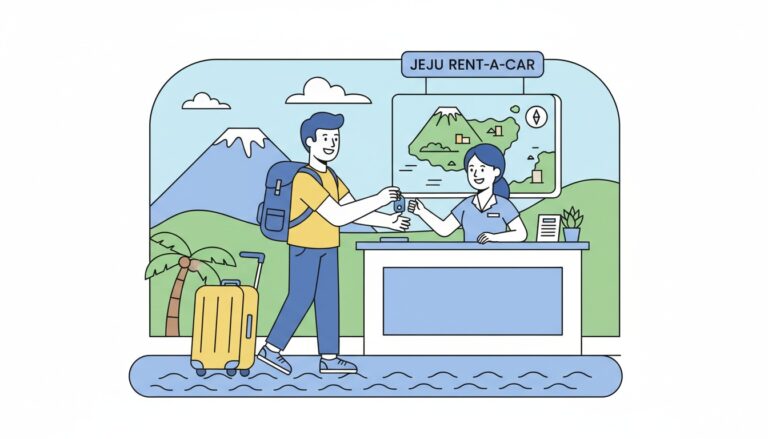
Driving in Korea? 3 Phrases to Rent a Car Without Panic
Introduction
Hello, this is Daily Hangul!
Are you planning a road trip to Jeju Island or a drive along the East Sea coast? Renting a car gives you freedom, but the language barrier at the rental counter can be terrifying. You don’t want to accidentally sign up for the wrong insurance or fail to set up the GPS, right?
Here is a synthetic case based on frequent learner feedback:
“Mark,” a learner planning a trip to Jeju, told me he was confident until the clerk asked about “Jacha” (insurance). He panicked, just nodded, and later realized he had zero coverage. Another student couldn’t figure out how to input the address into the Korean GPS and spent 30 minutes in the parking lot.
Textbooks teach you “I would like to rent an automobile,” but in reality, things move much faster. Today, we will learn the survival phrases to get your keys and hit the road safely.
At a Glance: Today’s Takeaways
- Key Phrases: Confirming reservations, Choosing full insurance, Asking for GPS help.
- Safe Zone: Use these at airport rental desks or rental offices throughout Korea.
- Level: B1 (Intermediate) – Essential because rental contracts involve money and legal responsibility. You need to be precise.
Table of Contents
- Deep Dive: 3 Essential Expressions
- Textbook vs. Real Korean
- Unique Analysis: The ‘Maltu’ Thermometer
- Role Play: At the Jeju Airport Rental Desk
- Shadowing Challenge
- FAQ & Wrap-up
Deep Dive: 3 Essential Expressions
1. 예약 확인해 주세요 (Please confirm my reservation)
- Pronunciation: Yeyak hwaginhae juseyo
- Meaning: Please check/confirm my reservation.
Usage & Register:
* To whom: The staff at the rental desk.
* Tone: Haeyo-che (Polite Informal) – Friendly yet respectful. Ideal for service interactions.
Tutor’s Secret Note:
Most foreigners book online beforehand. Don’t say “I want to rent a car” (which sounds like you walked in without a plan). Instead, start with “I have a reservation.” It speeds up the process significantly.
Pronunciation Clinic:
* Ye-yak (예약): Pronounce the ‘Ye’ clearly. Don’t slur it into ‘Yak’.
* Hwagin (확인): The ‘H’ is soft, almost like a sigh.
Examples:
1. 제 이름으로 예약 확인해 주세요.
(Je ireumeuro yeyak hwaginhae juseyo.)
Please confirm the reservation under my name.
2. 인터넷으로 예약했어요.
(Inteoneseuro yeyakaesseoyo.)
I made a reservation online.
3. 예약 번호 여기 있습니다.
(Yeyak beonho yeogi itseumnida.)
Here is my reservation number.
Alternatives:
* More Formal: 예약 확인 부탁드립니다. (Yeyak hwagin butakdeurimnida.)
* Casual (Not recommended for staff): 예약했는데. (Yeyakaenneunde.)
Mini Quiz (Click to see answer)
Q. Fill in the blank: “_______ number here.”
( ________ 번호 여기 있습니다. )
Answer: 예약 (Yeyak)
2. 완전 자차로 할게요 (I’ll take full coverage insurance)
- Pronunciation: Wanjeon jacharo halgeyo
- Meaning: I will go with the full collision damage waiver.
Usage & Register:
* To whom: Rental staff when discussing insurance options.
* Tone: Haeyo-che – Decisive and polite.
Tutor’s Secret Note:
This is the most important phrase today.
* 일반 자차 (Ilban jacha): Basic coverage (you pay a deductible if you scratch the car).
* 완전 자차 (Wanjeon jacha): Full coverage (usually zero deductible).
* Warning: If you just say “Yes” to everything, you might end up with basic coverage. Explicitly say “Wanjeon jacha” for peace of mind.
Pronunciation Clinic:
* Ja-cha (자차): Short for Jadongcha (Car). Pronounce ‘Ja’ and ‘Cha’ sharply.
Examples:
1. 보험은 완전 자차로 해 주세요.
(Boheomeun wanjeon jacharo hae juseyo.)
Please set the insurance to full coverage.
2. 완전 자차 포함인가요?
(Wanjeon jacha pohamingayo?)
Is full coverage included?
3. 일반 자차 말고 완전 자차로 변경할게요.
(Ilban jacha malgo wanjeon jacharo byeongyeonghalgeyo.)
I’ll change from basic to full coverage.
Alternatives:
* Asking regarding coverage: 풀 커버 되나요? (Pul keobeo doenayo? – Konglish acts often work!)
Mini Quiz
Q. Which word means “Full/Complete” in this context?
Answer: 완전 (Wanjeon)
3. 내비게이션은 어떻게 써요? (How do I use the GPS?)
- Pronunciation: Naebigeisyeoneun eotteoke sseoyo?
- Meaning: How do I use the navigation system?
Usage & Register:
* To whom: The staff showing you the car.
* Tone: Haeyo-che.
Tutor’s Secret Note:
Korean GPS systems are amazing but can be tricky if they are in Korean.
* Pro Tip: Ask the staff to set the language to English (Yeong-eo).
* Secret Tip: In Korea, we search by Phone Number not address! It is much faster.
Pronunciation Clinic:
* Nae-bi (내비): Short for Navigation. Stress the first syllable.
Examples:
1. 영어로 설정해 주실 수 있나요?
(Yeong-eoro seoljeonghae jusil su innayo?)
Can you set it to English?
2. 전화번호로 검색 되나요?
(Jeonhwabeonhoro geomsaek doenayo?)
Can I search by phone number?
3. 블루투스 연결은 어떻게 해요?
(Beullutuseu yeongyeoreun eotteoke haeyo?)
How do I connect Bluetooth?
Textbook vs. Real Korean
| Context | Book Korean (Too stiff/Formal) | Real Korean (Natural/Efficient) |
|---|---|---|
| Opening | 자동차를 빌리고 싶습니다. (I wish to rent an automobile.) |
예약 확인 좀 해 주세요. (Please check my reservation.) |
| Returning | 자동차를 반납하겠습니다. (I will return the automobile.) |
차 반납하러 왔어요. (I came to return the car.) |
Situation Checklist:
* Online Booking? -> Use Real Korean.
* Writing a formal email? -> Use Book Korean.
Unique Analysis: The ‘Maltu’ (Tone) Thermometer
In a busy rental office (especially at airports), efficiency is key. Let’s see how the “politeness distance” changes.
| Level | Expression | Feel | Recommendation |
|---|---|---|---|
| 1. Too Cold | 차 줘. (Give me a car.) | Rude/Aggressive. Never use this. | ❌ |
| 2. Cool & Fast | 예약했는데요. (I made a reservation.) | Efficient. Common in busy queues. | ⭕ (Good) |
| 3. Warm & Polite | 예약 확인 부탁드려요. (Please check…) | Respectful. Best for first interaction. | ✅ (Best) |
| 4. Overly Hot | 귀사의 자동차를 임차하고 싶사옵니다. | Sounds like a historical drama. Staff will be confused. | ❌ |
Real Scenario Role Play: At Jeju Airport
Setting: A busy rental car counter at Jeju International Airport.
Characters: You (Traveler), Staff (Rental Clerk)
Staff: 어서 오세요. 예약하셨나요?
(Eoseo oseyo. Yeyakhasyeonnayo?)
Welcome. Did you make a reservation?
You: 네, 제 이름으로 예약 확인해 주세요.
(Ne, je ireumeuro yeyak hwaginhae juseyo.)
Yes, please confirm the reservation under my name.
Staff: 네, 여권이랑 국제면허증 주시겠어요?
(Ne, yeogwonirang gukjemyeonheojeung jusigesseoyo?)
Sure, can I have your passport and International Driving Permit?
You: 여기요. 아, 그리고 보험은 완전 자차 맞나요?
(Yeogiyo. A, geurigo boheomeun wanjeon jacha mannayo?)
Here. Ah, and is the insurance full coverage?
Staff: 네, 맞습니다. 차량은 3구역에 있습니다.
(Ne, matseumnida. Charyangeun sam-guyeoge itseumnida.)
Yes, that’s correct. The car is in Zone 3.
You: 감사합니다. 내비게이션은 영어로 되나요?
(Gamsahamnida. Naebigeisyeoneun yeong-eoro doenayo?)
Thank you. Does the GPS work in English?
💡 Culture Tip:
Always have your International Driving Permit (IDP) ready physically. Digital copies are often rejected!
Shadowing & Speaking Challenge
Repeat this script 3 times to build muscle memory!
“예약 확인해 주세요. 완전 자차로 하고 싶어요.”
(Yeyak hwaginhae juseyo. Wanjeon jacharo hago sipeoyo.)
Checklist:
– [ ] 1st Try: Read slowly looking at the text.
– [ ] 2nd Try: Don’t look at the text, focus on intonation.
– [ ] 3rd Try: Imagine you are at the counter and say it confidently.
⚠️ Pronunciation Point:
When saying 완전 (Wanjeon), make sure the ‘n’ (ㄴ) sound is clear. It distinguishes it from other words.
FAQ (Frequently Asked Questions)
Q1: Can I rent a car with just my home country’s license?
A: No. You strictly need an International Driving Permit (IDP) issued in your home country before you leave.
* Phrase: 국제 면허증 있어요. (Gukje myeonheojeung isseoyo. – I have an IDP.)
Q2: What if I scratch the car?
A: If you chose “Wanjeon Jacha” (Full Coverage), usually you are safe. If not, call the rental company immediately.
* Phrase: 차에 기스가 났어요. (Chae giseuga nasseoyo. – The car got scratched.)
Conclusion & Action Item
Renting a car in Korea is the start of an amazing adventure. Remember: “Reservation (Yeyak), Full Coverage (Wanjeon Jacha), GPS (Naebi).”
Today’s Mission:
Next time you are in a car (even a taxi or your own), point to the GPS and say “Naebigeishyeon” out loud 3 times!
Comment below:
Have you ever driven in a foreign country? What was the hardest part? Let me know!
Final Quiz
Click to start the quiz!
- Which phrase is best for “Full Coverage Insurance”?
A) 일반 자차 (Ilban jacha)
B) 완전 자차 (Wanjeon jacha)
C) 자동차 (Jadongcha) -
How do Koreans usually search for locations on a GPS?
A) By Phone Number
B) By Zip Code
C) By Photo -
Fill in the blank: “Please check my reservation.”
= _______ 확인해 주세요.
Answers:
1. B
2. A
3. 예약 (Yeyak)
Frequently Asked Questions (FAQ)
Q: What does "예약 확인해 주세요 (Please confirm my reservation)" mean in Korean and how do you pronounce it?
A: In Korean, "예약 확인해 주세요 (Please confirm my reservation)" is pronounced [Yeyak hwaginhae juseyo] and means: Please check/confirm my reservation.
Q: What does "완전 자차로 할게요 (I'll take full coverage insurance)" mean in Korean and how do you pronounce it?
A: In Korean, "완전 자차로 할게요 (I'll take full coverage insurance)" is pronounced [Wanjeon jacharo halgeyo] and means: I will go with the full collision damage waiver.
Q: What does "내비게이션은 어떻게 써요? (How do I use the GPS?)" mean in Korean and how do you pronounce it?
A: In Korean, "내비게이션은 어떻게 써요? (How do I use the GPS?)" is pronounced [Naebigeisyeoneun eotteoke sseoyo?] and means: How do I use the navigation system?







