

Introduction
Hello, this is Daily Hangul! 👋
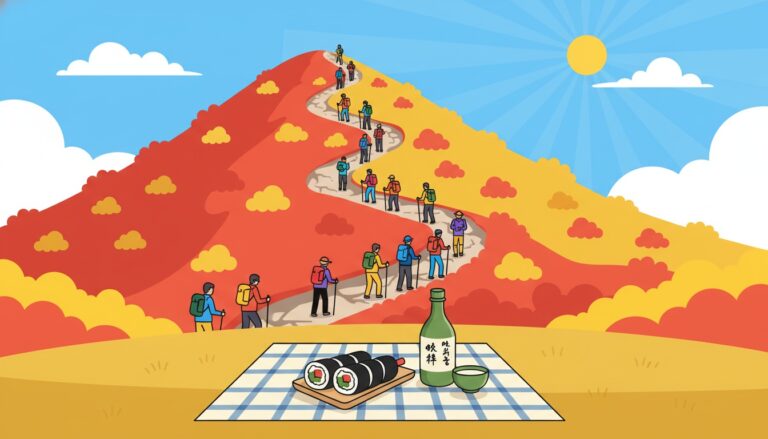
Is your Instagram feed filling up with red and yellow trees? That means “Danpung (Autumn Foliage)” season has arrived in Korea!
Today, we are going to talk about Hiking (Deungsan), the national pastime of Korea, especially in autumn.
Composite Case Study (Based on frequent learner experiences):
Many of our students often report a “culture shock” when visiting mountains like Bukhansan or Seoraksan for the first time. It wasn’t the steep trails that surprised them—it was the gear. They saw hundreds of people dressed in head-to-toe professional hiking brand gear, even on easy trails!
One student, “Mark,” shared that he felt underdressed in just a t-shirt and shorts. But don’t worry! You don’t need expensive gear to enjoy the view. You just need the right attitude and a few key Korean phrases to blend in.
Korean hiking isn’t just about walking up a hill; it’s about the “Danpung” (foliage), the shared snacks (cucumbers!), and the “Makgeolli” (rice wine) waiting at the bottom. Let’s learn how to hike like a local!
Summary: At a Glance
- Today’s Expressions: Essential phrases for describing autumn leaves and hiking struggles.
- Safe Usage: Suitable for friends, hiking clubs, and casual encounters on the trail.
- Level (B2): These phrases go beyond simple survival. They help you express feelings about nature and understand the unique “social culture” of Korean hiking.
Table of Contents
- Today’s Deep Dive Expressions
- Textbook vs. Real Korean
- Culture Analysis: The “Hiking Snack” Code
- Real-Life Scenario: Planning a Hike
- Shadowing Challenge
- FAQ
Today’s Core Expressions: Deep Dive
1. 단풍이 절정이에요 (Danpung-i jeoljeong-ieyo)
- Meaning: The autumn foliage is at its peak.
- Usage & Register:
- Target: Friends, coworkers, or even strangers on the mountain taking photos.
- Tone: Polite informal (Haeyo-che / 해요체).
- Tutor’s Secret Note:
- “Danpung” isn’t just “leaves”; it specifically refers to the changing colors of autumn.
- “Jeoljeong” (Peak/Climax) is the magic word news anchors use. Using this makes you sound very knowledgeable about the season.
- Pronunciation Clinic:
- Jeol-jeong: The ‘jeong’ is pronounced with a bit of stress. Make sure to articulate the ‘ng’ (ㅇ) sound clearly at the end.
- Examples:
- Seoraksan-eun danpung-i jeoljeong-ieyo. (The foliage in Seoraksan is at its peak.)
- Ibeon ju-mal-i danpung jeoljeong-il geoyeyo. (This weekend will be the peak of the foliage.)
- Waa, yeogi danpung-i jeoljeong-ineyo! (Wow, the foliage here is at its peak!)
- Alternatives:
- Polite: 단풍이 참 아름답습니다. (Danpung-i cham areumdapseumnida – The foliage is very beautiful.)
- Casual: 단풍 대박이다! (Danpung daebak-ida! – The foliage is awesome!)
Mini Quiz (Click to see answer)
Fill in the blank: “Next week, the foliage will be at its ______.”
다음 주에 단풍이 ______일 거예요.
Answer: 절정 (jeoljeong)
2. 정상까지 얼마나 남았어요? (Jeongsang-kkaji eolmana namasseoyo?)
- Meaning: How much further is it to the peak?
- Usage & Register:
- Target: Passing hikers coming down while you are going up.
- Tone: Polite informal (Haeyo-che).
- Tutor’s Secret Note:
- Warning: Koreans are famously optimistic on mountains. If they say “eolma an namasseoyo” (not much left) or “da wasseoyo” (almost there), do not trust them 100%. It usually means you have at least 20 more minutes of hard climbing!
- Pronunciation Clinic:
- Nam-a-sseo-yo: Connect the sound. Pronounce it like [Na-ma-sseo-yo] (나마써요).
- Examples:
- Jeongsang-kkaji eolmana namasseoyo? (How much further to the peak?)
- Hwajangsil-kkaji eolmana namasseoyo? (How far is the restroom?)
- Jeongsang-eun ajik meoreosseoyo? (Is the peak still far away?)
- Alternatives:
- Casual: 아직 멀었어? (Ajik meoreosseo? – Is it still far?)
- More Formal: 정상까지 소요 시간이 얼마나 됩니까? (Jeongsang-kkaji soyo sigan-i eolmana doemnikka? – How much time does it take to the peak?)
3. 하산하고 파전에 막걸리 어때요? (Hasan-hago pajeon-e makgeolli eottaeyo?)
- Meaning: How about Pajeon (Green onion pancake) and Makgeolli (Rice wine) after going down?
- Usage & Register:
- Target: Hiking buddies.
- Tone: Suggestive/Inviting (Haeyo-che).
- Tutor’s Secret Note:
- For many Koreans, hiking is just the excuse to eat tasty food afterward. This phrase is the “golden key” to making local friends. The combination of Pajeon and Makgeolli is the traditional post-hike reward.
- Pronunciation Clinic:
- Mak-geol-li: The double ‘l’ (ㄹㄹ) creates a rolling L sound. Not “Mak-geo-ri”, but “Mak-geol-li”.
- Examples:
- Deungsan kkeunna-go makgeolli hanjan haeyo. (Let’s have a glass of makgeolli after hiking.)
- Oneul-eun pajeon-e makgeolli-ga ttaeng-gyeo-yo. (Today, I’m craving pajeon and makgeolli.)
- Naeryeoga-seo mwo meogeulkkayo? (What shall we eat after going down?)
- Alternatives:
- Polite: 내려가서 식사 같이 하실래요? (Naeryeoga-seo siksa gachi hasillaeyo? – Would you like to eat together after going down?)
- Casual: 등산 후엔 막걸리지! (Deungsan hu-en makgeolli-ji! – After hiking, it has to be makgeolli!)
Textbook vs. Real Korean
| Context | Textbook Korean (Book) | Real Korean (Street/Mountain) |
|---|---|---|
| Hobbies | 제 취미는 등산입니다. (Je chwimi-neun deungsan-imnida) My hobby is mountain climbing. |
전 산 타는 거 좋아해요. (Jeon san taneun geo joahaeyo) I like “riding” (climbing) mountains. |
| Exhaustion | 너무 힘듭니다. (Neomu himdeumnida) It is too difficult. |
아이고, 죽겠다! (Aigo, jukgetda!) Oh my, I’m dying! (Used affectionately/jokingly) |
Situation Checklist:
* Use Textbook Korean when introducing yourself formally at a business meeting.
* Use Real Korean when chatting with friends or struggling halfway up the trail.
Unique Analysis: The “Hiking Snack” Culture 🥒
The Secret of the Cucumber (Oi / 오이)
If you go hiking in Korea, you will see many people eating whole cucumbers like ice pops. Why?
| Item | Function | Meaning |
|---|---|---|
| Cucumber (Oi) | Hydration without heaviness. | “I am a pro hiker.” |
| Cup Ramyeon | Warmth & Salt. | “I carried hot water all the way up here for this moment.” |
| Chocolate Bar | Quick Energy. | Emergency fuel. |
Pro Tip: If someone offers you a piece of fruit or cucumber, accept it with a smile and say “Jal meok-get-seumnida” (I will eat it well). Sharing food is a huge part of hiking culture (Jeong / 정).
Role Play: Planning a Weekend Hike 🍂
Setting: A cafe in Seoul. Friends Minji (Korean) and Alex (Foreigner) are discussing weekend plans.
Alex: 이번 주말에 날씨 좋은데, 뭐 할까?
(Ibeon jumal-e nalssi joeunde, mwo halkka?)
Weather is good this weekend, what should we do?
Minji: 단풍이 절정이라던데, 우리 등산 갈래?
(Danpung-i jeoljeong-iradeonde, uri deungsan gallae?)
I heard the foliage is at its peak, wanna go hiking?
Alex: 좋아! 그런데 나 초보자야. 정상까지 얼마나 걸려?
(Joa! Geureonde na choboja-ya. Jeongsang-kkaji eolmana geollyeo?)
Sounds good! But I’m a beginner. How long does it take to the peak?
Minji: 아차산은 쉬워. 1시간이면 충분해.
(Achasan-eun swiwo. Han-sigan-imyeon chungbunhae.)
Mt. Achasan is easy. 1 hour is enough.
Alex: 오케이. 그럼 내려와서 파전에 막걸리 콜?
(Okay. Geureom naeryeowa-seo pajeon-e makgeolli call?)
Okay. Then Pajeon and Makgeolli after coming down, deal?
Minji: 당연하지! 그게 등산의 묘미지.
(Dangyeonhaji! Geuge deungsan-ui myomi-ji.)
Of course! That’s the real joy of hiking.
💡 Cultural Tip: In Korea, “Call?” (콜?) is a slang way to say “Deal?” or “I’m in!”
Shadowing Challenge 🗣️
Mission: Repeat this sentence 3 times to sound natural on the mountain.
“힘내세요! 거의 다 왔어요!”
(Him-nae-se-yo! Geo-ui da wa-sseo-yo!)
“Cheer up! We’re almost there!”
- [ ] Attempt 1 (Slow)
- [ ] Attempt 2 (Normal Speed)
- [ ] Attempt 3 (Cheerfully, like you are encouraging a tired friend)
Pronunciation Point: Link “da” and “wasseoyo” smoothly. Focus on the enthusiastic intonation!
FAQ: Hiking in Korea 🏔️
Q1: Do I really need expensive hiking gear for mountains in Seoul?
A: Not necessarily for beginners! For mountains like Namsan or Inwangsan, sneakers are fine. But for Bukhansan or Seoraksan (rocky terrain), Deungsanhwa (Hiking boots) are strongly recommended for safety. Koreans love gear, but safety comes first.
Q2: Can I drink alcohol on the mountain?
A: It depends. Drinking is illegal at the peak and on specific designated trails in National Parks to prevent accidents. Save the Makgeolli for the restaurants at the base of the mountain (Deung-san-ro entrance). It tastes better there anyway!
Conclusion & Today’s Mission
Hiking in Korea is a beautiful blend of nature, exercise, and social eating. Don’t be afraid to join the “Red Wave” of autumn hikers this weekend!
📝 Today’s Mission:
Next time you walk past a mountain or a park with autumn trees, say out loud: “Waa, danpung-i jeoljeong-ineyo!” (Wow, the foliage is at its peak!)
Question for you: Have you ever tried “Makgeolli”? What is your favorite hiking snack? Tell me in the comments!
Final Quiz 🧠
Click to test your knowledge!
- What is the Korean word for “Autumn Foliage”?
- A) Gwang-an-li
- B) Danpung
- C) Kimchi
- What does a Korean hiker usually mean by “We are almost there”?
- A) We are literally 1 minute away.
- B) We have arrived.
- C) Keep going, it’s still a long way (encouragement).
- Fill in the blank: After hiking, Koreans often eat Pajeon and drink ______.
- (Answer: Makgeolli)
Answers: 1-B, 2-C, 3-Makgeolli
Frequently Asked Questions (FAQ)
Q: What does "단풍이 절정이에요 (Danpung-i jeoljeong-ieyo)" mean in Korean and how do you pronounce it?
A: In Korean, "단풍이 절정이에요 (Danpung-i jeoljeong-ieyo)" is pronounced [see lesson guide] and means: The autumn foliage is at its peak.
Q: What does "정상까지 얼마나 남았어요? (Jeongsang-kkaji eolmana namasseoyo?)" mean in Korean and how do you pronounce it?
A: In Korean, "정상까지 얼마나 남았어요? (Jeongsang-kkaji eolmana namasseoyo?)" is pronounced [see lesson guide] and means: How much further is it to the peak?
Q: What does "하산하고 파전에 막걸리 어때요? (Hasan-hago pajeon-e makgeolli eottaeyo?)" mean in Korean and how do you pronounce it?
A: In Korean, "하산하고 파전에 막걸리 어때요? (Hasan-hago pajeon-e makgeolli eottaeyo?)" is pronounced [see lesson guide] and means: How about Pajeon (Green onion pancake) and Makgeolli (Rice wine) after going down?







