

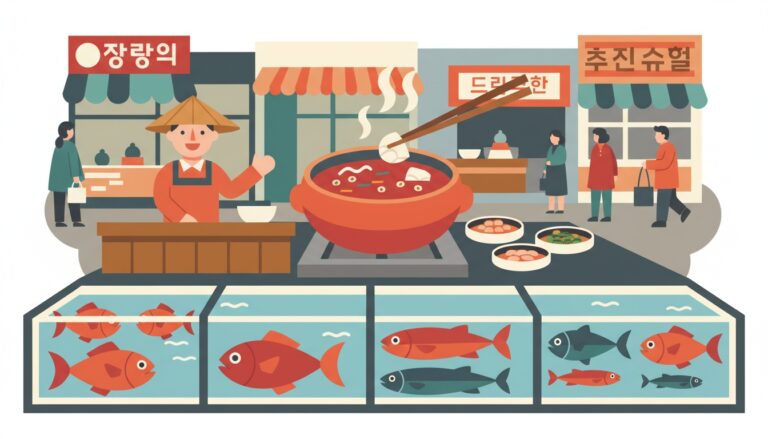
Don’t Panic at the Seafood Market! 🐟 How to Order the Best Maeuntang Like a Pro
Hello, everyone! It’s your favorite Korean tutor, Daily Hangul! 😊
Have you ever walked into a Korean seafood market (like Noryangjin or Jagalchi)? It’s chaotic, loud, and full of energy, right?
I remember one of my students, Mike, went to a sashimi restaurant near the ocean. He wanted to order that spicy, boiling red fish stew he saw in the K-Drama Hometown Cha-Cha-Cha. But when the owner asked, “Which fish do you want?” he froze! He just pointed at the most expensive one and ended up paying $100 for a soup! 😱
Today, I’m going to save your wallet and your taste buds. Let’s learn how to choose the perfect fish for Maeuntang (Spicy Fish Stew) like a local expert.
1. Today’s Core Expressions (Deep Dive)
To get the best stew, you need to know who the “King of Broth” is. Here are the top 3 terms you need.
1. 우럭 (Ureok)
- Pronunciation: [U-reok]
- Meaning: Rockfish
[Tutor’s Secret Note 🤫]
Listen closely! If you want a delicious, oily, and rich broth, Ureok is the answer. While Gwang-eo (Flatfish) is popular for Sashimi, Ureok is the absolute champion for Maeuntang because the head and bones create a deep flavor. When in doubt? Just shout “Ureok!”
[Pronunciation Clinic 🗣️]
Don’t say “U-rock.” The ‘eo’ (어) sound is deeper, like the ‘u’ in “cup.” Connect the sounds smoothly: U-reok.
2. 매운탕거리 (Maeuntang-geori)
- Pronunciation: [Mae-un-tang-geo-ri]
- Meaning: Fish parts specifically for stew (usually heads and bones left after sashimi)
[Tutor’s Secret Note 🤫]
This is a budget-saver hack! If you eat Sashimi, you can ask for Maeuntang-geori. Often, they will give you the spicy stew for a very cheap price (or sometimes free as ‘Service’) because you already bought the fish meat!
3. 얼큰하게 (Eol-keun-ha-ge)
- Pronunciation: [Eol-keun-ha-ge]
- Meaning: Spicy and refreshing (Make it spicy!)
[Tutor’s Secret Note 🤫]
This isn’t just “spicy” (Maep-ge). Eol-keun-ha-ge describes that satisfying feeling when hot, spicy soup hits your stomach and makes you say “Ahhh~.” It implies a rich, deep spice that cures a hangover.
2. Textbook vs. Real Korean (Context Comparison)
Don’t sound like a robot! Here is how to sound natural at the market.
📘 Book Korean (Too Formal)
* “어떤 생선이 매운탕에 좋습니까?” (Eotteon saengseoni maeuntange joseumnikka?)
* Translation: Which fish is good for spicy fish stew?
* Vibe: You sound like you are interviewing the fish.
🔥 Real Korean (Street Smart)
* “사장님, 오늘 매운탕 뭐가 좋아요?” (Sajangnim, oneul maeuntang mwoga joayo?)
* Translation: Boss, what’s good for stew today?
* Vibe: Friendly, casual, and trusts the owner’s recommendation.
3. Real Life Scenario (Role Play)
📍 Setting: A bustling seafood restaurant near the beach in Sokcho.
Daily Hangul: (Looking at the menu) 사장님, 여기 매운탕 주세요! (Boss, give us Maeuntang please!)
Owner: 어떤 고기로 해드릴까요? (Which fish should I use?)
Daily Hangul: 국물 맛있는 걸로 추천해주세요. (Please recommend one with tasty broth.)
Owner: 그럼 우럭이 최고지! (Then Ureok is the best!)
Daily Hangul: 좋아요! 우럭으로 얼큰하게 해주세요! (Great! Please make it spicy with Ureok!)
[Culture Tip 💡] The “Cheek Meat” Delicacy
In Korea, the fish head is considered the tastiest part of the stew, specifically the cheek meat (bolsal). It has a chewy texture unlike the body meat. If you are eating with a Korean elder or a boss, offering them the fish head is a sign of respect (and they will love the cheek meat)!
4. FAQ – Questions My Students Ask
Q1: I can’t eat spicy food! Can I still order this?
A: Absolutely! You can ask for “Jiri” (지리) instead of Maeuntang. Jiri is a clear, non-spicy fish soup. Just say: “Ureok Jiri-ro juseyo” (Please give me Ureok clear soup).
Q2: Can I order Maeuntang without ordering Sashimi first?
A: Yes! This is called “Tong-Maeuntang” (통매운탕). “Tong” means “Whole.” It means they put the entire fish into the soup, not just the leftover bones. It’s more expensive but much more delicious and filling!
5. Daily Mission & Quiz
Today, we learned that Ureok is the King of Stews and Eol-keun-ha-ge is the magic word for delicious spice! 🐟
🌟 Today’s Mission:
Next time you watch a Mukbang or a K-Drama scene with seafood, check if the soup is Red (Maeuntang) or Clear (Jiri). If it’s red, imagine ordering it by saying “Eol-keun-ha-ge juseyo!”
⬇️ Pop Quiz ⬇️
Which fish did I say creates the best, richest broth for stew?
1. Gwang-eo (Flatfish)
2. Ureok (Rockfish)
3. Yeon-eo (Salmon)
(Scroll down for the answer)
.
.
.
.
.
Answer: 2. Ureok! (Don’t forget it!)
Frequently Asked Questions (FAQ)
Q: What does "매운탕거리 (Maeuntang-geori)" mean in Korean and how do you pronounce it?
A: In Korean, "매운탕거리 (Maeuntang-geori)" is pronounced [Mae-un-tang-geo-ri] and means: Fish parts specifically for stew (usually heads and bones left after sashimi)
Q: What does "얼큰하게 (Eol-keun-ha-ge)" mean in Korean and how do you pronounce it?
A: In Korean, "얼큰하게 (Eol-keun-ha-ge)" is pronounced [Eol-keun-ha-ge] and means: Spicy and refreshing (Make it spicy!)







