

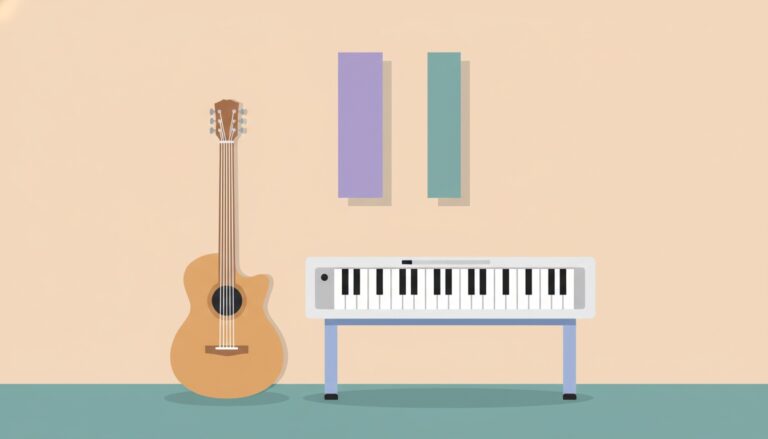
Did You Quit Piano Too? 🎹 Talking About ‘Giving Up’ in Korean!
👋 Hello, K-Learners!
안녕하세요! It’s Daily Hangul, your friendly guide to mastering Korean! 😊
Have you ever started learning a musical instrument, like the guitar or piano, but stopped because it was too hard or you got busy? 🎸🎹 Don’t worry, you are not alone! In fact, talking about “past failures” or things we quit is a great conversation starter in Korea.
In many K-Dramas, you might hear a character say, “I used to play, but I quit.” Today, let’s learn how to share these stories naturally. Let’s turn that “failure” into a Korean language “success”! 🚀
🔑 Key Expressions
Here are 3 common expressions to talk about learning and quitting.
1. 배웠어요 (I learned / I took lessons)
- Pronunciation: [Baewosseoyo]
- English Meaning: I learned / I took lessons
- Detail: This comes from the verb 배우다 (to learn). You use this to say you learned something in the past.
- Example: 피아노를 배웠어요. (I learned the piano.)
- 💡 Pronunciation Tip: The ‘웠’ sounds like ‘wot’ but softer. Try to slide the sounds together: Bae-woss-eo-yo.
2. 포기했어요 (I gave up)
- Pronunciation: [Pogihaesseoyo]
- English Meaning: I gave up
- Detail: 포기하다 means “to give up.” This is a very dramatic and common word! You might hear K-Pop idols say “포기하지 마!” (Don’t give up!) on survival shows. But today, we are admitting we did give up! 😅
- Example: 너무 어려워서 포기했어요. (It was too hard, so I gave up.)
- 💡 Pronunciation Tip: The ‘h’ in ‘hae’ is often pronounced very softly. It almost sounds like Pogi-aesseoyo in fast speech.
3. 하다가 그만뒀어요 (I was doing it, but I quit)
- Pronunciation: [Hadaga geumandwosseoyo]
- English Meaning: I stopped/quit while doing it
- Detail: This is a slightly advanced but super natural combo!
- ~다가 (daga): Indicates an action was interrupted (while doing…).
- 그만두다 (geumanduda): To stop or quit.
- Example: 기타를 치다가 그만뒀어요. (I was playing/learning guitar, but then I quit.)
- 💡 Pronunciation Tip: In ‘그만뒀어요’, the 뒀 sounds like ‘dwot’. Make sure to round your lips for the ‘w’ sound!
🗣️ Real Conversation
Imagine you are at a cafe with your Korean friend, Minji. She spots a guitar in the corner.
Minji: 톰 씨, 기타 칠 수 있어요?
(Tom, can you play the guitar?)
[Tom ssi, gita chil su isseoyo?]
Tom: 아니요. 옛날에 조금 배웠어요.
(No. I learned a little bit a long time ago.)
[Aniyo. Yennare jogeum baewosseoyo.]
Minji: 정말요? 지금은 안 쳐요?
(Really? You don’t play now?)
[Jeongmaryo? Jigeumeun an cheoyo?]
Tom: 네, 손가락이 너무 아파서 포기했어요.
(Yes, my fingers hurt too much, so I gave up.)
[Ne, songaragi neomu apaseo pogihaesseoyo.]
Minji: 아, 저도 피아노 치다가 그만뒀어요.
(Ah, I also quit while playing piano.)
[A, jeodo piano chidaga geumandwosseoyo.]
🇰🇷 Culture Tip: The “Piano Academy” Memories
If you ask a Korean person, “Did you learn piano?”, 8 out of 10 might say “Yes!” 😲
In Korea, going to a 피아노 학원 (Piano Academy) after school is almost a childhood rite of passage. Many children carry a yellow bag for their music books. Even if they don’t play anymore as adults, talking about their strict piano teachers or the “Czerny” (exercise books) brings back nostalgic memories. Try asking a Korean friend about their “Piano Academy” days!
📝 Wrap-up & Quiz
Today we learned how to be honest about our hobbies! It’s okay to quit sometimes. 😉
Let’s check your understanding:
- How do you say “I gave up” in Korean?
( Hint: P_ _ _ _ _ _ _ _ _ ) -
True or False: “배웠어요” means “I am learning right now.”
-
Fill in the blank:
“Too hard, so I quit.” -> “너무 어려워서 _______.”
a) 시작했어요 (started)
b) 그만뒀어요 (quit)
See you next time! 안녕! 👋
Answers:
1. 포기했어요 (Pogihaesseoyo)
2. False (It means “I learned” – past tense)
3. b) 그만뒀어요
Frequently Asked Questions (FAQ)
Q: What does "배웠어요 (I learned / I took lessons)" mean in Korean and how do you pronounce it?
A: In Korean, "배웠어요 (I learned / I took lessons)" is pronounced [Baewosseoyo] and means: I learned / I took lessons
Q: What does "포기했어요 (I gave up)" mean in Korean and how do you pronounce it?
A: In Korean, "포기했어요 (I gave up)" is pronounced [Pogihaesseoyo] and means: I gave up
Q: What does "하다가 그만뒀어요 (I was doing it, but I quit)" mean in Korean and how do you pronounce it?
A: In Korean, "하다가 그만뒀어요 (I was doing it, but I quit)" is pronounced [Hadaga geumandwosseoyo] and means: I stopped/quit while doing it







