

Introduction
Hello! It’s Daily Hangul (DailyHangul.com), here to upgrade your Korean skills! 👋✨
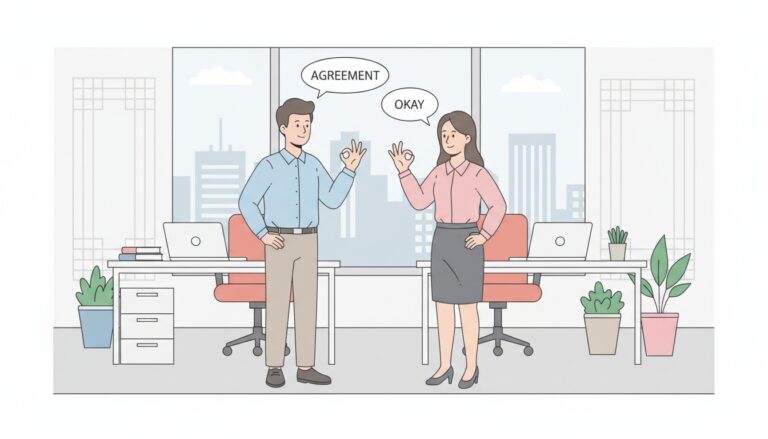
Have you ever watched a workplace K-Drama like Misaeng (Incomplete Life) or Start-Up? You often see colleagues discussing projects and trying to solve problems together. In real life, just like in dramas, we don’t always agree on everything! 😅
Today, we are going to learn how to find a compromise with your colleagues. These expressions are super useful when you need to suggest a new idea or agree on a solution politely. Mastering these will make you look professional and considerate, just like a favorite character from a drama! 💼🤝
Let’s dive in! 🚀
Key Expressions
Here are 3 essential phrases to help you negotiate and find a middle ground smoothly.
1. 그럼, 이렇게 하는 건 어때요?
- Pronunciation: [Geureom, ireoke haneun geon eottaeyo?]
- Meaning: Then, how about doing it this way?
- Explanation: This is the magic phrase for compromising! When you want to suggest an alternative solution, start with ‘그럼’ (Then) and propose your idea. It shows you are listening but have a different suggestion.
- 💡 Pronunciation Tip:
- In ‘이렇게’ (like this), the ‘ㅎ’ (h) sound is weak. It blends with the ‘ㄱ’ (k) in the next syllable, making it sound like [이러케 / i-reo-ke]. This makes your speech flow much smoother!
2. 반반씩 양보해요.
- Pronunciation: [Banbanssik yangbohaeyo.]
- Meaning: Let’s meet halfway. (Lit. Let’s yield half and half.)
- Explanation: ‘양보하다’ means ‘to yield’ or ‘to compromise.’ If you are stuck in a disagreement, suggesting to yield ‘반반’ (half-half) is a very fair and friendly way to solve it.
- 💡 Pronunciation Tip:
- ‘양보’ is pronounced clearly as [yang-bo]. Make sure to pronounce the double consonant ‘씩’ (ssik) with a strong, tense sound!
3. 좋아요, 그렇게 해요.
- Pronunciation: [Joayo, geureoke haeyo.]
- Meaning: Good, let’s do that.
- Explanation: Once you find a solution you agree with, use this phrase to confirm the deal! It’s polite, positive, and concludes the discussion perfectly.
- 💡 Pronunciation Tip:
- ‘좋아요’ sounds like [조아요 / jo-a-yo] because the bottom ‘ㅎ’ becomes silent when followed by a vowel.
Real Dialogue
Let’s see how two colleagues, Min-su and Sarah, decide on a meeting time.
Min-su: 내일 9시에 회의할까요?
(Shall we have the meeting tomorrow at 9 AM?)
Sarah: 9시는 너무 빨라요. 그럼, 10시는 어때요?
(9 is too early. Then, how about 10 o’clock?)
Min-su: 음, 10시는 제가 바빠요.
(Hmm, I am busy at 10.)
Sarah: 아, 그래요? 그럼 반반씩 양보해서 9시 반은 어때요?
(Oh, really? Then how about we compromise and meet at 9:30?)
Min-su: 좋아요, 그렇게 해요!
(Good, let’s do that!)
Culture Tip: The Art of “Nunchi” 👀
In Korean office culture, directly saying “No, I hate that idea” is considered quite rude. Instead, Koreans use Nunchi (눈치)—the art of sensing the atmosphere.
If you disagree, instead of a hard “No,” it’s better to say “그건 좀 어려울 것 같아요” (That seems a bit difficult) or offer an alternative using “~는 어때요?” (How about…?). Being soft and indirect helps maintain harmony in the team! 🕊️
Conclusion & Quiz
Great job today! You are now ready to handle disagreements and find solutions like a pro in a Korean office. Remember, being polite and suggesting alternatives is key! 🔑
📝 Mini Quiz
- How do you say “Let’s do that” in Korean?
( __________ , 그렇게 해요. ) -
True or False: In Korea, it is polite to say “No!” very loudly and directly during a meeting.
( O / X ) -
Fill in the blank: “How about doing it this way?”
( 이렇게 하는 건 __________? )
Answers:
1. 좋아요 (Joayo)
2. X (It’s better to be indirect!)
3. 어때요 (eottaeyo)
Frequently Asked Questions (FAQ)
Q: What does "그럼, 이렇게 하는 건 어때요?" mean in Korean and how do you pronounce it?
A: In Korean, "그럼, 이렇게 하는 건 어때요?" is pronounced [Geureom, ireoke haneun geon eottaeyo?] and means: Then, how about doing it this way?
Q: What does "반반씩 양보해요." mean in Korean and how do you pronounce it?
A: In Korean, "반반씩 양보해요." is pronounced [Banbanssik yangbohaeyo.] and means: Let's meet halfway. (Lit. Let's yield half and half.)
Q: What does "좋아요, 그렇게 해요." mean in Korean and how do you pronounce it?
A: In Korean, "좋아요, 그렇게 해요." is pronounced [Joayo, geureoke haeyo.] and means: Good, let's do that.







