

Hello! It’s Daily Hangul! 👋
안녕하세요! Welcome back to Daily Hangul, your best friend for learning Korean! 🇰🇷✨
Have you ever faced a “crisis” where your smartphone screen shattered or your laptop suddenly wouldn’t turn on while traveling? 😱 It happens! In K-Dramas, this is often the moment the main character loses important photos or contacts.
Today, we are going to learn what to say at a repair shop (Service Center), specifically when the staff tells you, “It’s better to buy a new one than to fix this.”
Let’s master these expressions so you can make the smart choice without panicking! Ready? Let’s go! 🚀
🔑 Key Expressions
Here are 3 essential phrases you might hear or use at a Korean Service Center (AS Center).
1. 수리비가 많이 나와요.
- Pronunciation: [Suribi-ga mani nawayo]
- Meaning: The repair cost is high.
- Explanation:
- 수리비 (Suribi) means “repair cost.”
- 많이 (Mani) means “a lot” or “much.”
- The staff uses this to warn you that fixing the item might be expensive.
- 💡 Pronunciation Tip:
In the word 많이, the bottom letter ‘ㅎ’ (h) is silent! So, do not pronounce it as [man-hi]. It sounds smooth like [ma-ni].
2. 새로 사는 게 더 나아요.
- Pronunciation: [Saero saneun ge deo na-ayo]
- Meaning: It is better to buy a new one.
- Explanation:
- 새로 (Saero) means “newly.”
- 사는 게 (Saneun ge) means “buying (it).”
- 더 나아요 (Deo na-ayo) means “it is better.”
- This is a soft suggestion (advice) often used when the repair cost is almost the same as the price of a new product.
- 💡 Pronunciation Tip:
나아요 (Better) comes from the base form 낫다 (Nat-da). When conjugated, the ‘ㅅ’ sound disappears. So it flows like [Na-a-yo], not [Nat-a-yo].
3. 고민 좀 해볼게요.
- Pronunciation: [Gomin jom haebolgeyo]
- Meaning: I’ll think about it.
- Explanation:
- This is a magic phrase! ✨ If you are not sure whether to pay for the repair or buy a new one, you don’t have to decide immediately. Use this phrase to politely say you need some time to decide.
💬 Real-life Conversation
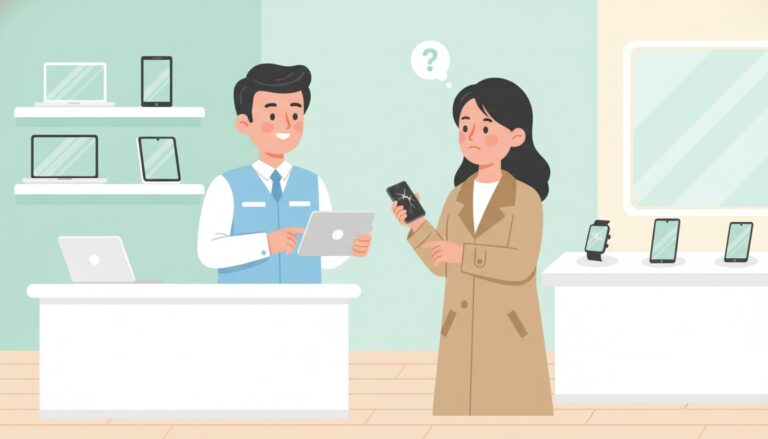
Imagine you are at an electronics service center with a broken phone.
🧑🔧 Technician: 액정이 깨졌네요. 수리비가 많이 나와요.
(The screen is broken. The repair cost is high.)
[Aekjeong-i kkaejyeonneyo. Suribi-ga mani nawayo.]
👤 You: 얼마예요?
(How much is it?)
[Eolmayeyo?]
🧑🔧 Technician: 40만 원이에요. 새로 사는 게 더 나아요.
(It’s 400,000 won. It’s better to buy a new one.)
[Sasip-man wonieyo. Saero saneun ge deo na-ayo.]
👤 You: 아, 진짜요? 음… 고민 좀 해볼게요.
(Ah, really? Hmm… I’ll think about it.)
[A, jinjja-yo? Eum… Gomin jom haebolgeyo.]
🇰🇷 Culture Tip: “AS Center”
In Korea, repair shops for electronics are commonly called “AS Center” (AS센터). “AS” stands for “After Service” (After-sales service).
Korea is famous for its Ppalli-ppalli (Hurry, hurry) culture! 🏃♂️💨
For major brands like Samsung or LG, you can often walk into an AS Center and get your phone fixed in under an hour while you wait on a comfortable sofa drinking free coffee. It’s incredibly fast and convenient!
📝 Wrap-up & Quiz
Today, we learned how to handle a situation where repairs are too expensive. Don’t feel pressured to decide right away—remember to say “I’ll think about it”!
Let’s check what you remember!
- What does “Suribi” (수리비) mean?
(A) New phone
(B) Repair cost -
Fill in the blank: “It is better to buy a new one.”
= ____ 사는 게 더 나아요. (Saero saneun ge deo na-ayo) -
True or False: If you want some time to decide, you say “Gomin jom haebolgeyo.”
( ) True / ( ) False
Good job today! See you next time! 안녕! 👋
Answers:
1. (B)
2. 새로 (Saero)
3. True
Frequently Asked Questions (FAQ)
Q: What does "수리비가 많이 나와요." mean in Korean and how do you pronounce it?
A: In Korean, "수리비가 많이 나와요." is pronounced [Suribi-ga mani nawayo] and means: The repair cost is high.
Q: What does "새로 사는 게 더 나아요." mean in Korean and how do you pronounce it?
A: In Korean, "새로 사는 게 더 나아요." is pronounced [Saero saneun ge deo na-ayo] and means: It is better to buy a new one.
Q: What does "고민 좀 해볼게요." mean in Korean and how do you pronounce it?
A: In Korean, "고민 좀 해볼게요." is pronounced [Gomin jom haebolgeyo] and means: I'll think about it.







