

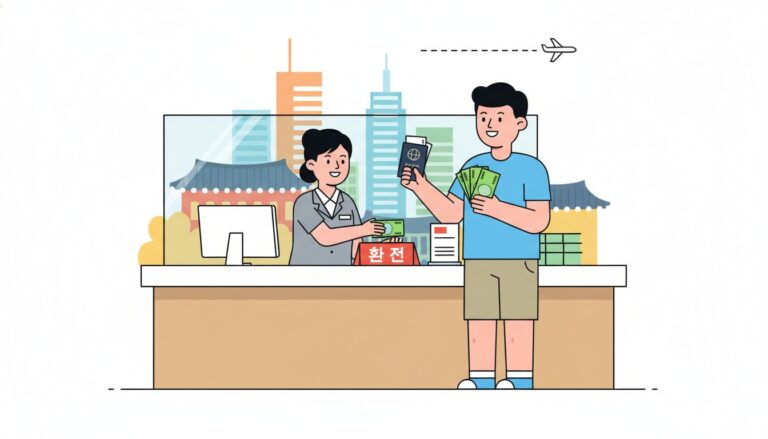
Hello! Welcome to Daily Hangul! ✈️🇰🇷
Annyeonghaseyo! This is Daily Hangul, here to upgrade your Korean skills! 😊
Imagine you’ve just landed at Incheon International Airport. You are so excited to try Tteokbokki (spicy rice cakes) like your favorite K-drama characters, but wait! You need Korean cash (Won) first! 😱
Don’t worry! Today, we will learn how to exchange money at a bank or a currency exchange booth. These expressions are super useful for your first day in Korea. Ready to become a smart traveler? Let’s go! 🚀
💰 Key Expressions
Here are the 3 most important phrases you need when exchanging money.
1. 환전해 주세요 (Please exchange money)
- Pronunciation: [Hwanjeonhae juseyo]
- English Meaning: Please exchange money.
- Explanation: “Hwanjeon” means currency exchange. Adding “-hae juseyo” makes it a polite request. You can say this as soon as you walk to the counter!
- 💡 Pronunciation Tip: When you say 환전해 (Hwanjeonhae), the ‘n’ sound in ‘jeon’ flows into the ‘h’, making it sound softer, almost like [Hwan-jeo-nae].
2. 여권 여기 있어요 (Here is my passport)
- Pronunciation: [Yeogwon yeogi isseoyo]
- English Meaning: Here is my passport.
- Explanation: In Korea, you must show your ID (passport) to exchange money. “Yeogwon” is passport. “Yeogi isseoyo” means “It is here.”
- 💡 Pronunciation Tip: The ‘g’ in 여권 (Yeogwon) is pronounced strongly, almost like a ‘k’ sound (Yeo-kwon) because of the double consonant rule in pronunciation.
3. 영수증 주세요 (Please give me a receipt)
- Pronunciation: [Yeongsujeung juseyo]
- English Meaning: Please give me a receipt.
- Explanation: It’s always smart to check the exchange rate! “Yeongsujeung” means receipt. You can use this phrase in restaurants and cafes too!
🗣️ Real-life Conversation
Let’s see how to use these in a real situation at the airport bank! 🏦
A: Tourist (You)
B: Bank Teller
A: 안녕하세요! 환전해 주세요.
[Annyeonghaseyo! Hwanjeonhae juseyo.]
(Hello! Please exchange money.)
B: 네, 얼마를 바꾸시겠어요?
[Ne, eolmareul bakkusigesseoyo?]
(Yes, how much would you like to exchange?)
A: 100달러요. 여기 여권 있어요.
[Baek-dalleo-yo. Yeogi yeogwon isseoyo.]
(100 dollars. Here is my passport.)
B: 네, 잠시만요… 여기 있습니다.
[Ne, jamsimanyo… yeogi issseumnida.]
(Okay, just a moment… Here you go.)
A: 감사합니다. 영수증 주세요.
[Gamsahamnida. Yeongsujeung juseyo.]
(Thank you. Please give me a receipt.)
🇰🇷 Culture Tip: Cash is King for Street Food!
While almost all shops in Korea accept credit cards, you absolutely need cash (Hyeon-geum) for two things:
1. Street Food: To buy Bungeoppang (fish-shaped pastry) or Eomuk (fish cake soup) like in K-dramas!
2. T-Money Card: To recharge your transportation card for the subway and bus.
Pro Tip: Exchange centers in Myeong-dong often have better rates than the airport! 😉
📝 Wrap-up & Quiz
Great job today! Now you are ready to get some Korean Won and start your journey. Let’s check if you remember the key phrases!
Quiz:
1. How do you say “Please exchange money” in Korean?
( 환[ ]해 주세요 )
2. True or False: You don’t need a passport to exchange money in Korea.
( True / False )
⬇️ Answers ⬇️
- 전 (jeon) -> 환전해 주세요 (Hwanjeonhae juseyo)
- False (You must have your passport!)
Frequently Asked Questions (FAQ)
Q: What does "환전해 주세요 (Please exchange money)" mean in Korean and how do you pronounce it?
A: In Korean, "환전해 주세요 (Please exchange money)" is pronounced [Hwanjeonhae juseyo] and means: Please exchange money.
Q: What does "여권 여기 있어요 (Here is my passport)" mean in Korean and how do you pronounce it?
A: In Korean, "여권 여기 있어요 (Here is my passport)" is pronounced [Yeogwon yeogi isseoyo] and means: Here is my passport.
Q: What does "영수증 주세요 (Please give me a receipt)" mean in Korean and how do you pronounce it?
A: In Korean, "영수증 주세요 (Please give me a receipt)" is pronounced [Yeongsujeung juseyo] and means: Please give me a receipt.







