

Hello! It’s Daily Hangul! 👋
안녕하세요! Welcome back to Daily Hangul, your best friend for learning Korean! 😊
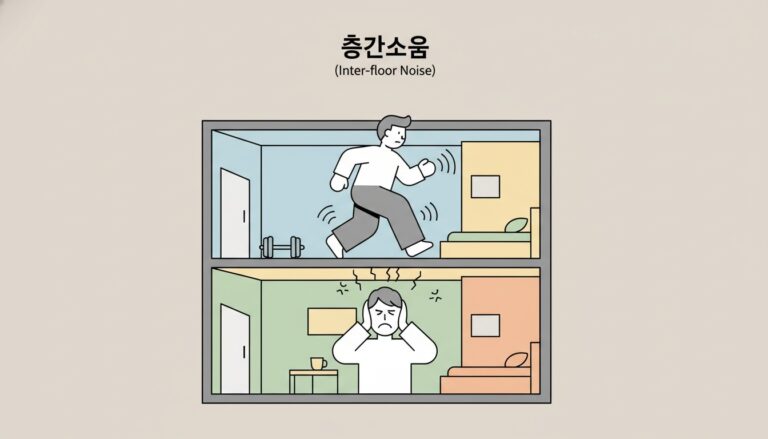
Have you ever watched a K-Drama where the main character lives in an apartment or a “One-room” (studio)? 🏢 Since many Koreans live in multi-story buildings, there is one very common problem: Noise!
Specifically, we call the noise coming from the floor above “층간 소음 (Cheung-gan-so-eum)”.
Today, we will learn how to politely but firmly tell your neighbor (or the building manager) that it is too loud. Let’s protect your peaceful rest! 😴✨
🔑 Key Expressions
1. 너무 시끄러워요.
- Pronunciation: [Neomu sikkeureowoyo]
- Meaning: It’s too noisy.
- Detail:
- 너무 (Neomu) means “too” or “very.”
- 시끄러워요 (Sikkeureowoyo) comes from the adjective “to be noisy.”
- You can use this phrase when the noise is unbearable. It’s a straightforward expression.
- 💡 Pronunciation Tip: In 시끄러워요, the double consonant ‘ㄲ’ (kk) is a tense sound. Pronounce it strongly and sharply, like the ‘k’ in “sky”! 💥
2. 쿵쿵 소리가 나요.
- Pronunciation: [Kungkung soriga nayo]
- Meaning: There is a thumping sound.
- Detail:
- 쿵쿵 (Kungkung) is an onomatopoeia (sound word) for heavy footsteps or banging. Koreans love using sound words!
- If the noise is music, you can say 노래 (norae) instead of 쿵쿵.
- 💡 Pronunciation Tip: For 소리가 (soriga), the ‘ㄹ’ sounds like a soft ‘r’ or ‘l’ because it is between vowels. It flows smoothly! 🌊
3. 조용히 좀 해주세요.
- Pronunciation: [Joyonghi jom haejuseyo]
- Meaning: Please be quiet / Please keep it down.
- Detail:
- 조용히 (Joyonghi) means “quietly.”
- 좀 (Jom) literally means “a little,” but here it softens the request, making it sound more like “please.”
- This is a polite request, but it shows you are serious.
- 💡 Pronunciation Tip: In 해 주세요 (haejuseyo), say it as one connected flow. Don’t stop between the words!
🗣️ Real Conversation
Imagine you are calling the security office (guard) or talking to a neighbor via the intercom.
A: Tenant (You)
B: Neighbor
A: 저기요, 위층에서 쿵쿵 소리가 나요.
[Jeogiyo, wicheung-eseo kungkung soriga nayo.]
(Excuse me, there is a thumping sound from upstairs.)
B: 아, 정말요? 죄송합니다.
[A, jeongmaryo? Joesonghamnida.]
(Oh, really? I am sorry.)
A: 지금 너무 시끄러워요. 주의 좀 부탁드려요.
[Jigeum neomu sikkeureowoyo. Juui jom butakdeuryeoyo.]
(It is too noisy right now. Please be careful.)
B: 네, 알겠습니다. 조용히 할게요.
[Ne, algetseumnida. Joyonghi halgeyo.]
(Yes, I understand. I will be quiet.)
🇰🇷 Culture Tip: “Slippers are Essential!”
In Korea, Floor Noise (층간 소음) is a very sensitive social issue because most people live in apartments with shared concrete floors. 🏢
To prevent fighting with neighbors, many Koreans wear “Noise-canceling slippers” (층간 소음 슬리퍼) inside the house! They have thick soles to absorb the sound of footsteps. 👣
Bonus Tip: In Korea, it is often considered safer and more polite to complain through the Management Office (관리실) or the Security Guard (경비실) rather than knocking on your neighbor’s door directly. This avoids direct confrontation! 🙅♂️
📝 Wrap-up & Quiz
Today we learned how to express discomfort with noise. Remember, a polite request goes a long way!
Let’s test your skills! (Answers are at the bottom)
- Fill in the blank: “It is too noisy!” = _______ 시끄러워요!
- Which word mimics the sound of heavy footsteps? ( 쾅쾅 / 쿵쿵 )
- True or False: In Korea, it is common to wear slippers inside to reduce noise. ( O / X )
See you next time! 안녕! 👋
Answers:
1. 너무 (Neomu)
2. 쿵쿵 (Kungkung)
3. O (True)
Frequently Asked Questions (FAQ)
Q: What does "너무 시끄러워요." mean in Korean and how do you pronounce it?
A: In Korean, "너무 시끄러워요." is pronounced [Neomu sikkeureowoyo] and means: It's too noisy.
Q: What does "쿵쿵 소리가 나요." mean in Korean and how do you pronounce it?
A: In Korean, "쿵쿵 소리가 나요." is pronounced [Kungkung soriga nayo] and means: There is a thumping sound.
Q: What does "조용히 좀 해주세요." mean in Korean and how do you pronounce it?
A: In Korean, "조용히 좀 해주세요." is pronounced [Joyonghi jom haejuseyo] and means: Please be quiet / Please keep it down.







