

Introduction
Hello, K-Culture lovers! 👋 It’s your favorite Korean tutor, Daily Hangul (DailyHangul.com)!
Have you been watching recent sci-fi K-Dramas like Grid or Black Knight? 📺 Korea makes amazing stories about the future! Today, we are going to talk about a slightly serious but very interesting topic: Artificial Intelligence (AI) and Ethics.
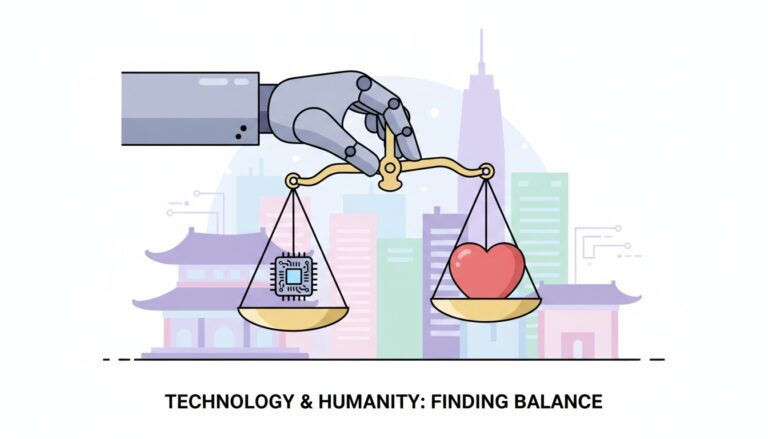
Specifically, imagine an AI that predicts crimes before they happen. Sounds cool, but what if the AI is wrong? What if it creates a social stigma against innocent people? 😱
Let’s learn how to express these deep thoughts in Korean so you can debate with your Korean friends! Let’s go! 🚀
Core Expressions
Here are 4 key expressions to discuss AI and fairness.
1. 인공지능 (Artificial Intelligence)
- Pronunciation: [In-gong-ji-neung]
- Meaning: AI
- Detail: This is the standard word for AI. You will hear this everywhere in news and tech dramas.
- 💡 Pronunciation Tip: Connect the sounds smoothly. It sounds like “In-gong-jee-neung.”
2. 편견 (Prejudice / Bias)
- Pronunciation: [Pyeon-gyeon]
- Meaning: Prejudice or Bias
- Detail: When we talk about AI making mistakes based on bad data, we say it has ‘Pyeon-gyeon’. This is the root cause of social stigma.
- 💡 Pronunciation Tip: The ‘gyeon’ sound is like the English word “Gone” but with a ‘y’ sound before the vowel.
3. 억울해요 (It’s unfair / I feel wronged)
- Pronunciation: [Eo-gul-hae-yo]
- Meaning: I feel unfairly treated / It is unfair
- Detail: This is a MUST-KNOW K-Drama phrase! 🌟 You use this when you are accused of something you didn’t do (like a crime predicted by AI). It expresses frustration and sadness.
- 💡 Pronunciation Tip: Because of the liaison rule, ‘억울’ sounds like [어굴 (Eo-gul)].
4. ~면 안 돼요 (You shouldn’t… / It is not allowed)
- Pronunciation: [~myeon an dwae-yo]
- Meaning: You shouldn’t do [Action]
- Detail: Use this grammar to talk about ethics. “You shouldn’t judge people” or “You shouldn’t discriminate.”
Real-life Conversation
Situation: Minji and Paul are discussing a news report about a new AI police system.
Minji: 이 인공지능은 범죄를 미리 알 수 있대요.
(I in-gong-ji-neung-eun beom-joe-reul mi-ri al su it-dae-yo.)
English: They say this AI can know crimes in advance.
Paul: 정말요? 하지만 기계도 편견이 있을 수 있어요.
(Jeong-mal-yo? Ha-ji-man gi-gye-do pyeon-gyeon-i is-seul su i-sseo-yo.)
English: Really? But even machines can have bias.
Minji: 맞아요. 실수로 잡히면 정말 억울해요.
(Ma-ja-yo. Sil-su-ro jap-hi-myeon jeong-mal eo-gul-hae-yo.)
English: That’s right. If you get caught by mistake, it would feel so unfair.
Paul: 사람을 함부로 판단하면 안 돼요.
(Sa-ram-eul ham-bu-ro pan-dan-ha-myeon an dwae-yo.)
English: You shouldn’t judge people rashly.
Cultural Tip 🇰🇷
“Han (한)” and “Eo-gul (억울)”
In Korean culture, the feeling of being 억울하다 (Eo-gul-ha-da) is taken very seriously. It’s not just “annoying”; it’s a deep sense of injustice that touches the soul.
Many K-Dramas focus on a protagonist trying to clear their name from a false accusation (social stigma). If an AI wrongly labels someone a “criminal,” Koreans would sympathize deeply with that person’s Eo-gul-ham (sense of unfairness). Understanding this emotion helps you understand the heart of Korean storytelling! 🎭
Wrap-up & Quiz
Today we learned how to talk about the ethical problems of AI! Technology is great, but we must be careful about 편견 (Bias).
📝 Mini Quiz
- How do you say “Artificial Intelligence” in Korean?
( Hint: I _ _ _ _ _ _ _ _ _ _ _ ) - If you are falsely accused by an AI, how do you express your frustration?
“I am so ________!” ( Hint: 억울해요 ) - True or False: ~면 안 돼요 means “Please do this.”
✅ Answers:
1. 인공지능 (In-gong-ji-neung)
2. 억울해요 (Eo-gul-hae-yo)
3. False (It means “You shouldn’t” or “It is not allowed”)
Keep practicing, and see you next time! Annyeong! 👋
Frequently Asked Questions (FAQ)
Q: What does "인공지능 (Artificial Intelligence)" mean in Korean and how do you pronounce it?
A: In Korean, "인공지능 (Artificial Intelligence)" is pronounced [In-gong-ji-neung] and means: AI
Q: What does "편견 (Prejudice / Bias)" mean in Korean and how do you pronounce it?
A: In Korean, "편견 (Prejudice / Bias)" is pronounced [Pyeon-gyeon] and means: Prejudice or Bias
Q: What does "억울해요 (It's unfair / I feel wronged)" mean in Korean and how do you pronounce it?
A: In Korean, "억울해요 (It's unfair / I feel wronged)" is pronounced [Eo-gul-hae-yo] and means: I feel unfairly treated / It is unfair
Q: What does "~면 안 돼요 (You shouldn't... / It is not allowed)" mean in Korean and how do you pronounce it?
A: In Korean, "~면 안 돼요 (You shouldn't... / It is not allowed)" is pronounced [~myeon an dwae-yo] and means: You shouldn't do [Action]







