

Introduction
Annyeonghaseyo! Hello everyone! It’s your friendly Korean tutor, Daily Hangul (DailyHangul.com)! 👋✨
Today, we are going to take a break from K-Dramas and look at something a bit more intellectual! 🤓 Have you ever watched Korean news or discussed world history with Korean friends? To sound smart and professional, you need to know some specific terms!
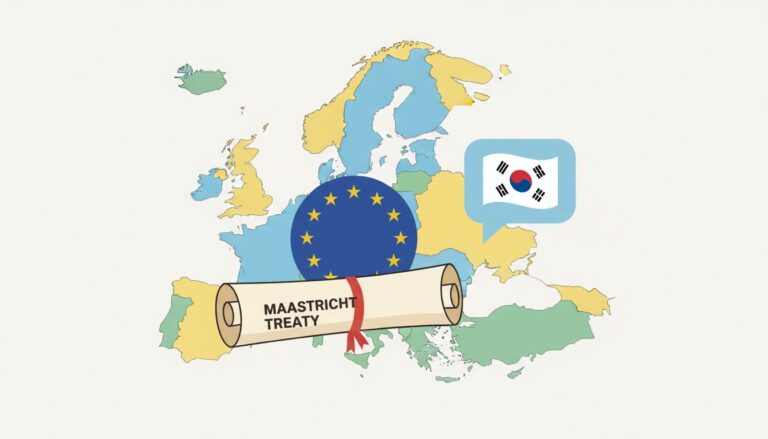
Today’s theme is “The Birth of the European Union (EU).” Specifically, we will talk about the famous Maastricht Treaty. Don’t worry, I’ll make it super easy and fun! Let’s level up your Korean to “News Anchor” mode! 🎙️🇰🇷
Core Expressions
Here are 4 key expressions to talk about the EU and history in Korean!
1. 유럽 연합 (European Union)
- Pronunciation: [Yureop Yeonhap]
- Meaning: European Union (EU)
- Detail: “유럽” comes from Europe, and “연합” means union or alliance. You will hear this constantly on the news!
- 💡 Pronunciation Tip: When you say 연합 (Yeonhap), the ‘ㅎ’ (h) sound is often weak. In fast speech, it sounds like [Yeonap] because the ‘ㄴ’ (n) sound slides over.
- Slow: Yeon-hap / Fast: Yeo-nap
2. 조약 (Treaty)
- Pronunciation: [Joyak]
- Meaning: Treaty / Pact
- Detail: This is a formal word used for agreements between countries. So, the “Maastricht Treaty” becomes 마스트리흐트 조약.
- 💡 Pronunciation Tip: The ‘k’ sound at the end of 약 (yak) is a “stopped” sound. You don’t release a puff of air. It’s short and sharp!
3. 탄생 (Birth / Emergence)
- Pronunciation: [Tansaeng]
- Meaning: Birth
- Detail: While we use this for people (very formally) or religious figures, it is frequently used metaphorically for the start of an organization or a new era.
- Example: EU의 탄생 (The birth of the EU).
4. 통합 (Integration)
- Pronunciation: [Tonghap]
- Meaning: Integration / Unification
- Detail: The EU is all about economic and political integration. This word is essential when discussing politics!
Real Conversation
Let’s see how two university students, Minji and Paul, talk about this topic in a study group!
Minji: 폴, 유럽 연합이 언제 시작됐는지 알아?
(Paul, Yureop Yeonhabi eonje sijakdwaenneunji ara?)
Minji: Paul, do you know when the European Union started?
Paul: 음… 마스트리흐트 조약 때문 아니야?
(Eum… Maseuteuriheuteu Joyak ttaemun aniya?)
Paul: Hmm… Wasn’t it because of the Maastricht Treaty?
Minji: 맞아! 그 조약이 EU 탄생의 시작이야.
(Maja! Geu joyagi EU tansaengui sijagiya.)
Minji: That’s right! That treaty is the start of the EU’s birth.
Paul: 유럽의 경제 통합은 정말 대단해.
(Yureobui gyeongje tonghabeun jeongmal daedanhae.)
Paul: Europe’s economic integration is really amazing.
Cultural Tip 🇰🇷
“Sino-Korean Words make you sound Professional!”
In Korea, when we talk about serious topics like politics, history, or law (often seen in dramas like Law School or Chief of Staff), we use words based on Chinese characters (Hanja).
Words like 조약 (Treaty) and 통합 (Integration) are formal Sino-Korean words. Using these instead of simple daily words shows that you are educated and capable of discussing serious matters. Next time you watch the news in Korea, listen for words ending in -합 (hap) or -약 (yak)!
Conclusion & Quiz
Great job! Today we traveled back to 1993 and learned how to talk about the Maastricht Treaty and the EU in Korean. Now you can discuss world history like a pro! 🎓
📝 Mini Quiz
Try to fill in the blanks!
- The Korean word for “European Union” is 유럽 OO.
- A formal agreement between countries (Treaty) is called OO.
(Scroll down for answers)
…
…
Answers:
1. 연합 (Yeonhap)
2. 조약 (Joyak)
See you next time! Annyeong! 👋
Frequently Asked Questions (FAQ)
Q: What does "유럽 연합 (European Union)" mean in Korean and how do you pronounce it?
A: In Korean, "유럽 연합 (European Union)" is pronounced [Yureop Yeonhap] and means: European Union (EU)
Q: What does "조약 (Treaty)" mean in Korean and how do you pronounce it?
A: In Korean, "조약 (Treaty)" is pronounced [Joyak] and means: Treaty / Pact
Q: What does "탄생 (Birth / Emergence)" mean in Korean and how do you pronounce it?
A: In Korean, "탄생 (Birth / Emergence)" is pronounced [Tansaeng] and means: Birth
Q: What does "통합 (Integration)" mean in Korean and how do you pronounce it?
A: In Korean, "통합 (Integration)" is pronounced [Tonghap] and means: Integration / Unification






