

Introduction
Hello, everyone! Welcome back to Daily Hangul, your best friend for mastering Korean! 🌟
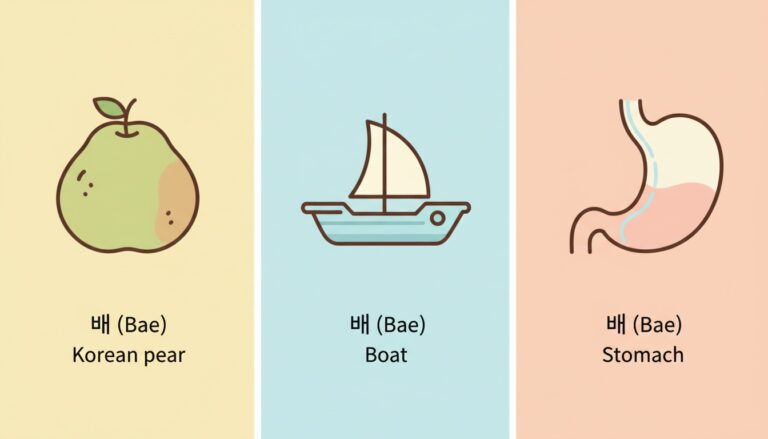
Have you ever watched a K-Drama and felt confused because a word didn’t make sense in the context? For example, a character says “My bae hurts,” but the subtitles say “My stomach hurts,” even though you learned that bae means “pear”! 🍐🚤
Don’t worry, your Korean isn’t broken! You’ve just encountered the fascinating world of Ambiguity (words with multiple meanings). Just like English has “bat” (baseball) and “bat” (animal), Korean is full of these fun puzzles.
Today, we will learn how to distinguish these meanings so you can understand your favorite Korean stars without subtitles! Let’s dive in! 🚀
Core Expressions: One Word, Many Meanings!
Here are the top 3 ambiguous words (homonyms) you will hear all the time in Korea. Context is key!
1. 배 (Bae)
- Pronunciation: [Bae]
- English Meaning: Stomach / Pear / Boat
- Explanation: This is the king of ambiguity!
- If you are at a fruit shop, it’s a Pear 🍐.
- If you are at the doctor, it’s your Stomach 🤰.
- If you are at the harbor, it’s a Boat 🚤.
- 💡 Pronunciation Tip: In standard Korean, the vowel length used to be different (longer for ‘pear’, shorter for ‘boat’), but nowadays, most young Koreans pronounce them exactly the same! You must rely on the situation.
2. 눈 (Nun)
- Pronunciation: [Nun]
- English Meaning: Eye / Snow
- Explanation:
- “눈이 예뻐요” (Nuni yeppeoyo) = Your eyes are pretty. 👀
- “눈이 와요” (Nuni wayo) = Snow is coming (It’s snowing). ❄️
- 💡 Pronunciation Tip: Just like ‘Bae’, context is everything. If you are pointing at the sky, it’s snow. If you are looking at a face, it’s eyes!
3. 사과 (Sagwa)
- Pronunciation: [Sagwa]
- English Meaning: Apple / Apology
- Explanation: This is often used in romantic dramas!
- If someone hands you a red fruit, it’s an Apple 🍎.
- If someone bows and looks sad, they are making an Apology 🙏.
Real-Life Conversation 🗣️
Let’s see how confusion happens in real life! Min-su and Anna are talking.
Anna: 민수 씨, 배 좋아해요?
(Minsu-ssi, bae joahaeyo?)
Min-su, do you like pears/boats?
Min-su: 네? 제 배요? 아니요, 살쪘어요.
(Ne? Je baeyo? Aniyo, saljjeosseoyo.)
Huh? My stomach? No, I gained weight.
Anna: 아니요! 먹는 배요! 달콤하잖아요.
(Aniyo! Meongneun baeyo! Dalkomhajanayo.)
No! The pear you eat! It’s sweet.
Min-su: 아! 과일 배! 네, 좋아해요.
(Ah! Gwail bae! Ne, joahaeyo.)
Ah! The fruit pear! Yes, I like it.
Culture Tip: The “Ajae Gag” (Dad Joke) 🤣
Did you know that Koreans love wordplay? Because there are so many words with the same sound but different meanings, there is a whole genre of humor called 아재 개그 (Ajae Gag), which translates to “Old Man Jokes” or “Dad Jokes.”
Example:
* Q: What is the most apologetic fruit?
* A: 사과 (Sagwa)! (Because it means both Apple and Apology). 🍎🙇♂️
Understanding these double meanings will help you understand Korean humor on variety shows like Running Man!
Wrap-up & Quiz 📝
Today we learned that one Korean word can have multiple meanings depending on the situation. Don’t panic—just look at the context!
Let’s practice! (True/False)
- If I say “My 배 (Bae) is full,” I am talking about a boat. ( )
- 눈 (Nun) can mean both ‘Eye’ and ‘Snow’. ( )
- If you want to say sorry, you can use the word 사과 (Sagwa). ( )
Answers:
1. False (It means Stomach!)
2. True
3. True
Keep practicing, and see you next time! Annyeong! 👋
Frequently Asked Questions (FAQ)
Q: What does "배 (Bae)" mean in Korean and how do you pronounce it?
A: In Korean, "배 (Bae)" is pronounced [Bae] and means: Stomach / Pear / Boat
Q: What does "눈 (Nun)" mean in Korean and how do you pronounce it?
A: In Korean, "눈 (Nun)" is pronounced [Nun] and means: Eye / Snow
Q: What does "사과 (Sagwa)" mean in Korean and how do you pronounce it?
A: In Korean, "사과 (Sagwa)" is pronounced [Sagwa] and means: Apple / Apology







