

Monday to Sunday: Master Korean Days of the Week! 📅
👋 Introduction
Annyeonghaseyo! (안녕하세요!) Welcome back to Daily Hangul, your best friend for learning Korean! 💖
Have you ever wondered when the next episode of your favorite K-Drama airs? Or maybe you want to make plans for a “Chimaek” (Chicken & Beer) night with friends in Seoul? To do any of that, you need to know the Days of the Week!
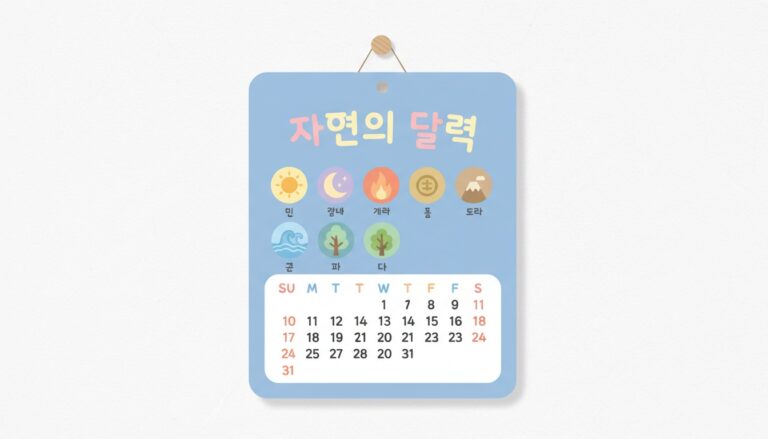
In Korean, the days of the week are named after the elements of nature (Moon, Fire, Water, Wood, Gold, Earth, Sun). It sounds poetic, right? ✨ Let’s master these magical words so you never miss a date again!
🔑 Key Expressions
1. The Magic Pattern: [Element] + Yoil
In Korean, every day of the week ends with the word 요일 (yoil), which means “day of the week.”
- Monday: 월요일 (Wol-yoil) – Moon 🌙
- Tuesday: 화요일 (Hwa-yoil) – Fire 🔥
- Wednesday: 수요일 (Su-yoil) – Water 💧
- Thursday: 목요일 (Mok-yoil) – Wood 🌳
- Friday: 금요일 (Geum-yoil) – Gold/Metal 🥇
- Saturday: 토요일 (To-yoil) – Earth/Soil ⛰️
- Sunday: 일요일 (Il-yoil) – Sun ☀️
2. 무슨 요일이에요?
- Pronunciation: [Museun yoil-ieyo?]
- English: What day of the week is it?
- Explanation: This is the standard way to ask for the day. You can add “오늘 (Oneul – Today)” at the beginning: “오늘 무슨 요일이에요?” (What day is it today?).
3. 주말
- Pronunciation: [Jumal]
- English: Weekend
- Explanation: Everyone’s favorite time! You will hear this a lot in variety shows when celebrities talk about their plans.
💡 Pronunciation Tip: The “Liaison” Rule
Korean loves to flow smoothly! When a syllable ends with a consonant and the next starts with a placeholder circle ‘ㅇ’ (ng/silent), the sound carries over.
- Monday (월요일): Written as Wol-yoil, but pronounced [워료일] (Wo-ryo-il).
- Thursday (목요일): Written as Mok-yoil, but pronounced [모교일] (Mo-gyo-il).
- Sunday (일요일): Written as Il-yoil, but pronounced [이료일] (I-ryo-il).
Don’t sound like a robot! Connect the sounds for a natural flow! 🌊
🗣️ Real Conversation
Situation: Min-ji and Jason are looking at a calendar to schedule a lunch date.
Min-ji: 오늘 무슨 요일이야?
(Oneul museun yoil-iya?)
Min-ji: What day is it today?
Jason: 오늘 화요일이야.
(Oneul hwa-yoil-iya.)
Jason: Today is Tuesday.
Min-ji: 그럼 우리 금요일에 만날까?
(Geureom uri geum-yoil-e mannalkka?)
Min-ji: Then, shall we meet on Friday?
Jason: 좋아! 금요일에 봐!
(Joa! Geum-yoil-e bwa!)
Jason: Good! See you on Friday!
🇰🇷 Culture Tip: “Bulgeum” (불금) 🔥
Have you heard the slang 불금 (Bulgeum) in K-dramas?
It stands for “Bul-ta-neun Geum-yoil” (Burning Friday). It is the Korean equivalent of “TGIF” (Thank God It’s Friday).
Since 화 (Hwa) means Fire, you might think Tuesday is the hot day, but Koreans “burn” their energy partying on Friday (Geum-yoil) night! So next time you go out on a Friday night, shout “Bulgeum!” 🍻
📝 Wrap-up & Quiz
Great job! You can now plan your week in Korean. Remember the elements of nature, and don’t forget to link your sounds!
Let’s test your skills:
- How do you say “Monday” in Korean? (Hint: Moon 🌙)
- Fill in the blank: “Burning Friday” is called ______ in Korean slang.
- (True/False) 목요일 is pronounced as [Mok-yoil] without linking sounds.
⬇️
⬇️
⬇️
Answers:
1. 월요일 (Wol-yoil)
2. 불금 (Bulgeum)
3. False (It is pronounced [Mo-gyo-il] due to the liaison rule!)
Frequently Asked Questions (FAQ)
Q: What does "주말" mean in Korean and how do you pronounce it?
A: In Korean, "주말" is pronounced [Jumal] and means: a key conversational Korean expression covered in this lesson.







