

Introduction
Annyeonghaseyo! (안녕하세요!) It’s your favorite Korean tutor, Daily Hangul, here to upgrade your Korean skills! 🚀
Have you ever watched K-Dramas like Start-Up or Misaeng and noticed how characters introduce themselves in business meetings? They don’t just say their names; they sound confident and professional! 💼
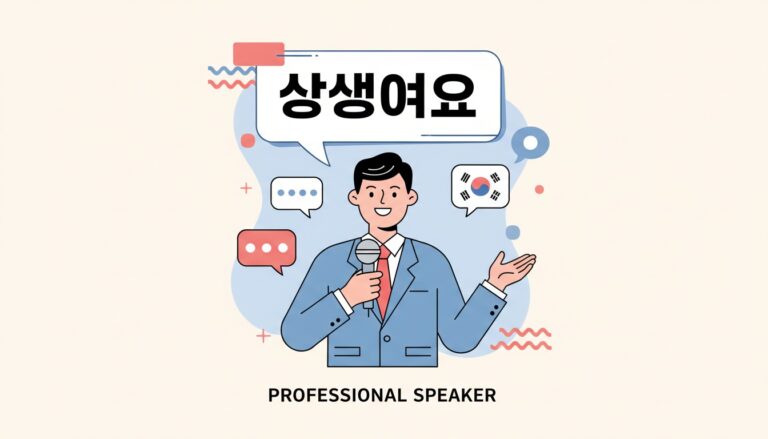
Today, we are going to learn how to introduce yourself concisely and impactfully in a group setting. Whether you are at a networking party or meeting new colleagues, these phrases will make you shine like a K-Drama protagonist! Let’s get started! ✨
Key Expressions
1. [Role]를 맡고 있는 [Name]입니다.
- Pronunciation: [[Role]-reul mat-go in-neun [Name]-im-ni-da]
- English Meaning: I am [Name], in charge of [Role].
- Detail: Instead of just saying “I am [Name],” adding your role immediately establishes your identity. It sounds very professional.
- 💡 Pronunciation Tip: The word 맡고 (in charge of) is written as
matgobut pronounced clearly as [mat-go]. The bottomㅌsounds like a ‘t’.
2. 만나서 반갑습니다.
- Pronunciation: [Man-na-seo ban-gap-seum-ni-da]
- English Meaning: Nice to meet you.
- Detail: This is the standard, formal way to say “Nice to meet you.” You will hear this everywhere, from business meetings to fan signs! Use this when addressing a group or someone higher in rank.
- 💡 Pronunciation Tip: In Korean, when
ㅂis at the bottom of a block followed byㄴ, the sound changes to ‘m’. So, 합니다 sounds like [ham-ni-da], and 반갑습니다 sounds like [ban-gap-seum-ni-da].
3. 잘 부탁드립니다.
- Pronunciation: [Jal bu-tak-deu-rim-ni-da]
- English Meaning: I look forward to working with you / Please look after me.
- Detail: This is the Magic Phrase of Korean culture! 🌟 It doesn’t translate perfectly to English, but it means “I rely on your kindness” or “Let’s work well together.” Saying this at the end of your intro shows you are humble and eager to cooperate.
- 💡 Pronunciation Tip: Focus on the flow! It’s a long phrase, so practice saying it in one smooth breath: Jal-butak-deurim-nida.
Real Dialogue
Situation: A networking event where people are introducing themselves.
👤 Minji (Newcomer): 안녕하세요! 마케팅 팀장을 맡고 있는 김민지입니다.
(Annyeonghaseyo! Marketing timjang-eul mat-go in-neun Kim Minji-imnida.)
Hello! I am Kim Minji, in charge of the Marketing Team Leader role.
👥 Group: 반갑습니다!
(Bangapseumnida!)
Nice to meet you!
👤 Minji: 오늘 만나서 반갑습니다. 앞으로 잘 부탁드립니다!
(Oneul mannaseo bangapseumnida. Apeuro jal butakdeurimnida!)
Nice to meet you all today. I look forward to working with you!
👤 Cheolsu: 네, 환영합니다, 민지 씨!
(Ne, hwanyeonghamnida, Minji-ssi!)
Yes, welcome, Minji!
Culture Tip 🇰🇷
The Art of the Business Card (Myeongham – 명함)
In Korea, after a cool self-intro, people often exchange business cards. Here is how to do it like a pro:
1. Two Hands: Always give and receive cards with two hands. It shows respect! 🙌
2. Read It: Don’t put it in your pocket immediately. Study the card for a few seconds and nod. It shows you value the person.
3. Placement: If you are sitting at a table, place the received cards in front of you during the meeting.
Mastering this small gesture will make you look like a true Korean expert!
Conclusion & Quiz
Great job today! 🎉 Now you can introduce yourself confidently in any professional setting. Remember, confidence + polite expressions = Success!
📝 Mini Quiz
- Fill in the blank: “I look forward to working with you.”
= ___ 부탁드립니다. (___ butakdeurimnida) -
True or False: You should put a business card in your pocket immediately after receiving it.
( O / X )
See you next time! Annyeong! 👋
Answers:
1. 잘 (Jal)
2. X (You should read it first!)
Frequently Asked Questions (FAQ)
Q: What does "[Role]를 맡고 있는 [Name]입니다." mean in Korean and how do you pronounce it?
A: In Korean, "[Role]를 맡고 있는 [Name]입니다." is pronounced [Role] and means: I am [Name], in charge of [Role].
Q: What does "만나서 반갑습니다." mean in Korean and how do you pronounce it?
A: In Korean, "만나서 반갑습니다." is pronounced [Man-na-seo ban-gap-seum-ni-da] and means: Nice to meet you.
Q: What does "잘 부탁드립니다." mean in Korean and how do you pronounce it?
A: In Korean, "잘 부탁드립니다." is pronounced [Jal bu-tak-deu-rim-ni-da] and means: I look forward to working with you / Please look after me.







