

Hello! I’m Daily Hangul (DailyHangul.com), here to upgrade your Korean skills! 🎓✨
Did you know that psychology can help you master Korean faster? Today, we are diving into a fascinating topic: B.F. Skinner’s Operant Conditioning!
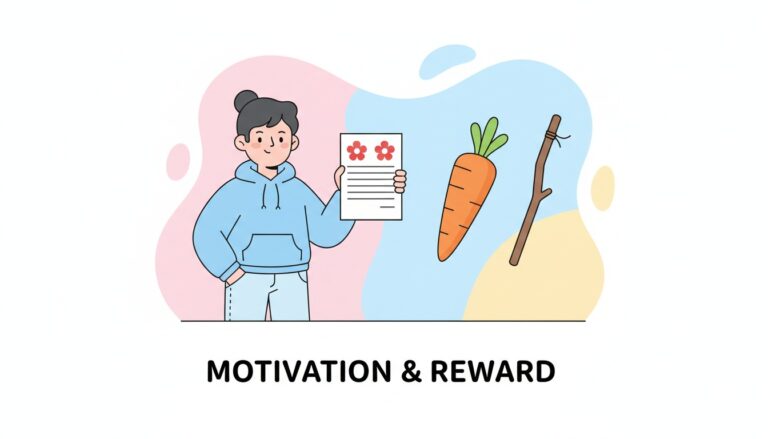
“Wait, that sounds hard!” Don’t worry! 🙅♂️ Simply put, it’s about how rewards (praise) and punishments (scolding) shape our behavior. In K-Dramas, you often see parents or bosses using “Carrots and Sticks” to get what they want. Let’s learn the Korean expressions related to this so you can use the power of psychology to boost your own learning! 🧠💪
🔑 Key Expressions: The Psychology of Learning
1. 참 잘했어요 (Cham jal-haesseoyo)
- Pronunciation: [Cham ja-rae-sseo-yo]
- English Meaning: You did a very good job! / Well done!
- Detailed Explanation: This is the ultimate Positive Reinforcement! In Skinner’s theory, praise encourages you to repeat good behavior. You will hear this constantly in Korean schools or variety shows when someone succeeds at a mission.
- 💡 Pronunciation Tip: Notice how 잘 (jal) flows into 했 (haet)? When ‘ㄹ’ meets ‘ㅎ’, the ‘ㅎ’ sound often becomes weak or disappears, making it sound smoother like [Ja-rae-sseo-yo].
2. 보상 (Bosang)
- Pronunciation: [Bo-sang]
- English Meaning: Reward / Compensation
- Detailed Explanation: Skinner says if you get a 보상 (like delicious K-BBQ 🥩) after studying, you will want to study more! In dramas, characters often ask, “What’s my reward?” when doing a favor.
- 💡 Pronunciation Tip: The ‘o’ in Bo is round and deep, like the ‘o’ in ‘home’. The ‘ang’ in Sang is nasal, like the ‘ng’ in ‘song’.
3. 당근과 채찍 (Danggeun-gwa Chaejjik)
- Pronunciation: [Dang-geun-gwa Chae-jjik]
- English Meaning: Carrot and Stick
- Detailed Explanation: This is the perfect idiom for Operant Conditioning! It means using both rewards (carrot 🥕) and punishments (whip/stick 🏒) to manage behavior. You might hear a CEO in a K-Drama say, “We need to use the carrot and stick strategy.”
- 💡 Pronunciation Tip: 채찍 (Chaejjik) has a tense sound (jj). You need to tense your throat and say it sharply to sound like a native!
🗣️ Real-Life Conversation: Study Strategy
(Minji and Jason are studying Korean at a cafe)
Minji: 제이슨, 오늘 단어 다 외웠어?
(Jason, did you memorize all the words today?)
Jason: 네! 다 외웠어요. 보상은 없나요?
(Yes! I memorized them all. Is there no reward?)
Minji: 오, 참 잘했어요! 여기 아이스 아메리카노 사 줄게.
(Oh, you did a great job! I’ll buy you an Iced Americano.)
Jason: 만약 못 외웠으면요?
(What if I hadn’t memorized them?)
Minji: 음… 그럼 당근과 채찍이지. 못 외우면 숙제 두 배야!
(Hmm… then it’s carrot and stick. If you didn’t, homework is double!)
🇰🇷 Cultural Tip: The “Grape” Sticker 🍇
In Korean elementary schools, teachers use a very famous form of Positive Reinforcement. It’s called the “Podo-al” (Grape grain) sticker chart.
When a student behaves well, they get a sticker to fill up a bunch of grapes on paper. Once the grape bunch is full, they get a wish granted or a prize! 🎁 Also, the “Cham Jal-haesseoyo” stamp usually features the Rose of Sharon (Korea’s national flower). If you see this stamp in a webtoon, you know the character was a model student!
📝 Wrap-up & Quiz
Today we learned how to use Psychology (Skinner’s theory) in Korean! Remember to give yourself a 보상 (Reward) every time you finish a lesson. It will make your brain happy! 🧠✨
Let’s check your understanding:
- Which phrase means “You did a great job”?
( A. 참 잘했어요 / B. 죄송합니다 ) - “Carrot and Stick” in Korean is [ Danggeun-gwa OOOO ]. Fill in the blank!
- (True/False) 보상 (Bosang) means “Punishment”.
[Answers]
1. A (Cham jal-haesseoyo)
2. 채찍 (Chaejjik)
3. False (It means Reward)
Frequently Asked Questions (FAQ)
Q: What does "참 잘했어요 (Cham jal-haesseoyo)" mean in Korean and how do you pronounce it?
A: In Korean, "참 잘했어요 (Cham jal-haesseoyo)" is pronounced [Cham ja-rae-sseo-yo] and means: You did a very good job! / Well done!
Q: What does "보상 (Bosang)" mean in Korean and how do you pronounce it?
A: In Korean, "보상 (Bosang)" is pronounced [Bo-sang] and means: Reward / Compensation
Q: What does "당근과 채찍 (Danggeun-gwa Chaejjik)" mean in Korean and how do you pronounce it?
A: In Korean, "당근과 채찍 (Danggeun-gwa Chaejjik)" is pronounced [Dang-geun-gwa Chae-jjik] and means: Carrot and Stick







