

Introduction
Hello, everyone! It’s Daily Hangul, here to upgrade your Korean skills! 👋✨
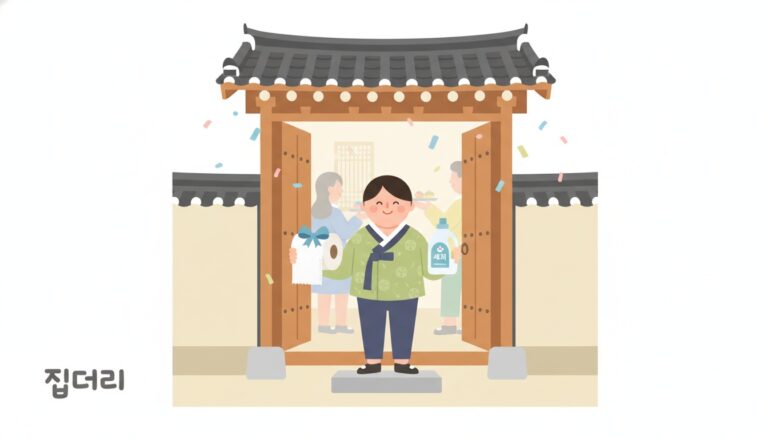
Have you ever watched a K-Drama where the characters move into a new house and invite their friends over for a party? That event is called Jipdeuri (집들이)!
If a Korean friend invites you to their new home, it means you are a very special friend to them. 🥰 Today, we will learn how to accept that invitation naturally and enthusiastically. You don’t want to just say “Okay.” You want to sound like a real local! Let’s get started! 🚀
Key Expressions
Here are 3 essential phrases to accept an invitation and show your excitement!
1. 초대해 줘서 고마워!
- Pronunciation: [Chodaehae jwoseo gomawo!]
- Meaning: Thanks for inviting me!
- Detail: This is a casual way to thank a friend. If you are talking to someone older or in a formal setting, you should say “초대해 주셔서 감사합니다 (Chodaehae jusyeoseo gamsahamnida).”
- 💡 Pronunciation Tip: In 줘서 (jwoseo), try to pronounce the ‘w’ sound clearly but quickly. It flows like ‘jwo-seo’.
2. 당연히 가야지 / 갈게!
- Pronunciation: [Dangyeonhi gayaji / Galge!]
- Meaning: Of course I’ll go / I’ll be there!
- Detail: 당연히 (Dangyeonhi) means “of course” or “naturally.” Adding this word shows strong willingness and enthusiasm. It makes the host feel happy!
- 💡 Pronunciation Tip: The ㅎ (h) in 당연히 is often weak. It sounds almost like [Dang-yeo-ni].
3. 뭐 사 갈까?
- Pronunciation: [Mwo sa galkka?]
- Meaning: What should I buy/bring?
- Detail: In Korea, it is polite not to go to a housewarming party empty-handed. Asking this shows you have good manners (Sense! 센스!).
- 💡 Pronunciation Tip: When pronouncing 갈까 (galkka), the double ㄲ sounds stronger and tense compared to a single ‘k’. It’s a sharp sound!
Real-life Conversation
Let’s see how Minji invites her friend Jason to her new house via text message. 📱
Minji: 제이슨, 이번 주 토요일에 우리 집에서 집들이 할 거야. 올 수 있어?
(Jason, I’m having a housewarming party this Saturday. Can you come?)
Jason: 와, 정말? 초대해 줘서 고마워! 당연히 가야지!
(Wow, really? Thanks for inviting me! Of course I’ll go!)
Minji: 잘됐다! 맛있는 거 많이 만들게.
(That’s great! I’ll make lots of delicious food.)
Jason: 기대된다! 빈손으로 갈 수 없지. 뭐 사 갈까?
(I’m looking forward to it! I can’t go empty-handed. What should I bring?)
Minji: 그냥 몸만 와! 😊
(Just bring yourself! 😊)
Cultural Tip: K-Housewarming Gifts 🎁
Did you notice Jason asked, “What should I buy?”
In Korea, for a Jipdeuri (Housewarming), there are two classic gifts that carry special meanings:
- Toilet Paper (휴지 – Hyuji): It symbolizes the hope that the host’s problems will “unroll” easily like toilet paper.
- Laundry Detergent (세제 – Seje): It symbolizes the hope that the host’s wealth will “bubble up” like detergent foam.
So, if you bring these, your Korean friends will be surprised by your cultural knowledge! 😲👏
Conclusion & Quiz
Today we learned how to accept a housewarming invitation with excitement! Don’t forget to ask what to bring to show your manners. 😉
📝 Mini Quiz
- How do you say “Of course I’ll go!” in casual Korean?
( Hint: D_______ G_____ ) -
(True/False) It is polite to go to a Korean housewarming party empty-handed.
-
Which gift symbolizes “wealth bubbling up”?
a) Water
b) Detergent
c) Flowers
See you next time with more fun Korean! 안녕! 👋
Answers:
1. 당연히 가야지 (Dangyeonhi gayaji)
2. False (You should bring a small gift!)
3. b) Detergent
Frequently Asked Questions (FAQ)
Q: What does "초대해 줘서 고마워!" mean in Korean and how do you pronounce it?
A: In Korean, "초대해 줘서 고마워!" is pronounced [Chodaehae jwoseo gomawo!] and means: Thanks for inviting me!
Q: What does "당연히 가야지 / 갈게!" mean in Korean and how do you pronounce it?
A: In Korean, "당연히 가야지 / 갈게!" is pronounced [Dangyeonhi gayaji / Galge!] and means: Of course I'll go / I'll be there!
Q: What does "뭐 사 갈까?" mean in Korean and how do you pronounce it?
A: In Korean, "뭐 사 갈까?" is pronounced [Mwo sa galkka?] and means: What should I buy/bring?







