

Introduction
Hello, everyone! It’s Daily Hangul, here to upgrade your Korean skills! 👋✨
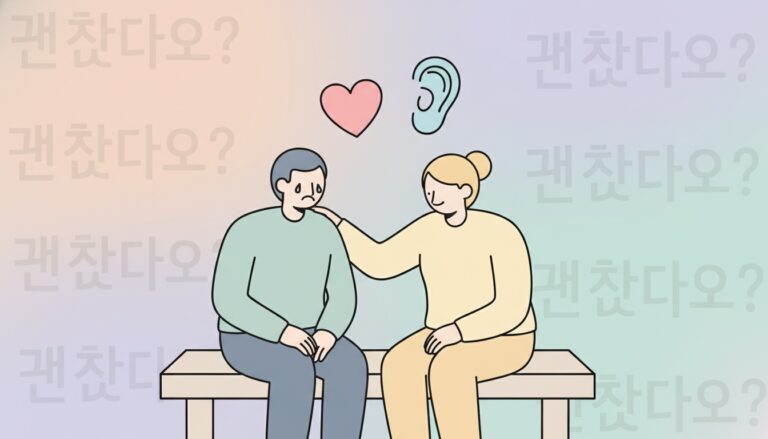
Today, we are going to talk about a very important topic: Mental Health. Just like we need a bandage for a cut, sometimes our hearts need first aid too. Have you ever seen a scene in a K-Drama where the main character looks sad, and their friend gently asks, “Are you okay?” 😢❤️
Knowing how to ask about someone’s feelings and offer comfort is a superpower in Korea. It shows you care! Today, let’s learn the basic expressions of Mental Health First Aid to help your friends when they are feeling down. Let’s start! 🚀
Key Expressions
1. 괜찮아요? (Are you okay?)
- Pronunciation: [Gwaenchanayo?]
- English Meaning: Are you okay?
- Detail: This is the most essential phrase! You hear this in every K-Drama (like It’s Okay to Not Be Okay). You can use this when someone looks sick, sad, or after they make a mistake. It’s a gentle way to check on them.
- 💡 Pronunciation Tip: Even though it is written as
괜찮아요, the ‘ㅎ’ (h) sound in the bottom is often silent or very weak. It sounds more like [Gwaen-cha-na-yo]. Say it softly for a caring vibe! 🤫
2. 무슨 일 있어요? (Is something wrong?)
- Pronunciation: [Museun il isseoyo?]
- English Meaning: Is something wrong? / What happened?
- Detail: If your friend sighs deeply or looks worried, you can ask this. “Museun” (무슨) means “what kind of,” and “Il” (일) means “matter” or “event.” You are asking, “Is there some matter?”
- 💡 Pronunciation Tip: When saying
일 있어요, the ‘ㄹ’ (l) sound moves over to the next vowel. It sounds like [I-ri-sseo-yo]. Connect the sounds smoothly! 🌊
3. 이야기 들어줄게요. (I will listen to you.)
- Pronunciation: [Iyagi deureojulgeyo.]
- English Meaning: I will listen to your story / I’m here to listen.
- Detail: Sometimes, people just need someone to listen. This is a very warm and supportive phrase. It tells your friend that they are not alone and you are ready to be a “good listener.”
4. 힘내세요! (Cheer up!)
- Pronunciation: [Himnaeseyo!]
- English Meaning: Cheer up! / Be strong!
- Detail: “Him” (힘) means strength or power. You are literally telling them to “bring out their strength.” It is the standard phrase for encouragement in Korea.
Real-life Conversation
Situation: Min-ji looks very down at a cafe, and her friend Jason notices.
Jason: 민지 씨, 얼굴이 안 좋아요. 괜찮아요? 😟
(Minji-ssi, eolguri an joayo. Gwaenchanayo?)
[Min-ji, you don’t look good. Are you okay?]
Min-ji: 아니요, 사실 좀 힘들어요. 😞
(Aniyo, sasil jom himdeureoyo.)
[No, actually I’m having a hard time.]
Jason: 무슨 일 있어요? 저한테 말해봐요.
(Museun il isseoyo? Jeohante malhaebwayo.)
[Is something wrong? Try telling me.]
Min-ji: 요즘 스트레스가 너무 많아요.
(Yojeum seuteureseuga neomu manayo.)
[I have too much stress these days.]
Jason: 그렇군요. 제가 이야기 들어줄게요. 커피 마시고 힘내세요! ☕️💪
(Geureokunyo. Jega iyagi deureojulgeyo. Keopi masigo himnaeseyo!)
[I see. I will listen to you. Drink some coffee and cheer up!]
Cultural Tip 🇰🇷
“Jeong” (정) and Sharing Burdens
In Korea, there is a unique concept called Jeong (정), which is a deep feeling of attachment and bond between people. Because of Jeong, Koreans often feel that sharing sadness makes it smaller! 🤝
Also, did you know? Asking “Have you eaten?” (밥 먹었어요? Bap meogeosseoyo?) is another way Koreans check on someone’s mental health. If someone is too sad to eat, it’s a big worry for Koreans. So, if you want to comfort someone, buying them a warm meal is sometimes the best “Mental Health First Aid”! 🥘❤️
Conclusion & Quiz
Today we learned how to be a supportive friend in Korean. Remember, a simple “Gwaenchanayo?” can make someone’s day much better! Try using these expressions with your friends or language partners.
📝 Mini Quiz!
- How do you ask “Are you okay?” in Korean?
( A. 안녕하세요 / B. 괜찮아요 ) -
Fill in the blank: “_______ isseoyo?” (Is something wrong?)
( A. 무슨 일 (Museun il) / B. 좋은 일 (Joeun il) ) -
What does “Himnaeseyo” mean?
( A. Good night / B. Cheer up )
Answer Key:
1. B (Gwaenchanayo)
2. A (Museun il)
3. B (Cheer up)
Frequently Asked Questions (FAQ)
Q: What does "괜찮아요? (Are you okay?)" mean in Korean and how do you pronounce it?
A: In Korean, "괜찮아요? (Are you okay?)" is pronounced [Gwaenchanayo?] and means: Are you okay?
Q: What does "무슨 일 있어요? (Is something wrong?)" mean in Korean and how do you pronounce it?
A: In Korean, "무슨 일 있어요? (Is something wrong?)" is pronounced [Museun il isseoyo?] and means: Is something wrong? / What happened?
Q: What does "이야기 들어줄게요. (I will listen to you.)" mean in Korean and how do you pronounce it?
A: In Korean, "이야기 들어줄게요. (I will listen to you.)" is pronounced [Iyagi deureojulgeyo.] and means: I will listen to your story / I'm here to listen.
Q: What does "힘내세요! (Cheer up!)" mean in Korean and how do you pronounce it?
A: In Korean, "힘내세요! (Cheer up!)" is pronounced [Himnaeseyo!] and means: Cheer up! / Be strong!







