

Hello! It’s Daily Hangul! (DailyHangul.com)
Hello, K-Culture lovers! 😊 Welcome back to Daily Hangul, your best friend for learning Korean easily and funnily!
Have you ever watched a K-Drama scene where the main character walks into a street food stall and confidently orders Tteokbokki? Or have you imagined yourself in a trendy Seoul cafe, wanting to order two iced Americanos, but you only know how to point with your finger? 👉👈
Don’t worry! Today, we are going to learn the essential survival skill for your food trips in Korea: Counting and Ordering Items! specifically focusing on “One” and “Two.” By the end of this post, you’ll be ordering like a local! Let’s go! 🚀
🍎 Core Expressions: Counting 1, 2, 3
In Korean, there are two number systems. For counting things (like apples, coffees, or tickets), we use Native Korean Numbers.
Here is the magic rule: When numbers meet a “counter word” (like ‘piece’ or ‘cup’), their shape changes slightly! 😲
1. One item
- Korean: 한 개
- Pronunciation: [Han gae]
- Meaning: One piece / One item
- Detail: The original number for one is 하나 (Hana). But when you count items using the generic counter 개 (gae), Hana becomes Han.
2. Two items
- Korean: 두 개
- Pronunciation: [Du gae]
- Meaning: Two pieces / Two items
- Detail: The number for two is 둘 (Dul). However, just like number one, when attached to a counter, the bottom sound ‘l’ disappears! So, Dul becomes Du.
3. Give me ~ please
- Korean: ~ 주세요
- Pronunciation: [~ Juseyo]
- Meaning: Please give me ~
- Detail: This is the magic phrase for ordering. You put the item and quantity first, then add Juseyo. It’s polite and works everywhere!
💡 Pronunciation Tip!
Why do we shorten the numbers? It’s for flow! Saying “Hana gae” or “Dul gae” feels clunky to Korean speakers.
– Hana ➔ Han (한)
– Dul ➔ Du (두)
– Set (3) ➔ Se (세)
Remember: Han, Du, Se! It sounds much smoother, right? 🎵
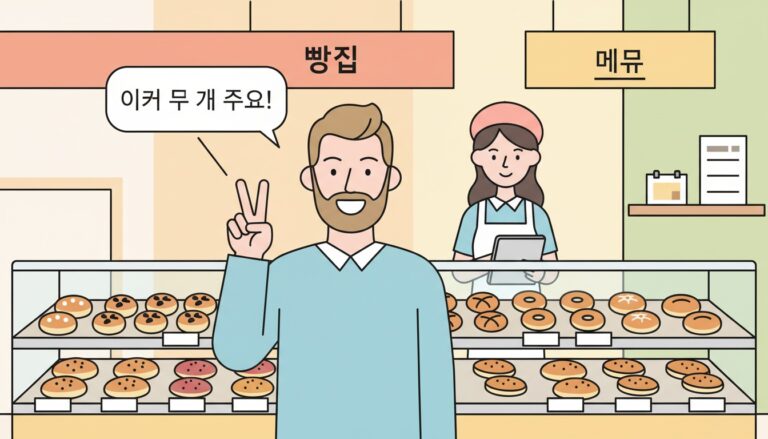
🗣️ Real Dialogue: At a Bakery 🍞
Imagine you are at a famous bakery in Hongdae. You see delicious salt bread (Sogum-ppang)!
A: Staff (Jigwon)
B: You (Customer)
A: 어서 오세요! 주문 도와드릴까요?
[Eoseo oseyo! Jumun dowadeurilkkayo?]
(Welcome! Can I help you order?)
B: 이 빵 맛있어요?
[I ppang masisseoyo?]
(Is this bread delicious?)
A: 네, 아주 인기 많아요!
[Ne, aju ingi manayo!]
(Yes, it’s very popular!)
B: 그럼, 이거 **두 개 주세요.**
[Geureom, igeo du gae juseyo.]
(Then, please give me two of these.)
A: 네, 알겠습니다!
[Ne, algesseumnida!]
(Okay, understood!)
🇰🇷 Culture Tip: The Universal Counter “Gae (개)”
Korean has many specific counters (e.g., ‘jan’ for cups, ‘byeong’ for bottles, ‘myeong’ for people).
However, as a beginner, remembering all of them is super hard! 🤯
Here is a secret: If you forget the specific counter, just use 개 (gae)!
It literally means “piece” or “item” and is understood for almost any inanimate object (apples, burgers, hats, etc.).
So, if you are at a cafe and forget the word for “cup,” saying “Coffee Han gae (One coffee)” is perfectly okay! Koreans will understand you 100%. 😉
📝 Wrap-up & Quiz
Great job today! You are now ready to order items without just pointing at the menu. Remember the rhythm: Han, Du, Se!
Let’s check your understanding!
Q1. How do you say “Two items” in Korean?
(A) Dul gae
(B) Du gae
Q2. Fill in the blank to order one apple.
Apple ______ juseyo. (Apple one item please give me.)
Q3. True or False?
When counting objects, you use the number “Hana” exactly as it is without changing it. (O / X)
[Answers]
1. (B) Du gae (Remember to drop the ‘l’!)
2. Han gae (한 개)
3. X (False! Hana becomes Han before a counter.)
Frequently Asked Questions (FAQ)
Q: What does "One item" mean in Korean and how do you pronounce it?
A: In Korean, "One item" is pronounced [Han gae] and means: One piece / One item
Q: What does "Two items" mean in Korean and how do you pronounce it?
A: In Korean, "Two items" is pronounced [Du gae] and means: Two pieces / Two items
Q: What does "Give me ~ please" mean in Korean and how do you pronounce it?
A: In Korean, "Give me ~ please" is pronounced [~ Juseyo] and means: Please give me ~







