

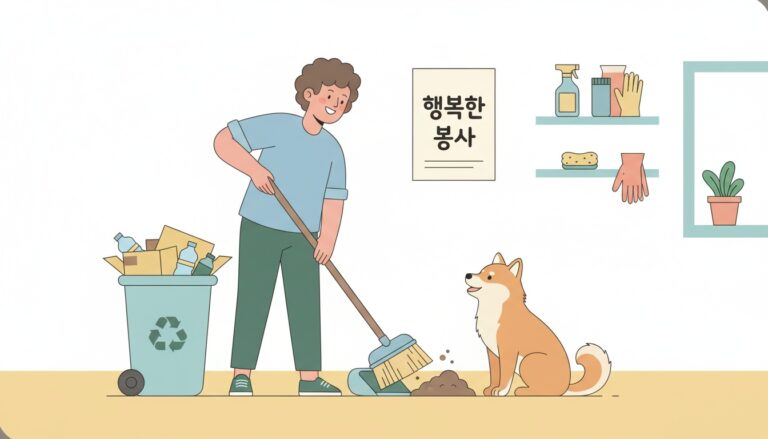
Volunteer in Korea: Let’s Clean Together! 🧹🐶
🌟 Intro
Hello, Daily Hangul family! It’s your favorite Korean tutor, Daily Hangul! 😊
Have you ever seen your favorite K-pop idols or K-drama stars volunteering at animal shelters or community centers? It is a heartwarming part of Korean culture! Today, we are going to learn how to be a helpful hero in Korea.
Imagine you are volunteering at a shelter (bohosso). You need to communicate with other volunteers to clean up and organize. Don’t worry! These expressions are super simple and useful. Let’s make the world cleaner and your Korean better! Fighting! (Hwaiting!) 💪
📚 Key Expressions
Here are 4 phrases you must know when helping out with cleaning!
1. 청소 도구 어디 있어요?
- Pronunciation: [Cheongso dogu eodi isseoyo?]
- English: Where are the cleaning tools?
- Explanation: When you arrive, you need equipment! ‘Cheongso’ means cleaning, and ‘dogu’ means tools. You can replace ‘Cheongso dogu’ with specific items like ‘Bitjaru’ (broom) or ‘Geolle’ (rag/mop).
- 💡 Pronunciation Tip: In ‘Isseoyo’ (있어요), the double ‘s’ (ㅆ) sound moves to the next block because the next letter is a placeholder ‘o’ (ㅇ). So it sounds like [i-sseo-yo].
2. 제가 바닥을 쓸게요.
- Pronunciation: [Jega badeugeul sseulgeyo.]
- English: I will sweep the floor.
- Explanation: ‘Jega’ means ‘I’ (humble form). ‘Sseulgeyo’ comes from the verb ‘sseulda’ (to sweep). Use this when you want to volunteer for a specific task!
- 💡 Pronunciation Tip: Be careful with ‘Ss’ (ㅆ) in ‘Sseulgeyo’. It is a strong, hissing sound! Tense your tongue to make a sharp ‘S’ sound.
3. 쓰레기통 비워주세요.
- Pronunciation: [Sseuregitong biwojuseyo.]
- English: Please empty the trash can.
- Explanation: ‘Sseuregitong’ is a trash can. ‘Biwojuseyo’ means ‘Please empty it’. Teamwork is key! Use this when asking a partner for help.
4. 수고하셨습니다!
- Pronunciation: [Sugohasyeotseumnida!]
- English: Thank you for your hard work! / Good job!
- Explanation: This is the most important phrase in Korean work culture! You say this to everyone when the work is finished. It shows respect and appreciation.
💬 Real-life Conversation
Let’s see how Minji and Paul (a foreign volunteer) talk at a dog shelter.
Minji: 안녕하세요! 오늘 같이 청소해요. (Hello! Let’s clean together today.)
Paul: 네! 청소 도구 어디 있어요? (Yes! Where are the cleaning tools?)
Minji: 저쪽에 있어요. (They are over there.)
Paul: 알겠어요. 제가 바닥을 쓸게요. (Okay. I will sweep the floor.)
Minji: 좋아요. 그럼 저는 창문을 닦을게요. (Good. Then I will wipe the windows.)
(After 1 hour)
Paul: 와, 정말 깨끗해요! (Wow, it’s really clean!)
Minji: 오늘 수고하셨습니다! (You worked hard today!)
🇰🇷 Culture Tip: Bunli-sugeo (Recycling)
In Korea, cleaning isn’t just about sweeping! ‘Bunli-sugeo’ (분리수거), or separate recycling, is extremely important. ♻️
When you clean a facility, you cannot throw everything in one bag. You must separate:
* Ilban (General trash) 🗑️
* Plastic (Plastics)
* Kaen (Cans)
* Jong-i (Paper)
If you mix them, the trash might not be collected! Showing you know how to sort trash makes you look like a local expert! 😎
📝 Wrap-up & Quiz
Today we learned how to be helpful volunteers! Volunteering is a great way to make Korean friends. Don’t be shy to say “Jega halgeyo” (I will do it)!
Pop Quiz!
- How do you say “Where is the broom?” in Korean?
(Hint: Broom = Bitjaru)
A: Bitjaru eodi isseoyo?
B: Bitjaru annyeonghaseyo? -
True or False: In Korea, you can throw all trash into one big bag.
( ) True / ( ) False
Answers:
1. A (Bitjaru eodi isseoyo?)
2. False (You must do ‘Bunli-sugeo’ / Recycling!)
Frequently Asked Questions (FAQ)
Q: What does "청소 도구 어디 있어요?" mean in Korean and how do you pronounce it?
A: In Korean, "청소 도구 어디 있어요?" is pronounced [Cheongso dogu eodi isseoyo?] and means: a key conversational Korean expression covered in this lesson.
Q: What does "제가 바닥을 쓸게요." mean in Korean and how do you pronounce it?
A: In Korean, "제가 바닥을 쓸게요." is pronounced [Jega badeugeul sseulgeyo.] and means: a key conversational Korean expression covered in this lesson.
Q: What does "쓰레기통 비워주세요." mean in Korean and how do you pronounce it?
A: In Korean, "쓰레기통 비워주세요." is pronounced [Sseuregitong biwojuseyo.] and means: a key conversational Korean expression covered in this lesson.
Q: What does "수고하셨습니다!" mean in Korean and how do you pronounce it?
A: In Korean, "수고하셨습니다!" is pronounced [Sugohasyeotseumnida!] and means: a key conversational Korean expression covered in this lesson.







