

Hello! It’s Daily Hangul! 👋
Hello, everyone! It’s Daily Hangul (DailyHangul.com), here to upgrade your Korean skills! 🚀
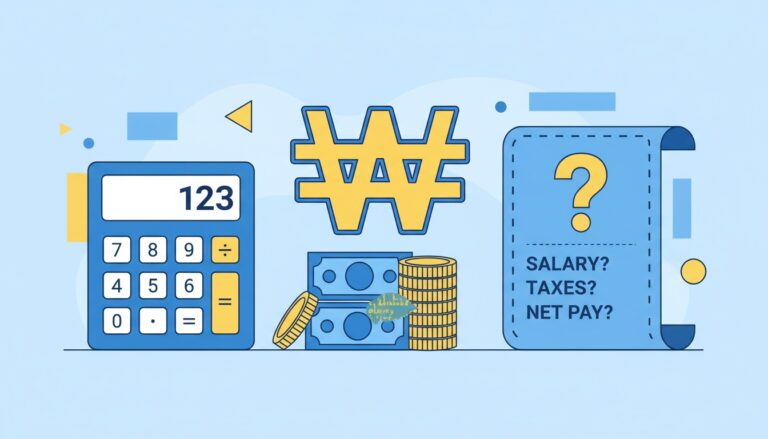
Have you ever received your paycheck (or looked at a contract) and thought, “Wait, why is the amount different from what I expected?” 🤔
In Korea, just like in many other countries, taxes are automatically deducted from your salary. Whether you are working part-time, as a freelancer, or as a full-time employee, understanding Income Tax (소득세) is crucial!
Today, we will learn how to ask about taxes and your actual take-home pay. You might hear these terms in office K-dramas like Misaeng (Incomplete Life) or Start-Up when characters discuss their salaries. Let’s get started! 💼💸
Core Expressions 🗣️
Here are the 4 essential expressions you need to know when talking about taxes and salary.
1. 소득세 [Sodeuk-se]
- English: Income tax
- Explanation: This is the formal word for the tax on your earnings. ‘소득’ means income, and ‘세’ stands for tax.
- 💡 Pronunciation Tip: Pronounce it clearly as [So-deuk-se]. There are no tricky sound changes here!
2. 세금 [Segeum]
- English: Tax
- Explanation: This is the general word for ‘tax’. It is used more often in casual conversation than ‘소득세’.
- 💡 Pronunciation Tip: Just like it is written: [Se-geum].
3. 얼마나 공제돼요? [Eolmana gongje-dwaeyo?]
- English: How much is deducted?
- Explanation: ‘공제’ (Gongje) means deduction. This is a polite way to ask HR or your boss how much money is being taken out for taxes or insurance.
- 💡 Pronunciation Tip: The ‘oe’ in ‘dwaeyo’ sounds like ‘weh’. So say it like [gong-je-dweh-yo].
4. 세금 떼고 얼마예요? [Segeum ttego eolmayeyo?]
- English: How much is it after tax? (Lit. Taking off tax, how much is it?)
- Explanation: This is a very common, slightly more casual (but still polite with ‘-yo’) way to ask for your net pay. ‘떼다’ (tteda) means to remove or take off.
- 💡 Pronunciation Tip: ‘떼’ (tte) has a double consonant ‘ㄸ’. You need to tense your mouth and make a strong ‘T’ sound, almost like the ‘t’ in ‘stop’.
Real-life Dialogue 💬
Imagine you are discussing your first paycheck with the HR manager.
Min-su (Employee): 저기요, 월급에 대해 질문 있어요.
[Jeogiyo, wolgeube daehae jilmun isseoyo.]
(Excuse me, I have a question about my salary.)
Manager: 네, 말씀하세요.
[Ne, malseumhaseyo.]
(Yes, go ahead.)
Min-su: 이번 달 소득세는 얼마나 공제돼요?
[Ibeon dal sodeukseneun eolmana gongje-dwaeyo?]
(How much income tax is deducted this month?)
Manager: 3.3%가 공제됩니다.
[Sam-jeom-sam peosenteuga gongje-doemnida.]
(3.3% will be deducted.)
Min-su: 아, 그럼 세금 떼고 얼마예요?
[A, geureom segeum ttego eolmayeyo?]
(Ah, then how much is it after tax?)
Manager: 통장으로 200만 원 들어올 거예요.
[Tongjangeuro ibaek-man won deureool geoyeyo.]
(2 million won will come into your bank account.)
Culture Tip 🇰🇷
“The 13th Month Salary” (13월의 월급)
Have you heard of Yeonmal-jeongsan (연말정산)? It means “Year-end Tax Settlement.” In Korea, employees settle their taxes at the beginning of the next year (usually January or February).
If you paid more taxes than necessary, you get money back! Koreans jokingly call this refund “The 13th Month Salary.” But be careful—if you didn’t pay enough, you might have to pay extra! 😲 Make sure to keep your receipts (cash receipts) to get a better tax refund!
Wrap-up & Quiz 📝
Now you can confidently ask about your hard-earned money! Don’t be shy when talking about finances. It’s important!
Let’s practice! (Answers are at the bottom)
- What is the Korean word for “Income Tax”?
( Hint: S_ _ _ _ _ – s _ ) - Fill in the blank: 세금 _____ 얼마예요? (How much is it after taking off tax?)
a) 넣고 (neoko) b) 떼고 (ttego)
See you next time! 안녕! 👋
Answers:
1. 소득세 (Sodeuk-se)
2. b) 떼고 (ttego)
Frequently Asked Questions (FAQ)
Q: What does "소득세 [Sodeuk-se]" mean in Korean and how do you pronounce it?
A: In Korean, "소득세 [Sodeuk-se]" is pronounced [Tip: Pronounce it clearly as [So-deuk-se] and means: a key conversational Korean expression covered in this lesson.
Q: What does "세금 [Segeum]" mean in Korean and how do you pronounce it?
A: In Korean, "세금 [Segeum]" is pronounced [Tip: Just like it is written: [Se-geum] and means: a key conversational Korean expression covered in this lesson.
Q: What does "얼마나 공제돼요? [Eolmana gongje-dwaeyo?]" mean in Korean and how do you pronounce it?
A: In Korean, "얼마나 공제돼요? [Eolmana gongje-dwaeyo?]" is pronounced [Tip: The 'oe' in 'dwaeyo' sounds like 'weh'. So say it like [gong-je-dweh-yo] and means: a key conversational Korean expression covered in this lesson.
Q: What does "세금 떼고 얼마예요? [Segeum ttego eolmayeyo?]" mean in Korean and how do you pronounce it?
A: In Korean, "세금 떼고 얼마예요? [Segeum ttego eolmayeyo?]" is pronounced [Tip: '떼' (tte] and means: a key conversational Korean expression covered in this lesson.







