

Introduction
Hello! It’s Daily Hangul (DailyHangul.com), here to upgrade your Korean skills! 🌟
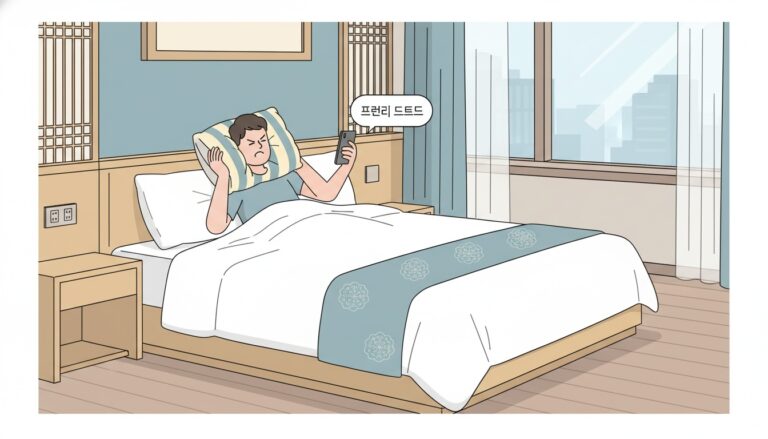
Imagine this: You finally arrived in Korea for your dream trip. You check into your hotel, ready to rest after a long flight… but wait! 😱 The people in the room next door are having a loud party! You need your beauty sleep to explore Seoul tomorrow.
In K-Dramas, the main character might bang on the wall or shout, but in real life, calling the front desk is the best solution. Today, let’s learn how to politely but firmly complain about noise so you can get a good night’s sleep! 😴📞
Key Expressions
1. 옆방이 너무 시끄러워요.
- Pronunciation: [Yeopbangi neomu sikkeureowoyo]
- Meaning: The room next door is too noisy.
- Explanation:
- Yeopbang (옆방) means “next room” or “room next door.”
- Sikkeureowoyo (시끄러워요) comes from the adjective “to be noisy.”
- This is the most direct way to explain the situation to the hotel staff.
2. 잠을 못 자겠어요.
- Pronunciation: [Jameul mot jagesseoyo]
- Meaning: I can’t sleep.
- Explanation:
- Mot (못) means “cannot.”
- Adding this phrase emphasizes how serious the problem is. It tells the staff, “This is really bothering me!”
3. 확인 좀 부탁드려요.
- Pronunciation: [Hwagin jom butakdeuryeoyo]
- Meaning: Please check on it.
- Explanation:
- Hwagin (확인) means “check” or “confirmation.”
- Butakdeuryeoyo (부탁드려요) is a very polite way to say “I ask you” or “Please.”
- It’s a gentle but clear request for the staff to take action.
💡 Pronunciation Tip
Linking Sounds (Liason):
In the phrase 옆방이 (Yeopbangi), the bottom consonant ‘ㅂ’ (p/b) moves to the next syllable because ‘이’ starts with a vowel.
So, instead of saying [Yeop-bang-i], it sounds more like [Yeop-ban-gi]. This makes your speech flow smoothly like a native! 🌊
Real Conversation
(A: Guest / B: Hotel Staff)
A: 여보세요? 여기 501호인데요.
(Yeoboseyo? Yeogi 501-hoindeyo.)
Hello? This is room 501.
B: 네, 고객님. 무엇을 도와드릴까요?
(Ne, gogaeknim. Mueoseul dowadeurilkkayo?)
Yes, sir/ma’am. How can I help you?
A: 옆방이 너무 시끄러워요. 잠을 못 자겠어요.
(Yeopbangi neomu sikkeureowoyo. Jameul mot jagesseoyo.)
The room next door is too noisy. I can’t sleep.
B: 죄송합니다. 바로 확인해 보겠습니다.
(Joesonghamnida. Baro hwagi-nhae bogetseumnida.)
I apologize. I will check on it immediately.
A: 네, 부탁드려요.
(Ne, butakdeuryeoyo.)
Yes, please.
Culture Tip 🇰🇷
“Indirect Conflict Resolution”
In Korea, avoiding direct confrontation with strangers is often preferred to maintain social harmony. Instead of knocking on the neighbor’s door yourself (which might be seen as aggressive or rude), it is considered much more polite and safe to ask a manager or staff member to mediate the situation. So, don’t hesitate to call the front desk (프런트 데스크)! They are used to handling these situations quickly (“Palli-palli” culture! 🚀).
Wrap-up & Quiz
Today, we learned how to handle a noise complaint at a hotel. Now you can protect your peaceful night in Korea! 🌙
Let’s check what you learned!
- Fill in the blank:
“The room next door is too noisy.”
= ________이 너무 시끄러워요. (________i neomu sikkeureowoyo.) -
True or False:
It is better to knock on the neighbor’s door and shout than to call the front desk in Korea. (O / X)
Answers:
1. 옆방 (Yeopbang)
2. X (False! Call the front desk for a polite resolution.)
Frequently Asked Questions (FAQ)
Q: What does "옆방이 너무 시끄러워요." mean in Korean and how do you pronounce it?
A: In Korean, "옆방이 너무 시끄러워요." is pronounced [Yeopbangi neomu sikkeureowoyo] and means: The room next door is too noisy.
Q: What does "잠을 못 자겠어요." mean in Korean and how do you pronounce it?
A: In Korean, "잠을 못 자겠어요." is pronounced [Jameul mot jagesseoyo] and means: I can't sleep.
Q: What does "확인 좀 부탁드려요." mean in Korean and how do you pronounce it?
A: In Korean, "확인 좀 부탁드려요." is pronounced [Hwagin jom butakdeuryeoyo] and means: Please check on it.







