

✨ Annyeonghaseyo! It’s Daily Hangul! ✨
Hello, everyone! ❤️ Welcome back to Daily Hangul, your best friend for learning Korean!
Today, we are going to talk about a slightly serious but very important topic: Money and Fairness! 💸⚖️
Have you ever watched a K-Drama where a Chaebol (rich conglomerate heir) gets in trouble for money issues? Or have you seen news about taxes in Korea? Understanding these words will help you understand Korean news and deep conversations much better! Don’t worry, I made it super easy for you! Let’s get started! 🚀
📚 Key Expressions: Taxes & Fairness
Here are 4 essential expressions to discuss wealth and duty!
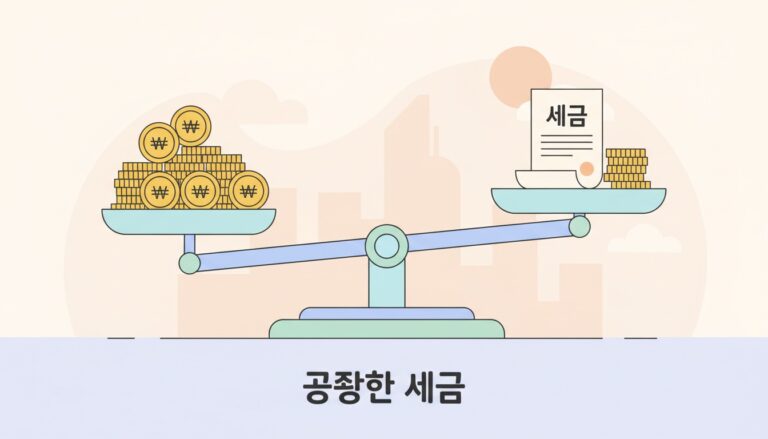
1. 세금 (Segeum)
- Pronunciation: [Se-geum]
- English Meaning: Tax
- Explanation: This is the money we pay to the government. In Korea, paying taxes honestly is considered a very important civic duty. You will hear this word often in the news!
- 💡 Pronunciation Tip: The ‘S’ is soft, like ‘Sun’. ‘Geum’ sounds like the ‘gum’ in ‘chewing gum‘.
2. 부자 (Buja)
- Pronunciation: [Bu-ja]
- English Meaning: Rich person / Wealthy person
- Explanation: You hear this all the time in K-Dramas! It refers to someone with a lot of money.
- 💡 Pronunciation Tip: ‘Bu’ is like ‘Boot’ without the ‘t’. ‘Ja’ is soft, not a strong ‘Z’ sound.
3. 공평해요 (Gongpyeonghaeyo)
- Pronunciation: [Gong-pyeong-hae-yo]
- English Meaning: It is fair
- Explanation: When you want to say that taxes or rules apply equally to everyone, you use this word. If it’s unfair, you can say “불공평해요” (Bulgongpyeonghaeyo).
- 💡 Pronunciation Tip: ‘Pyeong’ can be tricky! It’s one syllable. Try to say ‘Pyuh-ng’ smoothly.
4. 의무 (Uimu)
- Pronunciation: [Ui-mu]
- English Meaning: Duty / Obligation
- Explanation: Paying taxes is a citizen’s ‘duty’. It sounds a bit formal, but it’s a great word to know to sound smart!
- 💡 Pronunciation Tip: ‘Ui’ is a unique Korean vowel. Try to shape your mouth for ‘Eu’ and say ‘Ee’ quickly combined.
💬 Real-Life Conversation
Let’s see how friends talk about news regarding a rich celebrity!
(Situation: Minji and Paul are watching the news at a cafe.)
Minji: 저 뉴스 봤어? 저 부자가 세금을 안 냈대.
(Jeo nyuseu bwasseo? Jeo bujaga segeumeul an naetdae.)
Did you see that news? They say that rich person didn’t pay taxes.
Paul: 정말? 그건 공평하지 않아!
(Jeongmal? Geugeon gongpyeonghaji ana!)
Really? That is not fair!
Minji: 맞아. 우리는 세금을 열심히 내는데.
(Maja. Urineun segeumeul yeolsimhi naeneunde.)
Right. We pay taxes hard (diligently).
Paul: 시민의 의무는 중요해.
(Siminui uimuneun jungyohae.)
A citizen’s duty is important.
🇰🇷 Culture Tip: Yeonmal-jeongsan (Year-End Tax Settlement)
In Korea, there is a very famous season called “Yeonmal-jeongsan” (연말정산), which usually happens in January or February.
It’s a system where workers calculate the taxes they paid over the past year. If you spent money wisely (using cash receipts, credit cards, etc.), you might get money back! 💰 Koreans jokingly call this the “13th Month Salary” (13월의 월급) because getting that refund feels like a bonus. But if you didn’t manage it well, you might have to pay more… 😭
📝 Wrap-up & Quiz
Today we learned how to talk about money, taxes, and fairness! Even though it’s a serious topic, using words like “공평해요” (It’s fair) can be used in daily life, like when sharing a cake! 🍰
Let’s check your understanding! (Answers are at the bottom)
- What is the Korean word for “Tax”?
( A. 부자 / B. 세금 ) -
How do you say “It is fair” in Korean?
( ㅁㅇㅍㅇㅎㅐㅕ ) -
(O/X Quiz) “Buja” means a poor person.
( O / X )
Great job today! See you next time! Annyeong! 👋
Answers:
1. B. 세금
2. 공평해요
3. X (Buja means Rich person)
Frequently Asked Questions (FAQ)
Q: What does "세금 (Segeum)" mean in Korean and how do you pronounce it?
A: In Korean, "세금 (Segeum)" is pronounced [Se-geum] and means: Tax
Q: What does "부자 (Buja)" mean in Korean and how do you pronounce it?
A: In Korean, "부자 (Buja)" is pronounced [Bu-ja] and means: Rich person / Wealthy person
Q: What does "공평해요 (Gongpyeonghaeyo)" mean in Korean and how do you pronounce it?
A: In Korean, "공평해요 (Gongpyeonghaeyo)" is pronounced [Gong-pyeong-hae-yo] and means: It is fair
Q: What does "의무 (Uimu)" mean in Korean and how do you pronounce it?
A: In Korean, "의무 (Uimu)" is pronounced [Ui-mu] and means: Duty / Obligation







