

Introduction
Hello! It’s Daily Hangul, here to upgrade your Korean skills! 🌟
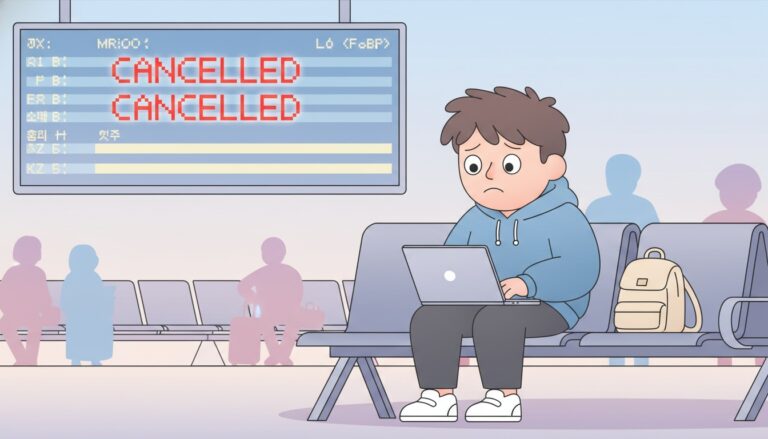
Are you a Digital Nomad working while traveling in Korea? Or maybe you are dreaming of a “workation” in Seoul or Jeju Island? Imagine this: You are enjoying your trip, but suddenly… 😱 Your flight gets canceled!
You have a team meeting in an hour, and you are stuck at the airport. Don’t panic! In K-Dramas, when the main character gets stuck on an island due to a typhoon, they call their boss immediately. Today, we will learn how to professionally inform your team about travel emergencies in Korean. Let’s become a pro digital nomad! 💼✈️
Key Expressions
Here are 3 essential expressions to survive a travel emergency.
1. 비행기가 취소됐어요.
- Pronunciation: [Bihaenggiga chwisodoesseoyo]
- Meaning: My flight was canceled.
- Explanation: This is the most direct way to explain the situation.
- 비행기 (Bihaenggi) means “airplane.”
- 취소 (Chwiso) means “cancellation.”
- 됐어요 (Doesseoyo) is the past tense form meaning “became” or “was done.”
- 💡 Pronunciation Tip: In 취소 (Chwiso), try to pronounce ‘Chwi’ quickly as one syllable. Also, 됐어요 sounds like [Dwaesseoyo] but is often pronounced closer to [Daesseoyo] in rapid speech.
2. 회의 시간을 바꾸고 싶어요.
- Pronunciation: [Hoeui siganeul bakkugo sipeoyo]
- Meaning: I want to change the meeting time.
- Explanation: When you are stuck, you might miss a scheduled meeting. Use this to propose a change.
- 회의 (Hoeui) means “meeting.”
- 바꾸다 (Bakkuda) means “to change.”
- ~고 싶어요 (~go sipeoyo) means “I want to…”
- 💡 Pronunciation Tip: 회의 (Hoeui) can be tricky! It is often pronounced as [Hwe-i] or even [He-i] in casual speech, which is easier to say!
3. 정말 죄송합니다.
- Pronunciation: [Jeongmal joesonghamnida]
- Meaning: I am really sorry.
- Explanation: In Korean business culture, even if the flight cancellation isn’t your fault, it’s polite to apologize for the disruption to the team’s schedule. This shows professionalism.
- 💡 Pronunciation Tip: Pay attention to 합니다 (Hamnida). Because of Korean sound rules, the ㅂ (b) sound changes to an ㅁ (m) sound when followed by ㄴ. So, pronounce it as [Ham-ni-da], not [Hab-ni-da]!
Real-life Conversation
Let’s see how Alex (a digital nomad) talks to Manager Kim when his flight from Jeju to Seoul is canceled.
📞 On the Phone
Alex: 팀장님, 큰일 났어요. 비행기가 취소됐어요.
(Team leader, big trouble. My flight was canceled.)
Manager Kim: 정말요? 날씨 때문인가요?
(Really? Is it because of the weather?)
Alex: 네, 태풍이 와요. 그래서 오늘 회의 시간을 바꾸고 싶어요.
(Yes, a typhoon is coming. So, I want to change the meeting time today.)
Manager Kim: 알겠어요. 조심해서 오세요.
(I understand. Please come back safely.)
Alex: 이해해 주셔서 감사합니다. 정말 죄송합니다.
(Thank you for understanding. I am really sorry.)
Culture Tip 🇰🇷
“Ho-gu” (Reporting) Culture
In Korean workplaces, quick reporting (보고, Bogo) is crucial. If a problem arises (like a canceled flight), telling your boss immediately is seen as very responsible. Don’t wait until the last minute!
Also, using the phrase “양해 부탁드립니다” (Yanghae butakdeurimnida), which means “I ask for your understanding,” makes you sound like a native business professional. Try adding this message in your team chat!
Conclusion & Quiz
Today, we learned how to handle unexpected travel mishaps while working remotely. Don’t worry about the disruption; just communicate clearly in Korean! 🌈
📝 Mini Quiz
- How do you say “My flight was canceled” in Korean?
- 비행기가 (________)됐어요.
- True or False: 죄송합니다 (Joesonghamnida) is pronounced as [Joe-song-hab-ni-da]. (O / X)
-
Which word means “Meeting”?
- A. 비행기 (Bihaenggi)
- B. 회의 (Hoeui)
⬇️ Answers ⬇️
- 취소 (Chwiso)
- X (False! It is pronounced [Joe-song-ham-ni-da])
- B
Frequently Asked Questions (FAQ)
Q: What does "비행기가 취소됐어요." mean in Korean and how do you pronounce it?
A: In Korean, "비행기가 취소됐어요." is pronounced [Bihaenggiga chwisodoesseoyo] and means: My flight was canceled.
Q: What does "회의 시간을 바꾸고 싶어요." mean in Korean and how do you pronounce it?
A: In Korean, "회의 시간을 바꾸고 싶어요." is pronounced [Hoeui siganeul bakkugo sipeoyo] and means: I want to change the meeting time.
Q: What does "정말 죄송합니다." mean in Korean and how do you pronounce it?
A: In Korean, "정말 죄송합니다." is pronounced [Jeongmal joesonghamnida] and means: I am really sorry.







