

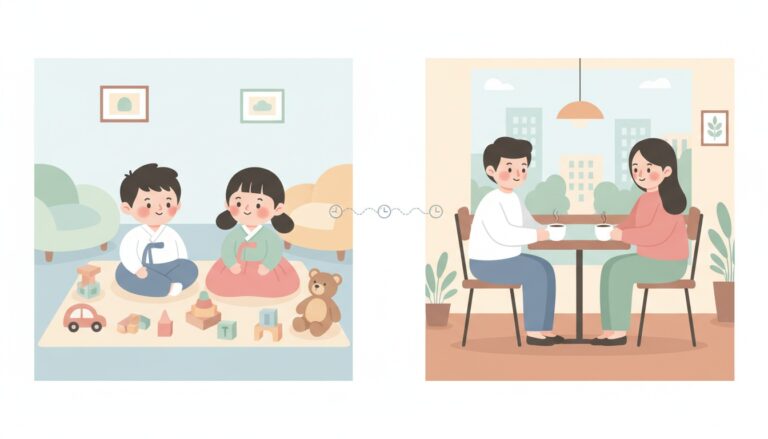
Childhood Friends vs. Now? 🧒➡️🧑 Let’s Compare!
Introduction
Annyeonghaseyo! It’s your favorite Korean tutor, Daily Hangul! 👋😊
Have you ever watched the K-drama Reply 1988 (응답하라 1988)? The bond between the characters is unbreakable because they grew up together. In Korea, friends you meet in childhood and friends you meet as an adult often feel different.
Today, we will learn how to compare relationships and talk about your “besties” in Korean. Whether you want to introduce your oldest friend or a new coworker you became close with, this lesson is for you! Let’s dive in! 🚀
Key Expressions
1. 소꿉친구 (Sokkup-chingu)
- Pronunciation: [Sokkup-chingu]
- English Meaning: Childhood friend
- Detail: This word is super cute! “소꿉 (Sokkup)” refers to “playing house” (a kids’ game), and “친구 (chingu)” means friend. So, it literally means a friend you played house with. You can use this for a friend you’ve known since you were very little.
- 💡 Pronunciation Tip: The ‘ㄲ’ in 소꿉 is a tense sound. Pronounce it sharply, like the ‘k’ in ‘sky’.
2. 친해요 (Chinhaeyo)
- Pronunciation: [Chinaeyo]
- English Meaning: (We are) close
- Detail: This comes from the adjective “친하다 (chinhada)”. You use this to describe the distance in a relationship.
- Example: “우리는 안 친해요.” (We are not close.)
- 💡 Pronunciation Tip: Notice the [Chinaeyo] pronunciation? When ‘ㅎ (h)’ comes between vowels or after ‘ㄴ(n)’, the sound becomes very weak or disappears. So instead of Chin-hae-yo, it sounds smoother like Chi-nae-yo.
3. ~보다 (Boda)
- Pronunciation: [Boda]
- English Meaning: Than (comparison particle)
- Detail: This is the magic grammar for today! You attach this to the noun you are comparing against.
- A boda B = (More/Less) than A.
- Example: “가족보다” (Than family).
Real-life Conversation
Situation: Min-ji is showing a photo to her foreign friend, Alex.
👱 Alex: 이 사진 누구예요? (I sajin nuguyeyo?)
Who is in this picture?
👩 Min-ji: 제 소꿉친구 지수예요. (Je sokkup-chingu Jisuyeyo.)
It’s my childhood friend, Jisoo.
👱 Alex: 와, 정말 오래됐네요! 지금도 친해요? (Wa, jeongmal oraedwaenneyo! Jigeumdo chinhaeyo?)
Wow, it’s been a long time! Are you still close?
👩 Min-ji: 네! 대학 친구들보다 더 친해요. (Ne! Daehak chingudeul-boda deo chinhaeyo.)
Yes! We are closer than my college friends.
Culture Tip 🇰🇷
“Are we really ‘Chingu’?”
In Korea, the word 친구 (Chingu) strictly implies you are the same age. If you are close but one person is older, you usually call them Unnie/Oppa/Hyung/Noona instead of just “Chingu.”
However, 소꿉친구 (Childhood friends) are the exception! Even if there is a slight age difference, if you grew up together like in Reply 1988, the hierarchy often disappears, and you just treat each other like family. Knowing this nuance makes you look like a pro! 😎
Conclusion & Quiz
Today we learned how to talk about our oldest friends and compare relationships using ~보다. Try using these words when introducing your friends to Koreans!
📝 Mini Quiz
- How do you say “Childhood friend” (literally ‘playing house friend’) in Korean?
( Hint: S_ _ _ _ _ – c _ _ _ _ _ ) -
True or False: The particle ~보다 (boda) is used to say “Hello”.
( O / X )
Answers:
1. 소꿉친구 (Sokkup-chingu)
2. X (It means “than” for comparison!)
Frequently Asked Questions (FAQ)
Q: What does "소꿉친구 (Sokkup-chingu)" mean in Korean and how do you pronounce it?
A: In Korean, "소꿉친구 (Sokkup-chingu)" is pronounced [Sokkup-chingu] and means: Childhood friend
Q: What does "친해요 (Chinhaeyo)" mean in Korean and how do you pronounce it?
A: In Korean, "친해요 (Chinhaeyo)" is pronounced [Chinaeyo] and means: (We are) close
Q: What does "~보다 (Boda)" mean in Korean and how do you pronounce it?
A: In Korean, "~보다 (Boda)" is pronounced [Boda] and means: Than (comparison particle)







