

Introduction
Annyeonghaseyo! 👋 It’s your favorite Korean tutor, Daily Hangul (DailyHangul.com)!
Have you ever watched intense Korean political dramas like Chief of Staff (보좌관) or Queenmaker? People in suits are always running around a big building with a dome roof, shouting about “passing the bill!” 🏃♂️💨
Today, we are going to learn some smart expressions related to how a bill becomes a law in Korea. Even if you aren’t a politician, these words appear frequently in the news and dramas. Let’s upgrade your Korean IQ today! Let’s go! (Gaja! 가자!) 🚀
Core Expressions 📚
Here are 4 key words to help you understand the journey of a law!
1. 국회 (Gukhoe)
- Pronunciation: [Guk-hoe]
- Meaning: National Assembly (Parliament)
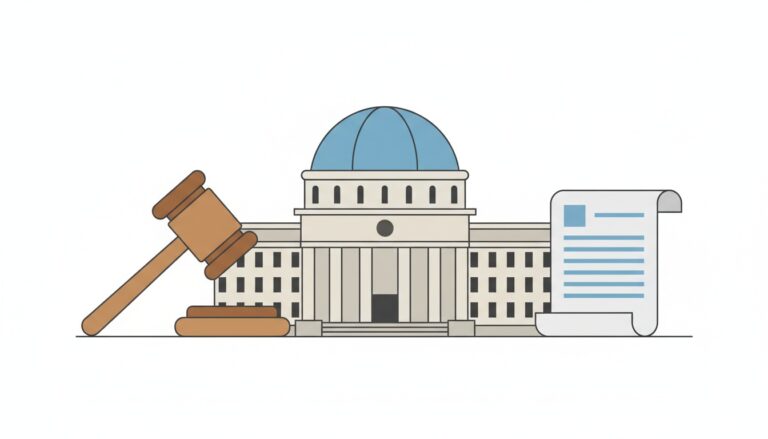
- Detail: This is where the laws are made. In Seoul, it’s located on an island called Yeouido. If you see a building with a giant blue-green dome in a drama, that is the Gukhoe!
- 💡 Pronunciation Tip: When ‘ㄱ’ (k) meets ‘ㅎ’ (h), they combine to make a strong ‘K’ sound. So instead of Guk-hoe, it sounds like [Gu-koe].
2. 법안 (Beoban)
- Pronunciation: [Beob-an]
- Meaning: Bill (Draft of a law)
- Detail: Before it becomes a law, it is just a proposal. This proposal is called Beoban. In dramas, politicians fight to protect their ‘Beoban’!
- 💡 Pronunciation Tip: Connect the sounds! The ‘ㅂ’ (b) at the bottom moves to the next syllable. It sounds like [Beo-ban].
3. 투표 (Tupyo)
- Pronunciation: [Tu-pyo]
- Meaning: Vote / Voting
- Detail: To make a bill into a law, politicians must vote. You can also use this word when voting for your favorite K-Pop idol on music shows! 🗳️
4. 통과 (Tonggwa)
- Pronunciation: [Tong-gwa]
- Meaning: Pass / Passage
- Detail: When a bill gets enough votes, it “passes.” We say “Tonggwa-dwaesseo” (It passed). You can also use this when you pass a test! ✅
Real-life Conversation 🗣️
Imagine two friends, Minji and Jason, watching the evening news.
Minji: 와! 드디어 그 법안이 국회를 통과했어!
(Wa! Deudieo geu beoban-i gukhoe-reul tonggwa-haesseo!)
Wow! Finally, that bill passed the National Assembly!
Jason: 정말? 투표 결과가 좋았어?
(Jeongmal? Tupyo gyeolgwa-ga joasseo?)
Really? Was the voting result good?
Minji: 응, 찬성이 많았어. 이제 진짜 법이 되는 거야.
(Eung, chanseong-i manasseo. Ije jinjja beop-i doeneun geoya.)
Yes, there were many ‘yes’ votes. Now it becomes a real law.
Jason: 다행이다!
(Dahaeng-ida!)
That’s a relief!
Culture Tip 🇰🇷
The Legend of the Robot beneath the Dome? 🤖
The National Assembly building in Yeouido has a distinctive green dome. There is a funny urban legend in Korea that says if the country is in great danger, the dome opens up and a giant robot (Taekwon V) comes out to save Korea! Of course, it’s just a joke, but it shows how iconic that building is to Koreans. Whenever you see that dome on TV, remember: that is where the Beoban (Bill) fights to become a Beop (Law)!
Wrap-up & Quiz 📝
Today we learned how a bill travels through the Gukhoe to become a law! Now you can understand the climax scenes in political K-dramas much better. 😎
Let’s check your memory!
- What is the Korean word for “National Assembly”?
( Hint: G _ _ h _ e ) - If a bill is successful, we say it “passed.” How do you say “Pass” in Korean?
A) Tupyo
B) Tonggwa
[Answers]
1. Gukhoe (국회)
2. B) Tonggwa (통과)
See you next time with more fun Korean! Annyeong! 👋
Frequently Asked Questions (FAQ)
Q: What does "국회 (Gukhoe)" mean in Korean and how do you pronounce it?
A: In Korean, "국회 (Gukhoe)" is pronounced [Guk-hoe] and means: National Assembly (Parliament)
Q: What does "법안 (Beoban)" mean in Korean and how do you pronounce it?
A: In Korean, "법안 (Beoban)" is pronounced [Beob-an] and means: Bill (Draft of a law)
Q: What does "투표 (Tupyo)" mean in Korean and how do you pronounce it?
A: In Korean, "투표 (Tupyo)" is pronounced [Tu-pyo] and means: Vote / Voting
Q: What does "통과 (Tonggwa)" mean in Korean and how do you pronounce it?
A: In Korean, "통과 (Tonggwa)" is pronounced [Tong-gwa] and means: Pass / Passage







