

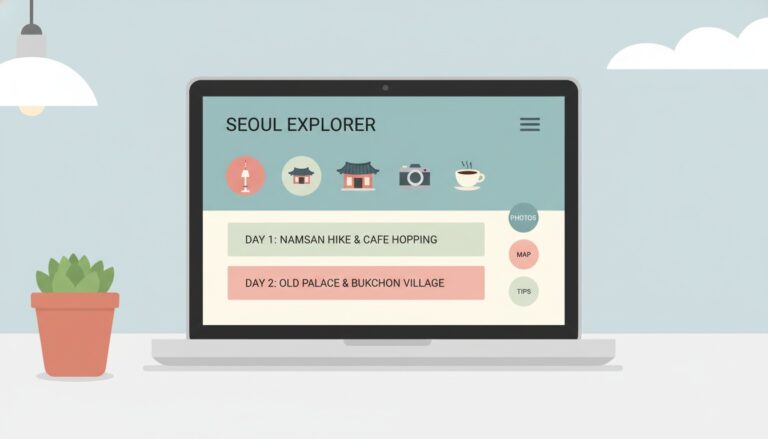
✈️ Tell Your Travel Story Like a Pro: Essential Korean Storytelling Words!
Introduction
Hello, everyone! It’s Daily Hangul, here to upgrade your Korean skills! 👋😊
Have you ever traveled to Korea or planned a dream trip? When you come back, you want to tell your friends all about it, right? “First, I did this, then I did that…”
Just saying “It was good” is boring! To make your travel story exciting—like a Travel Vlog on YouTube—you need to know how to structure your story.
Today, we will learn the magic words that connect your travel memories into a perfect story. These are super useful not just for travel, but for any daily conversation! Let’s get started! 🚀
Key Expressions: Designing Your Story
To tell a good story, you need a structure: Start -> Middle -> End. Here are the essential transition words.
1. 먼저 (Meonjeo)
- Pronunciation: [Meonjeo]
- English Meaning: First / First of all
- Detail: You use this to start your story. It signals to the listener, “Okay, the story begins here!”
2. 그다음에 (Geuda-eume)
- Pronunciation: [Geuda-eume]
- English Meaning: Next / After that
- Detail: This is the most useful phrase to keep the story moving. If you watch Korean variety shows like Running Man or Journey to the West, you’ll hear members explaining their missions using this!
3. 마지막으로 (Majimageuro)
- Pronunciation: [Majimageuro]
- English Meaning: Finally / Lastly
- Detail: Use this to wrap up your story. It tells your friend, “This is the ending!”
4. ~에 갔어요 (~e gasseoyo)
- Pronunciation: [~e gasseoyo]
- English Meaning: I went to ~
- Detail: This is the basic past tense sentence to describe your movement. Just put the place name before “-e gasseoyo.”
💡 Pronunciation Tip!
Let’s look at 갔어요 (went).
Although it is written asgass-eo-yo, when you speak naturally, the double ‘s’ (ㅆ) sound carries over to the next vowel.
So it sounds more like [가써요 (Gasseoyo)].
* Try it: Seoul-e gasseoyo (I went to Seoul).
Real Conversation: My Trip to Seoul
Here is a conversation between Mina and Alex about Alex’s weekend trip.
Mina: 알렉스, 주말에 뭐 했어요? (Alex, what did you do on the weekend?)
[Alex, jumare mwo haesseoyo?]
Alex: 서울 여행을 했어요! (I traveled to Seoul!)
[Seoul yeohaeng-eul haesseoyo!]
Mina: 오, 어디에 갔어요? (Oh, where did you go?)
[O, eodie gasseoyo?]
Alex: 먼저, 경복궁을 봤어요. (First, I saw Gyeongbokgung Palace.)
[Meonjeo, Gyeongbokgung-eul bwasseoyo.]
Alex: 그다음에, 명동에서 쇼핑했어요. (Next, I shopped in Myeongdong.)
[Geuda-eume, Myeongdong-eseo syoping-haesseoyo.]
Alex: 마지막으로, 남산 타워에 갔어요. (Finally, I went to Namsan Tower.)
[Majimageuro, Namsan Tawo-e gasseoyo.]
Mina: 와, 완벽한 코스네요! (Wow, that’s a perfect course!)
[Wa, wanbyeokan koseuneyo!]
Culture Tip: The “Injeung-shot” (인증샷) 📸
When Koreans travel, taking an “Injeung-shot” (Proof shot) is very important! It’s a photo that proves you were there.
If you structure your travel story well using “Meonjeo, Geuda-eume, Majimageuro,” showing your Injeung-shots in that order makes you look like a pro storyteller! Many Koreans upload their travel photos on Instagram or make “Vlogs” using this exact structure to share their memories.
Next time you travel, try taking photos for your “First, Next, Finally” moments!
Wrap-up & Practice Quiz
Today we learned how to structure your travel story using sequence words.
Let’s check your memory! Fill in the blanks:
- (Start of the story): ________, I ate Bibimbap.
- (Middle of the story): ________, I drank coffee.
- (End of the story): ________, I went home.
(Options: 마지막으로 / 먼저 / 그다음에)
Did you get it right? Practice telling your day to yourself using these words! See you next time! Annyeong! 👋❤️
[Answers]
1. 먼저 (Meonjeo)
2. 그다음에 (Geuda-eume)
3. 마지막으로 (Majimageuro)
Frequently Asked Questions (FAQ)
Q: What does "먼저 (Meonjeo)" mean in Korean and how do you pronounce it?
A: In Korean, "먼저 (Meonjeo)" is pronounced [Meonjeo] and means: First / First of all
Q: What does "그다음에 (Geuda-eume)" mean in Korean and how do you pronounce it?
A: In Korean, "그다음에 (Geuda-eume)" is pronounced [Geuda-eume] and means: Next / After that
Q: What does "마지막으로 (Majimageuro)" mean in Korean and how do you pronounce it?
A: In Korean, "마지막으로 (Majimageuro)" is pronounced [Majimageuro] and means: Finally / Lastly
Q: What does "~에 갔어요 (~e gasseoyo)" mean in Korean and how do you pronounce it?
A: In Korean, "~에 갔어요 (~e gasseoyo)" is pronounced [~e gasseoyo] and means: I went to ~







