

Hello! It’s Daily Hangul! (매일한글) 👋
Hello, everyone! It’s Daily Hangul, here to upgrade your Korean skills! 🚀
Do you ever feel like your day is too busy? In K-dramas like Start-Up or Itaewon Class, successful characters always have a plan! Today, we are going to learn how to write a To-Do List (할 일 목록) in Korean.
Writing short notes is different from speaking. It’s shorter, punchier, and makes you look like a pro! Let’s get your life organized, K-style! 📝✨
🔑 Key Expressions
In Korean notes or lists, we often change verbs into their noun form by adding -기 (-gi) at the end. This makes it perfect for bullet points!
1. 공부하기
- Pronunciation: [Gongbuhagi]
- English Meaning: Studying / To study
- Detail: The verb is ‘공부하다’ (to study). By changing ‘다’ to ‘기’, it becomes “Studying.” You can put any subject before it, like 한국어 공부하기 (Studying Korean).
- 💡 Pronunciation Tip: The ‘g’ in ‘Gong’ is soft, like ‘g’ in ‘go’. The ‘h’ is fully aspirated.
2. 장보기
- Pronunciation: [Jangbogi]
- English Meaning: Grocery shopping
- Detail: This comes from ‘장을 보다’ (to do grocery shopping). In a to-do list, we drop the particle ‘을’ and add ‘기’. It’s a very common daily task!
- 💡 Pronunciation Tip: ‘Jang’ sounds like the ‘jang’ in ‘Django’. Make sure the ‘b’ is soft.
3. 청소하기
- Pronunciation: [Cheongsohagi]
- English Meaning: Cleaning
- Detail: Derived from ‘청소하다’ (to clean). Whether it’s your room or your office, just write this down to remind yourself to tidy up.
- 💡 Pronunciation Tip: ‘Cheong’ has a ‘ch’ sound like ‘cheese’. ‘So’ is clear and crisp.
4. 친구 만나기
- Pronunciation: [Chingu mannagi]
- English Meaning: Meeting a friend
- Detail: ‘친구’ is friend, and ‘만나다’ is to meet. Combined, it becomes “Meeting a friend.” Simple, right?
- 💡 Pronunciation Tip: In ‘Man-na-gi’, make sure to pronounce the double ‘n’ clearly by holding the tongue position slightly longer.
🗣️ Real Conversation
Situation: Steve is showing his planner to his Korean friend, Mina, at a cafe.
Mina: 스티브, 뭐 해? (Steve, what are you doing?)
Steve: 오늘 할 일 목록 쓰고 있어. (I’m writing today’s to-do list.)
Mina: 오, 진짜? 어디 봐! (Oh, really? Let me see!)
Steve: 자, 봐봐. 1. 한국어 공부하기, 2. 우유 사기. (Here, look. 1. Studying Korean, 2. Buying milk.)
Mina: 와! 진짜 한국 사람처럼 썼네! 대박! (Wow! You wrote it just like a Korean! Amazing!)
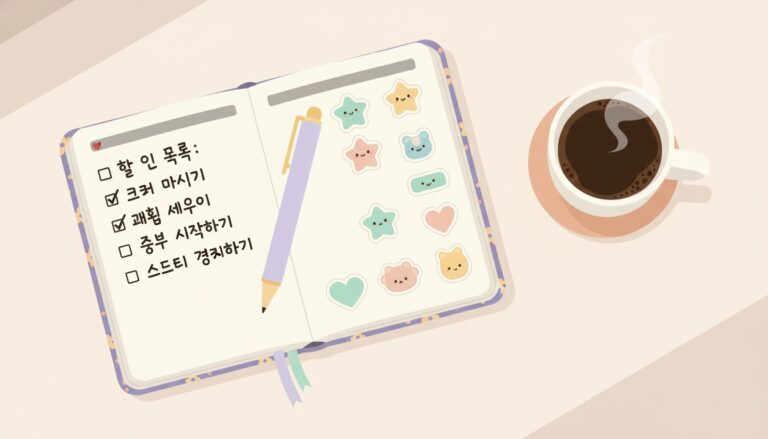
🇰🇷 Culture Tip: “Daku” (다꾸)
Have you heard of “Daku” (다꾸)? It is short for “Da-ieo-ri Kku-mi-gi” (다이어리 꾸미기), which means “Decorating a Diary.”
In Korea, writing a to-do list isn’t just about productivity; it’s a hobby! Many Koreans love using cute stickers, colorful masking tapes, and pastel highlighters to make their planners look beautiful. Next time you write your Korean to-do list, try adding a cute sticker! It might motivate you to study more! 🎀✏️
🎓 Wrap-up & Quiz
Today we learned how to turn verbs into list items using -기! Now you can organize your day in Korean.
Let’s practice! (Quiz)
- How do you write “Exercising” (Original verb: 운동하다) in a to-do list format?
(Hint: Change ‘다’ to ‘기’) -
True or False: In a simple note, you must use full sentences with all particles (like 은/는/이/가).
Answers:
1. 운동하기 [Undonghagi]
2. False (X) – In notes, we keep it short and often drop particles!
Frequently Asked Questions (FAQ)
Q: What does "공부하기" mean in Korean and how do you pronounce it?
A: In Korean, "공부하기" is pronounced [Gongbuhagi] and means: Studying / To study
Q: What does "장보기" mean in Korean and how do you pronounce it?
A: In Korean, "장보기" is pronounced [Jangbogi] and means: Grocery shopping
Q: What does "청소하기" mean in Korean and how do you pronounce it?
A: In Korean, "청소하기" is pronounced [Cheongsohagi] and means: Cleaning
Q: What does "친구 만나기" mean in Korean and how do you pronounce it?
A: In Korean, "친구 만나기" is pronounced [Chingu mannagi] and means: Meeting a friend







