

Introduction
Hello, everyone! It’s Daily Hangul here to upgrade your Korean skills! 🌟
Have you ever watched K-dramas like Reborn Rich (재벌집 막내아들) or Start-Up? You often see characters reading newspapers or watching the news, trying to guess the future of the economy. 📉📈
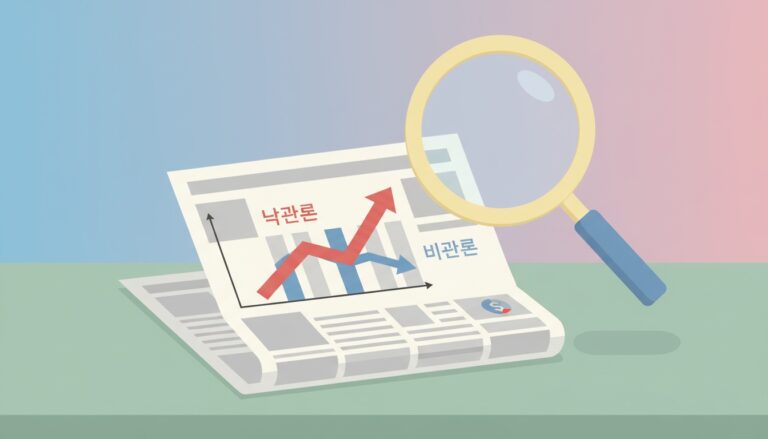
Today, we are going to learn how to identify Optimism vs. Pessimism in Korean economic news. This is a crucial skill for “Media Literacy”! By learning these words, you can tell if a news report is cheering for a boom or warning of a crisis. Let’s become smart Korean learners together! 🤓
Key Expressions
Here are 3 key expressions to spot the tone of the news!
1. 낙관적이다
- Pronunciation: [Nakgwanjeogida]
- Meaning: To be optimistic
- Explanation: This word is used when the news report thinks the future will be good. If you hear this, the article is focusing on the positive side.
- 💡 Pronunciation Tip: The ‘ㄱ’ (k) in 낙 (nak) meets the ‘ㄱ’ in 관 (gwan), making the sound stronger. It sounds a bit like [Nakkwanjeogida].
2. 비관적이다
- Pronunciation: [Bigwanjeogida]
- Meaning: To be pessimistic
- Explanation: This is the opposite of number 1. It is used when the outlook is gloomy or negative. If a news anchor uses this word, they are warning you about bad times.
- 💡 Pronunciation Tip: Pronounce each syllable clearly. ‘Bi-gwan-jeok-i-da’.
3. 전망이 밝다 / 어둡다
- Pronunciation: [Jeonmangi balda / eodupda]
- Meaning: The outlook is bright / dark
- Explanation: 전망 (Jeonmang) means “outlook” or “prospect.” News often describes the economy’s future as either “bright” (positive bias) or “dark” (negative bias).
- 💡 Pronunciation Tip: For 전망 [Jeonmang], the ‘ㄴ’ and ‘ㅁ’ flow together smoothly. For 밝다 [Balda], even though there is a double consonant ‘ㄺ’, we mostly pronounce the ‘ㄹ’ (l) sound here when followed by ‘다’.
Real-life Conversation
Let’s see how friends discuss conflicting news reports at a cafe! ☕
Min-su: 이 뉴스 좀 봐. 경제 전망이 밝다고 해.
(Look at this news. It says the economic outlook is bright.)
Sarah: 정말? 다른 신문은 아주 비관적이던데?
(Really? The other newspaper was very pessimistic though?)
Min-su: 그래? 어느 쪽을 믿어야 하지?
(Is that so? Which side should I believe?)
Sarah: 한쪽만 믿지 말고, 비교해서 봐야 해!
(Don’t believe just one side, you have to compare them!)
Cultural Tip 🇰🇷
“Gaemi” (Ants) in the News! 🐜
In Korean economic news, you might often hear the word 개미 (Gaemi), which means “Ant.” This isn’t about insects! It refers to individual investors like you and me, as opposed to big institutions or foreigners. News articles often have a bias trying to either encourage “Ants” to buy stocks (Optimism) or scare them into selling (Pessimism). Knowing today’s words will help you understand the mood of the market!
Conclusion & Quiz
Today we learned how to spot the mood in Korean news! Remember, news can be 낙관적 (optimistic) or 비관적 (pessimistic). Always check the 전망 (outlook) carefully!
📝 Mini Quiz
- What is the Korean word for “Optimistic”?
( ) -
True or False: 전망이 어둡다 means the outlook is good/bright.
( O / X ) -
Fill in the blank: “The economic outlook is bright” = 경제 ( )이 밝다.
⬇️ Answers
1. 낙관적이다 (Nakgwanjeogida)
2. X (It means the outlook is dark/bad)
3. 전망 (Jeonmang)
Frequently Asked Questions (FAQ)
Q: What does "낙관적이다" mean in Korean and how do you pronounce it?
A: In Korean, "낙관적이다" is pronounced [Nakgwanjeogida] and means: To be optimistic
Q: What does "비관적이다" mean in Korean and how do you pronounce it?
A: In Korean, "비관적이다" is pronounced [Bigwanjeogida] and means: To be pessimistic
Q: What does "전망이 밝다 / 어둡다" mean in Korean and how do you pronounce it?
A: In Korean, "전망이 밝다 / 어둡다" is pronounced [Jeonmangi balda / eodupda] and means: The outlook is bright / dark







