

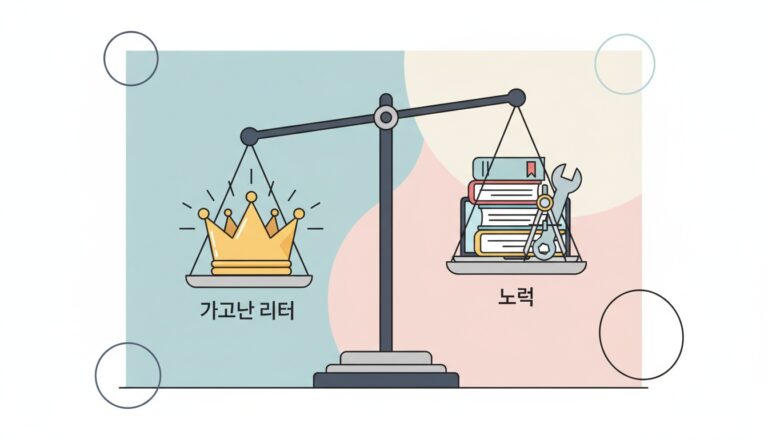
👑 Born to be a Leader? Or Made? (Great Man Theory in Korean)
👋 Introduction
Annyeonghaseyo! (안녕하세요!) It’s your friendly Korean tutor, Daily Hangul! 🍎
Have you ever watched a K-drama where the CEO (Chaebol heir) seems to have been born powerful? Or looked at a K-pop leader like RM of BTS and thought, “Wow, he was born to lead!”? 🤔
In academic terms, this is called the “Great Man Theory” (위인 이론). It suggests that leaders are born, not made. But today, we are going to learn how to talk about this and critique it in Korean! Do you think leaders are born? Or do they work hard? Let’s discuss this debate using easy Korean expressions! 🚀
🗣️ Key Expressions
Here are 3 essential phrases to discuss leadership and opinions!
1. 타고나다 [Tagonada]
- English: To be born with (a talent/quality)
- Meaning: This is the perfect word for the “Great Man Theory.” You use it when someone is naturally good at something without trying.
- Example: 리더십을 타고났어요. (He was born with leadership.)
- 💡 Pronunciation Tip: It sounds like [Ta-go-na-sseo-yo] when used in the past tense. The ‘ss’ (ㅆ) at the bottom moves to the next block!
2. 만들어지다 [Mandeureojida]
- English: To be made / To be created
- Meaning: This is the opposite view! Leaders are “made” through training and experience. You can say this to critique the idea that talent is everything.
- Example: 리더는 노력으로 만들어져요. (Leaders are made through effort.)
- 💡 Pronunciation Tip: Pronounce it as [Man-deu-reo-jyeo-yo]. The ‘r’ sound flows into the next syllable smoothly.
3. 제 생각은 달라요 [Je saenggageun dallayo]
- English: My opinion is different / I disagree
- Meaning: In academic discussions or daily life, you need to politely disagree to “critically examine” a theory. This is a very respectful way to say “I don’t think so.”
- Example: 그 이론에 제 생각은 달라요. (My opinion on that theory is different.)
- 💡 Pronunciation Tip: [Je saeng-ga-geun dal-la-yo]. Be careful with ‘ll’ (ㄹㄹ) in ‘dallayo’ – hold your tongue up a bit longer!
💬 Real Conversation
Situation: Two friends, Minji and Jason, are talking about a successful K-drama character.
Minji: 저 사장님은 정말 카리스마가 있어. 리더십을 타고난 것 같아.
(That CEO really has charisma. I think he was born with leadership.)
Jason: 음, 제 생각은 달라요.
(Hmm, my opinion is different.)
Minji: 정말? 왜 그렇게 생각해요?
(Really? Why do you think so?)
Jason: 좋은 리더는 경험과 노력으로 만들어져요.
(Good leaders are made through experience and effort.)
Minji: 아, 맞아요. 노력도 중요하죠!
(Ah, that’s right. Effort is important too!)
🇰🇷 Culture Tip: “Noryeok” (Effort)
While Koreans love stories of geniuses (천재), there is a huge cultural emphasis on 노력 (Noryeok – Effort).
Even if the “Great Man Theory” says leaders are born, in modern Korean society (and K-pop training systems!), the idea that “sweat and tears make the leader” is very strong. So, saying “He was made by effort” is often a bigger compliment than “He was born with it”! 😊
📝 Wrap-up & Quiz
Today we learned how to discuss the Great Man Theory in Korean! We learned how to say someone is “born with it” versus “made by effort.”
Let’s test your skills! (Answers at the bottom)
- If you want to say “He was born with talent,” you use: “______났어요.”
- If you want to say “My opinion is different,” you say: “제 ______은 달라요.”
Keep practicing, and see you next time! 안녕! 👋
(Quiz Answers: 1. 타고 (Tago), 2. 생각 (Saenggak))
Frequently Asked Questions (FAQ)
Q: What does "타고나다 [Tagonada]" mean in Korean and how do you pronounce it?
A: In Korean, "타고나다 [Tagonada]" is pronounced [Tip: It sounds like [Ta-go-na-sseo-yo] and means: This is the perfect word for the "Great Man Theory." You use it when someone is naturally good at something without trying.
Q: What does "만들어지다 [Mandeureojida]" mean in Korean and how do you pronounce it?
A: In Korean, "만들어지다 [Mandeureojida]" is pronounced [Tip: Pronounce it as [Man-deu-reo-jyeo-yo] and means: This is the opposite view! Leaders are "made" through training and experience. You can say this to critique the idea that talent is everything.
Q: What does "제 생각은 달라요 [Je saenggageun dallayo]" mean in Korean and how do you pronounce it?
A: In Korean, "제 생각은 달라요 [Je saenggageun dallayo]" is pronounced [Tip: [Je saeng-ga-geun dal-la-yo] and means: In academic discussions or daily life, you need to politely disagree to "critically examine" a theory. This is a very respectful way to say "I don't think so."







