

Introduction
Annyeonghaseyo! (안녕하세요!) Hello, everyone! It’s your friendly Korean tutor, Daily Hangul (DailyHangul.com)! 🌟
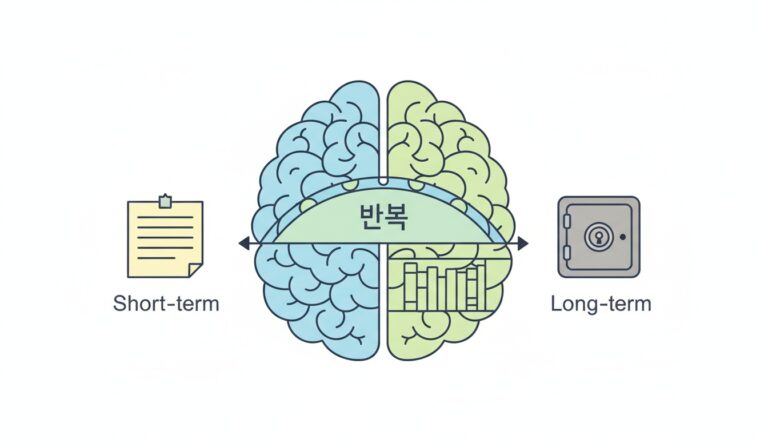
Have you ever watched a K-Drama, heard a new word, understood it in the moment, but completely forgot it 5 minutes later? 😅 That is the classic struggle between Short-term Memory and Long-term Memory!
Today, we are going to get a little smart and talk about Educational Psychology. Don’t worry, we won’t make it boring! We will learn the Korean terms for how our brain processes information so you can turn those fleeting K-Drama words into permanent vocabulary! If you’ve seen the intense studying in dramas like Sky Castle or Reply 1988, you know how serious Koreans are about memory! 🧠✨
Let’s hack your brain and upgrade your Korean skills together! 🚀
Key Expressions
Here are 4 key terms to describe how we learn and remember things!
1. 기억 (Memory)
- Pronunciation: [Gieok]
- English Meaning: Memory
- Detail: This is the basic noun for “memory.” You will hear this a lot in ballads or sad dramas when characters say “I want to erase my memories” (기억을 지우고 싶어).
- 💡 Pronunciation Tip: The final ‘ㄱ’ (k/g) is a stop sound. You don’t release the air. It sounds like “Ghee-ok” (stopping abruptly at the k).
2. 단기 기억 (Short-term Memory)
- Pronunciation: [Dangi gieok]
- English Meaning: Short-term memory
- Detail: ‘Dan’ (단) means short, and ‘Gi’ (기) means period. This is when you remember a phone number just long enough to dial it. In language learning, this is what happens when you cram for a test!
3. 장기 기억 (Long-term Memory)
- Pronunciation: [Janggi gieok]
- English Meaning: Long-term memory
- Detail: ‘Jang’ (장) means long. This is our goal! When information moves here, you can speak Korean fluently without thinking.
- 💡 Pronunciation Tip: In 장기 (Janggi), the ‘ng’ sound flows into the ‘g’, making it sound smooth.
4. 반복 (Repetition)
- Pronunciation: [Banbok]
- English Meaning: Repetition / Looping
- Detail: According to psychology, Banbok is the secret key to moving info from Short-term to Long-term memory. K-Pop fans know this word because of the “Repeat” button on music players!
Real Conversation
Let’s see how two students, Min-ji and Alex, talk about studying for their Korean exam.
Min-ji: 아, 단어가 기억이 안 나!
(Ah, daneoga gieogi an na!)
Ah, I can’t remember the vocabulary!
Alex: 진정해. 그건 그냥 단기 기억이라서 그래.
(Jinjeonghae. Geugeon geunyang dangi gieogiraseo geurae.)
Calm down. That’s just because it’s short-term memory.
Min-ji: 어떻게 해야 장기 기억이 될까?
(Eotteoke haeya janggi gieogi doelkka?)
What should I do to make it long-term memory?
Alex: 계속 반복해야지! 같이 연습하자.
(Gyesok banbokhaeyaji! Gachi yeonseuphaja.)
You have to keep repeating it! Let’s practice together.
Culture Tip: The “Gong-bu” (Study) Passion 🇰🇷
Did you know that in Korea, the process of moving information to Janggi gieok (Long-term memory) is taken very seriously?
If you visit a Korean cafe or library, you will often see students practicing ‘Banbok’ (Repetition). They use flashcards, rewrite notes, and recite words quietly. This intense focus on education is a huge part of Korean culture. In dramas, you might see characters eating “Yeot” (Korean taffy) before exams—it’s a superstition that the sticky candy will help the knowledge “stick” to their memory! 🍬📚
Conclusion & Quiz
Great job today! We learned that to master Korean, we need to move words from Dangi gieok to Janggi gieok using Banbok! Don’t be sad if you forget a word; just repeat it again! 😊
Pop Quiz! 📝
- What is the Korean word for “Memory”?
( A. 기억 / B. 기적 ) -
To move information to Long-term memory, what do you need to do?
( A. 포기 (Giving up) / B. 반복 (Repetition) ) -
True or False: “Dangi gieok” means Long-term memory.
( O / X )
[Answers]
1. A (기억)
2. B (반복)
3. X (It means Short-term memory!)
Frequently Asked Questions (FAQ)
Q: What does "기억 (Memory)" mean in Korean and how do you pronounce it?
A: In Korean, "기억 (Memory)" is pronounced [Gieok] and means: Memory
Q: What does "단기 기억 (Short-term Memory)" mean in Korean and how do you pronounce it?
A: In Korean, "단기 기억 (Short-term Memory)" is pronounced [Dangi gieok] and means: Short-term memory
Q: What does "장기 기억 (Long-term Memory)" mean in Korean and how do you pronounce it?
A: In Korean, "장기 기억 (Long-term Memory)" is pronounced [Janggi gieok] and means: Long-term memory
Q: What does "반복 (Repetition)" mean in Korean and how do you pronounce it?
A: In Korean, "반복 (Repetition)" is pronounced [Banbok] and means: Repetition / Looping







