

Introduction
Annyeonghaseyo! (안녕하세요!) Hello, everyone! It’s your friendly Korean tutor, Daily Hangul, here to upgrade your Korean skills! 🚀
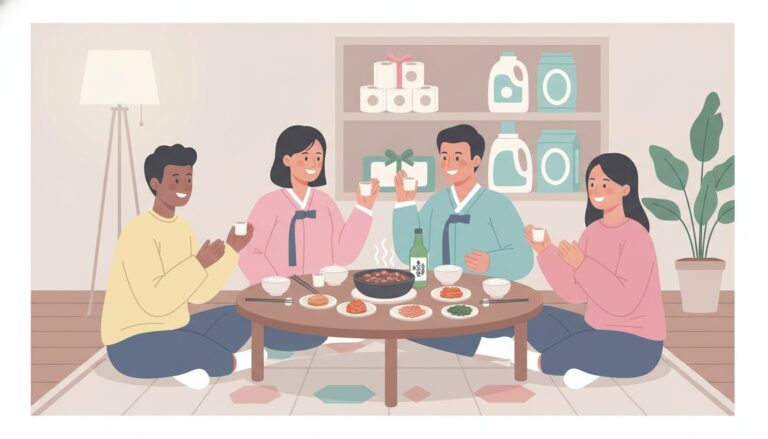
Have you ever watched a K-Drama where friends gather at someone’s house for a party or a meal? Maybe you’ve seen scenes in Reply 1988 or Hospital Playlist where they eat delicious food and laugh together. 🍗🍕
Today, we are going to learn how to be the best guest ever! If a Korean friend invites you to a party or dinner, knowing how to say “Thank you” properly will make a huge impression. Let’s learn some warm and natural expressions to show your gratitude! Are you ready? Let’s go! (Gaja! 가자!) 🏃♂️💨
Key Expressions
Here are 3 essential phrases to use after a party or gathering.
1. Thanks for inviting me!
- Korean: 초대해 줘서 고마워 (Casual) / 고마워요 (Polite)
- Pronunciation: [Chodaehae jwoseo gomawo]
- English Meaning: Thanks for inviting me.
- Explanation:
- ‘초대’ (Chodae) means invitation.
- ‘~해 줘서’ (~hae jwoseo) means “for doing [action] for me.”
- Use ‘고마워’ (gomawo) with close friends. Add ‘yo’ (요) at the end if you want to be polite!
- 💡 Pronunciation Tip: When saying ‘줘서’ (jwoseo), try to say it smoothly. It sounds a bit like ‘jwo-seo’.
2. The food is really delicious!
- Korean: 음식 진짜 맛있다
- Pronunciation: [Eumsik jinjja masitda]
- English Meaning: The food is really delicious!
- Explanation:
- ‘음식’ (Eumsik) is food.
- ‘진짜’ (Jinjja) means “really” or “seriously” (you hear this a lot in K-Dramas!).
- Complimenting the food is the best way to make the host happy! 🥰
- 💡 Pronunciation Tip: ‘맛있다’ is written as [masitda], but it is often pronounced as [mashitta]. This is because of a sound change rule where ‘s’ meets ‘i’. Sound like a native by saying “Ma-shit-da”!
3. It was so much fun today.
- Korean: 오늘 너무 즐거웠어
- Pronunciation: [Oneul neomu jeulgeowosseo]
- English Meaning: It was so much fun today.
- Explanation:
- ‘오늘’ (Oneul) means today.
- ‘너무’ (Neomu) means “so” or “too.”
- Use this phrase when saying goodbye to let them know you had a great time.
- 💡 Pronunciation Tip: In ‘즐거웠어’, the double ‘s’ (ㅆ) at the bottom transfers to the next vowel. So it sounds like [Jeul-geo-wo-sseo].
Real Conversation
Let’s see how these expressions work in real life! Minji invited Jason to her housewarming party.
(At the door, getting ready to leave)
Jason: 민지야, 오늘 초대해 줘서 고마워.
(Minji-ya, oneul chodaehae jwoseo gomawo.)
Minji, thanks for inviting me today.
Minji: 아니야, 와 줘서 내가 더 고맙지! 음식은 괜찮았어?
(Aniya, wa jwoseo naega deo gomapji! Eumsik-eun gwaenchannasseo?)
No problem, I’m more thankful you came! Was the food okay?
Jason: 응! 음식 진짜 맛있었어. 특히 불고기!
(Eung! Eumsik jinjja masisseosseo. Teuki Bulgogi!)
Yeah! The food was really delicious. Especially the Bulgogi!
Minji: 다행이다. 조심히 가!
(Dahaengida. Joshimhi ga!)
That’s a relief. Get home safe!
Culture Tip: Jipdeuri (집들이) 🎁
In Korea, a housewarming party is called ‘Jipdeuri’ (집들이).
If you are invited to a Jipdeuri, it is custom to bring a small gift! But here is the fun part: Koreans traditionally give toilet paper rolls 🧻 or laundry detergent 🧼.
Why?
– Toilet paper: Represents things unrolling smoothly (like your life/problems).
– Detergent bubbles: Represents wealth and luck bubbling up!
Next time you go to a Korean friend’s house, bring some toilet paper, and you will look like a true local! 😉
Wrap-up & Quiz
Today we learned how to express gratitude after a party. Don’t forget to compliment the food and the host! Showing appreciation is the key to Korean “Jeong” (affection/bonding). ❤️
📝 Mini Quiz
- Fill in the blank: “Thanks for inviting me!” = _____해 줘서 고마워! (Hint: Invitation)
- True or False: ‘맛있다’ (Delicious) is pronounced as [ma-sit-da].
See you next time! Annyeong! 👋
[Answers]
1. 초대 (Chodae)
2. False (It sounds more natural as [ma-shit-ta]!)
Frequently Asked Questions (FAQ)
Q: What does "Thanks for inviting me!" mean in Korean and how do you pronounce it?
A: In Korean, "Thanks for inviting me!" is pronounced [Chodaehae jwoseo gomawo] and means: Thanks for inviting me.
Q: What does "The food is really delicious!" mean in Korean and how do you pronounce it?
A: In Korean, "The food is really delicious!" is pronounced [Eumsik jinjja masitda] and means: The food is really delicious!
Q: What does "It was so much fun today." mean in Korean and how do you pronounce it?
A: In Korean, "It was so much fun today." is pronounced [Oneul neomu jeulgeowosseo] and means: It was so much fun today.







