

Hello! It’s Daily Hangul! 👋
Hello, everyone! It’s Daily Hangul, here to upgrade your Korean skills! 🚀
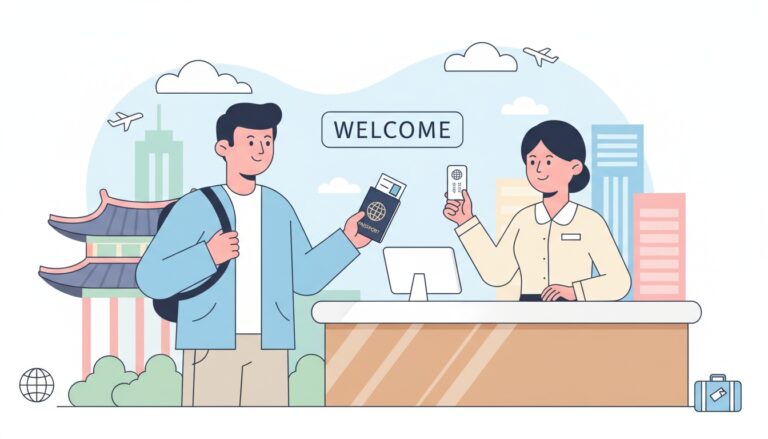
Imagine this: You’ve just arrived in Seoul for your dream trip. You are at the hotel front desk, you’ve handed over your passport, and the receptionist gives you a key card. But wait… you missed what they said! 😅
“Where is my room? What floor is it?”
Today, we will learn how to ask for your room number and floor so you don’t get lost in the hotel lobby! This is a scene you see in almost every K-Drama when the main character checks into a luxury hotel (like in King the Land 👑). Let’s master these essential travel phrases!
🔑 Key Expressions
Here are the 3 most useful expressions for finding your room!
1. What is my room number?
- Korean: 제 방 번호가 뭐예요?
- Pronunciation: [Je bang beonhoga mwoyeyo?]
- English Meaning: What is my room number?
- Detail:
- 제 (Je) means “my” (polite/formal).
- 방 (Bang) means “room.”
- 번호 (Beonho) means “number.”
- It’s the most standard way to ask for your room details.
2. What floor is it?
- Korean: 몇 층이에요?
- Pronunciation: [Myeot cheung-ieyo?]
- English Meaning: What floor is it?
- Detail:
- 몇 (Myeot) means “how many” or “what number.”
- 층 (Cheung) is the counter for “floors.”
- Use this when you are in the elevator and don’t know which button to press!
3. Where is the elevator?
- Korean: 엘리베이터는 어디예요?
- Pronunciation: [Ellibeiteoneun eodiyeyo?]
- English Meaning: Where is the elevator?
- Detail:
- 엘리베이터 (Ellibeiteo) is easy because it sounds just like “Elevator”!
- 어디예요 (Eodiyeyo) means “Where is it?”
💡 Pronunciation Tip: The Magic of Numbers
Wait! Which numbers should I use? 1️⃣2️⃣3️⃣
When talking about Room Numbers or Floors in Korean, we use Sino-Korean numbers (derived from Chinese characters).
- 10th floor: 십 층 (Sip-cheung)
- Room 302: 삼백이 호 (Sam-baek-i ho)
Don’t use: Hana, Dul, Set (Native Korean numbers) for room numbers. Use Il, I, Sam!
💬 Real Conversation
Let’s see how this works at the front desk!
Situation: You (A) have just checked in with the Receptionist (B).
B (Receptionist): 체크인 되었습니다. 여기 키 있습니다.
(Chekeu-in doe-eotseumnida. Yeogi ki itseumnida.)
Check-in is done. Here is your key.
A (You): 감사합니다. 제 방 번호가 뭐예요?
(Gamsahamnida. Je bang beonhoga mwoyeyo?)
Thank you. What is my room number?
B (Receptionist): 1204호입니다.
(Cheon-ibaek-sa-ho imnida.)
It is room 1204.
A (You): 아, 몇 층이에요?
(Ah, myeot cheung-ieyo?)
Ah, what floor is it?
B (Receptionist): 12층입니다. 엘리베이터는 저기예요.
(Sip-i-cheung imnida. Ellibeiteoneun jeogiyeyo.)
It’s the 12th floor. The elevator is over there.
🇰🇷 Culture Tip: The Mystery of the ‘F’ Floor
Have you ever stepped into a Korean elevator and seen an ‘F’ button instead of the number 4? 😲
In Korea (and many Asian countries), the number 4 is considered unlucky because the pronunciation for “four” (사, sa) sounds exactly like the Chinese character for “death” (死, sa).
So, hotels often mark the 4th floor as ‘F’ or skip it entirely! Don’t be scared if you get a room on the F floor; it’s just a cultural superstition! 👻
📝 Wrap-up & Mini Quiz
Great job! Now you can find your room without panic. Let’s check if you remember today’s expressions!
Quiz:
1. How do you say “What floor is it?” in Korean?
( M___ C____-ieyo? )
2. True or False: You should use Native Korean numbers (Hana, Dul) for room numbers. ( O / X )
3. Fill in the blank: “Je [_____] beonhoga mwoyeyo?” (My room number is what?)
Answers:
1. Myeot cheung (몇 층)
2. X (False! Use Sino-Korean numbers like Il, I, Sam)
3. bang (방)
See you next time with more fun Korean! Annyeong! 👋
Frequently Asked Questions (FAQ)
Q: What does "What is my room number?" mean in Korean and how do you pronounce it?
A: In Korean, "What is my room number?" is pronounced [Je bang beonhoga mwoyeyo?] and means: What is my room number?
Q: What does "What floor is it?" mean in Korean and how do you pronounce it?
A: In Korean, "What floor is it?" is pronounced [Myeot cheung-ieyo?] and means: What floor is it?
Q: What does "Where is the elevator?" mean in Korean and how do you pronounce it?
A: In Korean, "Where is the elevator?" is pronounced [Ellibeiteoneun eodiyeyo?] and means: Where is the elevator?







