

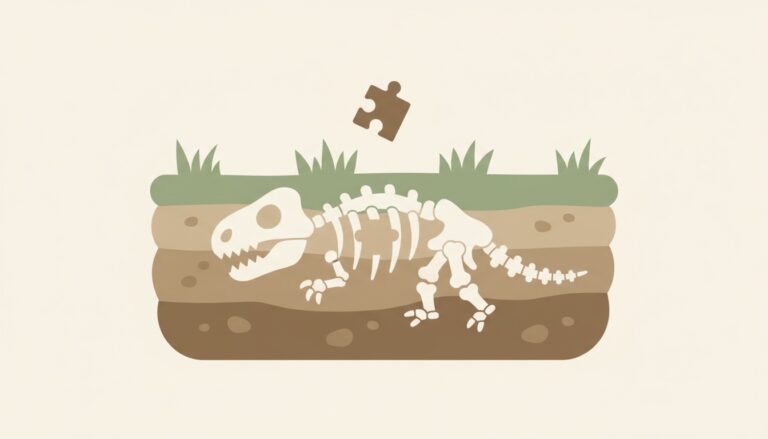
🦕 Where Did the Dinosaurs Go? Unlocking the Mystery of Fossils in Korean!
👋 Introduction
Hello, K-Culture lovers! It’s Daily Hangul here to upgrade your Korean skills! 🚀
Today, we are diving into a topic that sounds super smart but is actually very fun: Evolution and Fossils! 🦖 Have you ever watched a Korean sci-fi movie or a documentary and wondered how to talk about “missing clues”?
Just like in a K-Drama detective story where some evidence is missing, the history of life on Earth also has missing pages. Today, we will learn how to discuss the “Imperfection of the Fossil Record” using simple and useful Korean expressions. You can use these phrases not just for science, but whenever something is missing or incomplete in daily life! Let’s get started! 📚✨
🔑 Key Expressions
Here are 4 key expressions to help you talk about discoveries and missing pieces!
1. 화석 (Hwaseok)
- Pronunciation: [Hwa-seok]
- English: Fossil
- Detail: This is the star of today’s topic! You might hear this in news reports or museum scenes in dramas.
- 💡 Pronunciation Tip: Pronounce ‘Hwa’ like the ‘hwa’ in ‘Hwaseong Fortress’. It’s a clean, open sound.
2. 발견하다 (Balgyeonhada)
- Pronunciation: [Bal-gyeon-ha-da]
- English: To discover / To find
- Detail: Used when you find something new, whether it’s a dinosaur bone or a new delicious restaurant!
- Example: “화석을 발견했어요!” (I discovered a fossil!)
- 💡 Pronunciation Tip: The ‘gyeon’ (견) sound can be tricky. Try to say ‘gy’ + ‘on’ smoothly together.
3. 완벽하지 않다 (Wanbyeokhaji anta)
- Pronunciation: [Wan-byeok-ha-ji an-ta]
- English: To not be perfect / To be incomplete
- Detail: This is the core of our topic. The fossil record isn’t 100% complete. You can also use this when your homework or a plan isn’t finished yet.
- Example: “기록이 완벽하지 않아요.” (The record is not perfect.)
4. 빈틈 (Binteum)
- Pronunciation: [Bin-teum]
- English: Gap / Crack / Empty space
- Detail: Literally means a “gap.” In evolution, we talk about gaps in the record. In K-Dramas, if a character is perfect, we say they have “no binteum” (no weakness)!
- 💡 Pronunciation Tip: ‘Bin’ is short like ‘bin’ in trash bin. ‘Teum’ rhymes with ‘room’ but with a ‘T’.
💬 Real Dialogue
Imagine you are at a Natural History Museum with your Korean friend, Minji. 🏛️
Minji: 와, 이 공룡 진짜 크다! 그런데 뼈가 다 있는 건 아니네?
(Wa, i gongnyong jinjja keuda! Geureonde ppyeoga da inneun geon anine?)
Wow, this dinosaur is really big! But not all the bones are here?
You: 맞아. 화석 기록은 완벽하지 않아.
(Maja. Hwaseok girogeun wanbyeokhaji ana.)
That’s right. The fossil record is not perfect.
Minji: 아, 그래서 중간에 빈틈이 있구나.
(A, geuraeseo junggane binteumi itguna.)
Ah, so that’s why there are gaps in the middle.
You: 응, 우리는 모든 것을 발견하지 못했어. 아직 미스터리야!
(Eung, urineun modeun geoseul balgyeonhaji motaesseo. Ajik miseuteoriya!)
Yeah, we haven’t discovered everything. It’s still a mystery!
🇰🇷 Culture Tip
Did you know Korea has famous dinosaur sites? 🦕
In Goseong (고성), there is a world-famous site for dinosaur footprints! Koreans have a lot of “educational fever,” so many families visit the Goseong Dinosaur Museum on weekends. If you visit, you can say “화석이 많아요!” (There are many fossils!).
Also, in Korean culture, admitting that something is “not perfect” (완벽하지 않다) is a humble way to ask for feedback or show that there is room for improvement!
📝 Wrap-up & Quiz
Today we learned how to talk about the missing pieces of history!
- 화석 (Hwaseok) = Fossil
- 발견하다 (Balgyeonhada) = To discover
- 완벽하지 않다 (Wanbyeokhaji anta) = Not perfect
- 빈틈 (Binteum) = Gap
Pop Quiz! Fill in the blanks:
- Look! I ________ a dinosaur bone!
(봐! 공룡 뼈를 ________했어!) - The evidence is ________.
(증거가 ________ 않아요.)
Answers:
1. 발견 (Balgyeon)
2. 완벽하지 (Wanbyeokhaji)
Keep practicing, and see you next time! Annyeong! 👋
Frequently Asked Questions (FAQ)
Q: What does "화석 (Hwaseok)" mean in Korean and how do you pronounce it?
A: In Korean, "화석 (Hwaseok)" is pronounced [Hwa-seok] and means: a key conversational Korean expression covered in this lesson.
Q: What does "발견하다 (Balgyeonhada)" mean in Korean and how do you pronounce it?
A: In Korean, "발견하다 (Balgyeonhada)" is pronounced [Bal-gyeon-ha-da] and means: a key conversational Korean expression covered in this lesson.
Q: What does "완벽하지 않다 (Wanbyeokhaji anta)" mean in Korean and how do you pronounce it?
A: In Korean, "완벽하지 않다 (Wanbyeokhaji anta)" is pronounced [Wan-byeok-ha-ji an-ta] and means: a key conversational Korean expression covered in this lesson.
Q: What does "빈틈 (Binteum)" mean in Korean and how do you pronounce it?
A: In Korean, "빈틈 (Binteum)" is pronounced [Bin-teum] and means: a key conversational Korean expression covered in this lesson.







