

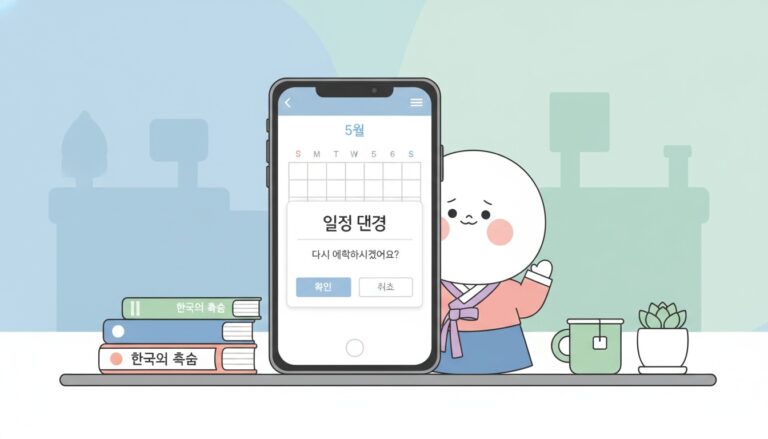
Hello! It’s Daily Hangul! 👋
Welcome back, everyone! It’s your favorite Korean tutor, Daily Hangul! 🍎✨
Have you ever made a plan but suddenly something urgent came up? 😱 It happens to everyone! In K-dramas, you often see characters frantically texting to change plans because of a sudden work crisis or a secret mission.
Today, we are going to learn how to Reschedule an Appointment via email or text message in Korean. This is a super useful skill to have, whether you are talking to a Korean friend or a business partner. Let’s learn how to do it politely and naturally! Let’s go! 🚀
Core Expressions 📚
Here are 3 essential expressions you need when changing plans.
1. 급한 일이 생겼어요.
- Pronunciation: [Geupan iri saenggyeosseoyo]
- English Meaning: Something urgent came up.
- Detail: You can use this phrase to explain why you can’t make it. It’s a polite and vague enough excuse that works in both business and casual settings without giving too much personal information.
- 💡 Pronunciation Tip: When saying 일이 (iri), the ‘L’ sound in ‘il’ carries over to the ‘i’, so it sounds like ‘i-ri’ (linking sound)!
2. 약속을 변경할 수 있을까요?
- Pronunciation: [Yaksogeul byeongyeonghal su isseulkkayo?]
- English Meaning: Can we change the appointment (time/date)?
- Detail: This is a formal and polite way to ask for a change.
- 약속 (Yaksok) = Appointment / Promise
- 변경하다 (Byeongyeonghada) = To change/modify
- 💡 Pronunciation Tip: In 약속 (Yak-sok), the ‘k’ sound at the end of ‘Yak’ stops abruptly. It’s not “Yak-u-sok”, it’s a tight “Yak”.
3. 죄송합니다.
- Pronunciation: [Joesonghamnida]
- English Meaning: I am sorry.
- Detail: In Korea, politeness is key! Even if the change is unavoidable, starting or ending your email with an apology shows good manners. If you are talking to a very close friend, you can say “미안해 (Mianhae)” instead.
Real Conversation 💬
Let’s see how Minji writes a short message to her Korean tutor, Mr. Kim, to reschedule their lesson.
Minji: 선생님, 안녕하세요. 혹시 내일 수업 시간을 바꿀 수 있을까요?
(Teacher, hello. By any chance, can we change the time for tomorrow’s class?)
Minji: 갑자기 회사에 급한 일이 생겼어요. 죄송합니다.
(Suddenly, something urgent came up at work. I am sorry.)
Mr. Kim: 안녕하세요, 민지 씨. 괜찮아요! 언제 시간이 돼요?
(Hello, Minji. It’s okay! When do you have time?)
Minji: 목요일 오후 2시는 어때요?
(How about Thursday at 2 PM?)
Mr. Kim: 네, 그럼 그때 봐요!
(Yes, see you then!)
Culture Tip 🇰🇷
“Korean Time” and Politeness
In Korea, being on time is very important. However, Koreans also understand that life is busy (especially the “Pali-Pali” or “Hurry-Hurry” culture!).
If you need to reschedule, doing it as early as possible is considered good manners. Also, when you suggest a new time, try to offer specific options (like “Thursday at 2 PM”) rather than just saying “Later.” This shows you are sincere about meeting them and not just trying to cancel! 😉
Wrap-up & Quiz 📝
Today we learned how to reschedule plans like a pro! Don’t be afraid to send that message if you need to. Koreans appreciate your honesty and politeness!
Let’s check what you learned!
- Fill in the blank: “_______ 일이 생겼어요.” (Something urgent came up.)
a) 예쁜 (Yeppeun)
b) 급한 (Geupan) -
True or False: It is rude to offer a specific new time when rescheduling.
(O / X)
Answers:
1. b) 급한 (Geupan)
2. X (False! Offering a specific time shows sincerity.)
See you in the next lesson! 안녕! 👋
Frequently Asked Questions (FAQ)
Q: What does "급한 일이 생겼어요." mean in Korean and how do you pronounce it?
A: In Korean, "급한 일이 생겼어요." is pronounced [Geupan iri saenggyeosseoyo] and means: Something urgent came up.
Q: What does "약속을 변경할 수 있을까요?" mean in Korean and how do you pronounce it?
A: In Korean, "약속을 변경할 수 있을까요?" is pronounced [Yaksogeul byeongyeonghal su isseulkkayo?] and means: Can we change the appointment (time/date)?
Q: What does "죄송합니다." mean in Korean and how do you pronounce it?
A: In Korean, "죄송합니다." is pronounced [Joesonghamnida] and means: I am sorry.







