

Introduction
Hello, K-Culture lovers! Welcome back to Daily Hangul! 👋 Your friendly guide to mastering Korean.
Have you ever watched a K-Drama and noticed how characters react when they sneeze or cough? They often turn their heads away quickly! In Korea, manners are very important, even when your nose tickles. 🤧
Today, we are going to learn how to handle a sudden sneeze or cough in public. Knowing these simple phrases will make you look super polite and considerate, just like a local! Let’s dive in! 🚀
Key Expressions
1. 죄송합니다 (I am sorry)
- Pronunciation: [Joesonghamnida]
- Meaning: I apologize / I am sorry.
- Explanation: This is the most standard and polite way to apologize. If you sneeze loudly in a quiet place (like a subway or library), saying this shows you have good manners. Use this with strangers or people older than you.
- 💡 Pronunciation Tip: It looks long, but say it smoothly! The ‘H’ in ‘ham’ is very soft, almost silent. It sounds like “Joe-song-am-ni-da.”
2. 미안해 (Sorry – Casual)
- Pronunciation: [Mianhae]
- Meaning: Sorry.
- Explanation: Use this only with close friends or people younger than you. If you are hanging out with your bestie and you cough, just say “Mianhae!”
- 💡 Pronunciation Tip: Pronounce ‘ae’ like the ‘a’ in ‘cat’ or ‘apple’.
3. 괜찮아요? (Are you okay?)
- Pronunciation: [Gwaenchanhayo?]
- Meaning: Are you okay?
- Explanation: In English, you say “Bless you” when someone sneezes. In Korea, we don’t have an exact translation for “Bless you.” Instead, if your friend sneezes continuously, you can ask “Gwaenchanhayo?” out of concern.
- 💡 Pronunciation Tip: The ‘h’ in ‘chan’ often moves to the next block, making it sound like [Gwaen-cha-na-yo].
4. 감기 조심하세요 (Be careful not to catch a cold)
- Pronunciation: [Gamgi josimhaseyo]
- Meaning: Please be careful of the cold / Take care of your health.
- Explanation: Since we don’t say “Bless you,” this is a great phrase to say when parting ways with someone who is coughing or sneezing. It’s very warm and caring!
Real Conversation
Situation: Jason and Minji are studying in a quiet cafe. Suddenly, Jason sneezes.
Jason: (Sneezes) 에취! (Echwi!)
Jason: 아, 죄송합니다. 놀랐죠?
(Ah, Joesonghamnida. Nollatjyo?)
(Ah, I’m sorry. Did I startle you?)
Minji: 아니에요. 괜찮아요? 감기 걸렸어요?
(Anieyo. Gwaenchanhayo? Gamgi geollyeosseoyo?)
(No, it’s fine. Are you okay? Did you catch a cold?)
Jason: 네, 목이 좀 아파요.
(Ne, mogi jom apayo.)
(Yes, my throat hurts a little.)
Minji: 저런… 따뜻한 물 마셔요. 감기 조심하세요!
(Jeoreon… ttatteutan mul masyeoyo. Gamgi josimhaseyo!)
(Oh no… drink some warm water. Please take care of your health!)
Culture Tip 🇰🇷
1. The “Bless You” Myth:
Unlike in Western cultures, Koreans usually do not say anything immediately after someone sneezes. Silence is perfectly normal! If you say “Bless you,” a Korean might look confused. Just ignore it or ask “Are you okay?” if it looks serious.
2. The “Dracula” Cough:
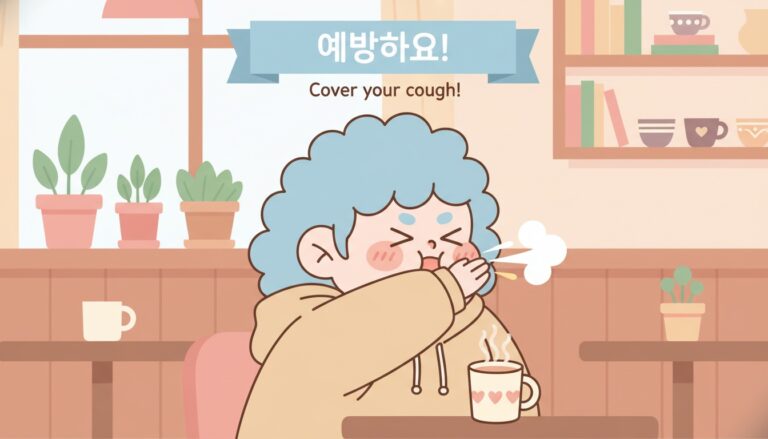
In Korea, hygiene etiquette is strict. When you cough or sneeze, you must cover your mouth. The best way is to turn your head away from people and cough into your inner elbow (like a vampire covering their face with a cape! 🧛♂️). Coughing into your bare hands is considered less sanitary.
Conclusion & Quiz
Great job! Now you know how to react politely when your nose tickles in Korea. Remember, a little “Joesonghamnida” goes a long way! 😊
📝 Mini Quiz
- Which phrase should you use to apologize to a stranger on the subway?
A) Mianhae
B) Joesonghamnida -
True or False: In Korea, you must always say “Bless you” when someone sneezes.
(O / X) -
Where should you cough if you don’t have a tissue?
A) Into your hands
B) Into your inner elbow (sleeve)
Answers:
1. B (Joesonghamnida is polite/formal)
2. X (Koreans usually don’t say anything, or just ask if you are okay)
3. B (The “Dracula” style!)
Frequently Asked Questions (FAQ)
Q: What does "죄송합니다 (I am sorry)" mean in Korean and how do you pronounce it?
A: In Korean, "죄송합니다 (I am sorry)" is pronounced [Joesonghamnida] and means: I apologize / I am sorry.
Q: What does "미안해 (Sorry - Casual)" mean in Korean and how do you pronounce it?
A: In Korean, "미안해 (Sorry - Casual)" is pronounced [Mianhae] and means: Sorry.
Q: What does "괜찮아요? (Are you okay?)" mean in Korean and how do you pronounce it?
A: In Korean, "괜찮아요? (Are you okay?)" is pronounced [Gwaenchanhayo?] and means: Are you okay?
Q: What does "감기 조심하세요 (Be careful not to catch a cold)" mean in Korean and how do you pronounce it?
A: In Korean, "감기 조심하세요 (Be careful not to catch a cold)" is pronounced [Gamgi josimhaseyo] and means: Please be careful of the cold / Take care of your health.







