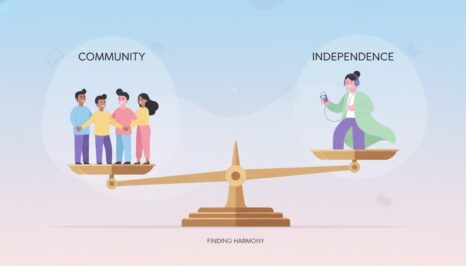
Me vs. We: Finding Balance in Korean Life! 🇰🇷⚖️
Annyeonghaseyo! Hello, K-Culture Lovers! 😊
Welcome back to Daily Hangul! Have you ever watched a K-Drama and noticed characters saying “Our mom” or “Our house” even when they are the only child? Or maybe you’ve seen the recent trend of people eating alone comfortably?
Korea is a fascinating mix of strong community spirit and a rising desire for personal independence. Today, we are going to learn how to navigate this balance like a local! Whether you want to bond with your Korean friends or politely ask for some “me time,” these expressions are essential. Let’s dive in! 🌊
Key Expressions: The “We” and the “I”
1. 우리 (Uri)
- Pronunciation: [U-ri]
- Meaning: We / Us / Our
- Description: This is the magic word of Korean culture! It represents community and belonging. Koreans use “Uri” instead of “My” for things shared by a group (family, country, school).
- Example: “우리 나라” (Uri nara) = Our country (Korea).
- 💡 Pronunciation Tip: The ‘R’ in Uri is not like the English ‘R’. It is a “flap R,” similar to the sound in the middle of the word “butter” or “water” in American English. Keep your tongue soft! 👅
2. 혼자 (Honja)
- Pronunciation: [Hon-ja]
- Meaning: Alone / By myself
- Description: Sometimes, you just need to be yourself! This word marks your independence. You might hear terms like Hon-bap (eating alone) or Hon-sul (drinking alone) in modern dramas.
- Example: “혼자 할 수 있어요.” (Honja hal su isseoyo) = I can do it alone.
- 💡 Pronunciation Tip: The ‘H’ is soft and breathy. The ‘ja’ sounds like the ‘ja’ in “Japan,” but softer.
3. 따로 (Ttaro)
- Pronunciation: [Tta-ro]
- Meaning: Separately
- Description: This is the perfect word for balance! It is used when you are with a group but want to do something individually, like paying for your own meal or leaving early.
- Example: “계산은 따로 해주세요.” (Gyesaneun ttaro haejuseyo) = Please calculate (the bill) separately.
- 💡 Pronunciation Tip: The ‘Tt’ (ㄸ) is a tense sound. Tense your throat muscles and say a sharp, strong ‘T’ without letting air burst out. It sounds higher in pitch than a normal ‘T’.
Real-life Conversation 🗣️
Situation: Min-ji and Alex are discussing plans for the weekend. Alex wants some personal time.
Min-ji: 우리 주말에 같이 영화 볼까?
(Uri jumare gachi yeonghwa bolkka?)
English: Shall we watch a movie together this weekend?
Alex: 미안해, 이번 주말은 혼자 쉬고 싶어.
(Mianhae, ibeon jumareun honja swigo sipeo.)
English: Sorry, I want to rest alone this weekend.
Min-ji: 아, 정말? 무슨 일 있어?
(A, jeongmal? Museun il isseo?)
English: Ah, really? Is something wrong?
Alex: 아니, 그냥 개인 시간이 필요해. 다음에 보자!
(Ani, geunyang gaein sigani piryohae. Daeume boja!)
English: No, I just need some personal time. Let’s meet next time!
Culture Tip: “Ttaro Tto Gachi” 🇰🇷
Have you heard the phrase “따로 또 같이” (Ttaro tto gachi)? It translates to “Separately and Together.”
Traditionally, Korea is a collective society where “Uri” (We) is very important. However, the younger generation (MZ Generation) values individual tastes and privacy.
Nowadays, it’s very cool to respect what is called “Gae-chwi” (short for Gaein Chwihyang = Personal Taste). So, don’t be afraid to say you want to do things “Honja” (Alone) or “Ttaro” (Separately). Your Korean friends will understand and respect your independence! It’s all about finding that harmony. 🧘♂️
Wrap-up & Quiz 📝
Today we learned how to balance being part of a group and being yourself in Korean!
- 우리 (Uri) = We/Our (Belonging)
- 혼자 (Honja) = Alone (Independence)
- 따로 (Ttaro) = Separately (Balance)
Let’s practice! Fill in the blanks:
- Mom, this is _______ house! (Hint: We/Our)
-> 엄마, 여기는 ( ? ) 집이에요! -
I want to travel _______. (Hint: Alone)
-> 저는 ( ? ) 여행하고 싶어요. -
Can we pay _______? (Hint: Separately)
-> ( ? ) 계산할 수 있어요?
[Answers]
1. 우리 (Uri)
2. 혼자 (Honja)
3. 따로 (Ttaro)
Great job today! Enjoy your “Uri” time and your “Honja” time! See you next time! 👋
Frequently Asked Questions (FAQ)
Q: What does "우리 (Uri)" mean in Korean and how do you pronounce it?
A: In Korean, "우리 (Uri)" is pronounced [U-ri] and means: We / Us / Our
Q: What does "혼자 (Honja)" mean in Korean and how do you pronounce it?
A: In Korean, "혼자 (Honja)" is pronounced [Hon-ja] and means: Alone / By myself
Q: What does "따로 (Ttaro)" mean in Korean and how do you pronounce it?
A: In Korean, "따로 (Ttaro)" is pronounced [Tta-ro] and means: Separately